
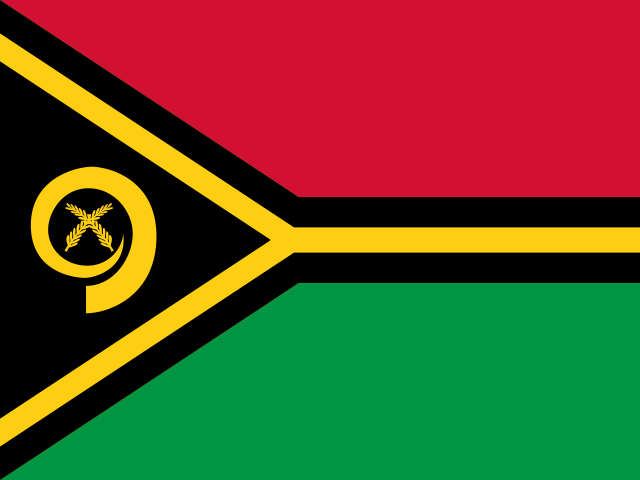
Vanuatu
Vanuatu is a chain of around 80 islands stretching through Melanesia in the southwest Pacific. Most are volcanic and mountainous, with tropical rainforest covering much of the wetter interiors, while coastal areas include coconut plantations, mangroves, beaches and coral reefs. Several volcanoes remain active, most famously Mount Yasur on Tanna, whose frequent eruptions are one of the country's defining natural features. Rainfall is generally highest on the larger northern islands, while southern islands such as Tanna experience a somewhat cooler and more seasonal climate. The archipelago's scattered geography has fostered considerable cultural diversity, with more than 100 indigenous languages spoken across a relatively small population. Infrastructure varies greatly between islands: Efate and Espiritu Santo are comparatively accessible, while many outer islands remain remote.
Overview
Vanuatu is particularly interesting for Melanesian endemics and island-restricted species. Espiritu Santo offers the richest birding, with extensive forest supporting species such as Vanuatu Kingfisher, Vanuatu White-eye and Vanuatu Honeyeater. The highly distinctive Vanuatu Megapode is another important target, occurring on several northern islands and nesting in volcanically heated or sun-warmed ground. Tanna holds the endemic Tanna Fruit Dove, while other islands contribute additional restricted subspecies and regional specialties. Forest birding can be demanding because many habitats are remote and trails limited. Birding tourism remains relatively undeveloped, so local guides and advance logistical planning are particularly valuable, especially outside Efate and Santo. Inter-island flights are often necessary for a comprehensive trip. Vanuatu is therefore best suited to birders interested in Pacific endemics and adventurous island birding, rather than easy accumulation of a large species list.
Top 10 target species
| Species | Annual frequency | January | February | March | April | May | June | July | August | September | October | November | December |
|---|---|---|---|---|---|---|---|---|---|---|---|---|---|
| Common Myna Acridotheres tristis | 48.1% | 58.9% | 62.5% | 41.0% | 57.4% | 35.0% | 56.3% | 48.6% | 36.7% | 46.9% | 42.6% | 60.2% | 31.1% |
| Yellow-fronted White-eye Zosterops flavifrons | 42.1% | 45.8% | 44.5% | 33.2% | 39.5% | 35.0% | 45.5% | 52.9% | 42.4% | 47.3% | 37.8% | 35.2% | 46.1% |
| Coconut Lorikeet Trichoglossus haematodus | 40.0% | 37.7% | 48.6% | 32.2% | 45.9% | 33.7% | 43.7% | 44.3% | 36.3% | 38.7% | 34.5% | 36.6% | 47.9% |
| Pacific Kingfisher Todiramphus sacer | 36.8% | 35.9% | 35.5% | 31.3% | 33.5% | 33.5% | 38.5% | 38.0% | 34.3% | 38.0% | 38.9% | 35.1% | 48.3% |
| Satin Swiftlet Collocalia uropygialis | 34.5% | 30.1% | 33.4% | 29.4% | 26.5% | 34.1% | 34.1% | 38.8% | 36.3% | 42.8% | 30.1% | 38.3% | 40.6% |
| Red-bellied Fruit-Dove Ptilinopus greyi | 34.3% | 30.6% | 30.3% | 28.9% | 30.0% | 30.7% | 38.4% | 43.0% | 39.8% | 44.6% | 32.1% | 28.6% | 34.0% |
| Silvereye Zosterops lateralis | 31.2% | 36.0% | 33.9% | 24.2% | 32.8% | 27.9% | 32.4% | 34.4% | 27.0% | 35.3% | 27.3% | 29.9% | 33.5% |
| Cardinal Myzomela Myzomela cardinalis | 28.6% | 31.3% | 23.3% | 21.0% | 33.0% | 27.4% | 27.4% | 34.8% | 38.2% | 31.8% | 26.7% | 24.2% | 24.8% |
| Pacific Emerald Dove Chalcophaps longirostris | 28.2% | 21.9% | 26.6% | 19.7% | 23.2% | 24.2% | 28.6% | 36.1% | 30.9% | 40.6% | 30.8% | 29.1% | 26.7% |
| Gray Fantail Rhipidura albiscapa | 23.7% | 20.6% | 19.5% | 19.8% | 23.9% | 21.9% | 27.0% | 29.3% | 25.0% | 32.4% | 21.5% | 19.6% | 23.4% |