
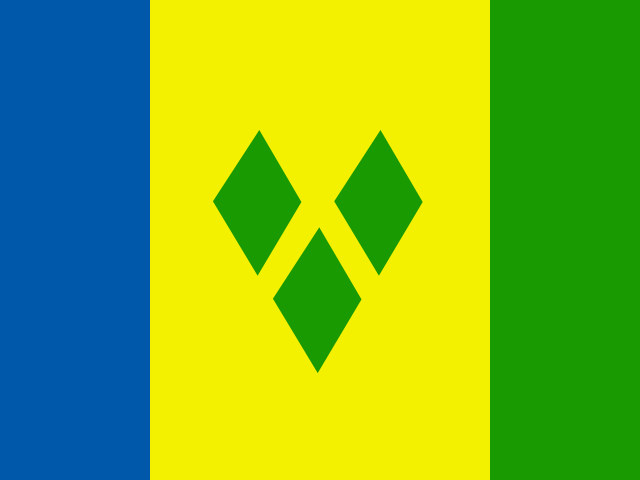
Saint Vincent and the Grenadines
Saint Vincent and the Grenadines combine the mountainous main island of Saint Vincent with a chain of smaller volcanic islands and cays stretching south towards Grenada. Saint Vincent is dominated by the active La Soufrière volcano and steep, heavily forested slopes, with rainforest, waterfalls and narrow valleys covering much of the interior. The Grenadines are generally drier, with scrub-covered hills, beaches, rocky coastlines and sheltered bays. This creates a striking contrast between the lush main island and the more exposed, semi-arid southern islands. The archipelago is also strongly maritime, with reefs, lagoons and numerous small islands forming an important part of its landscape. Recent international air connections have made Saint Vincent considerably easier to reach, while travel between the islands is possible by domestic flights and ferries.
Overview
Saint Vincent is particularly valuable for island endemics, above all the endangered Saint Vincent Parrot, the national bird. The Vermont Nature Trail through rainforest on Grand Bonhomme is the classic site, with the parrots most likely around dawn and dusk. The island also holds the endemic Whistling Warbler, while regional specialties include Lesser Antillean Tanager, Brown Trembler and Rufous-throated Solitaire. Coastal habitats and the Grenadines add Magnificent Frigatebird, White-tailed Tropicbird, terns, herons and egrets. Birding tourism is relatively small but local guides are available, and Saint Vincent's established nature trails make targeted endemic birding practical. The Grenadines are more oriented towards sailing and marine tourism, so a birding-focused visit is best centred on Saint Vincent itself, with the smaller islands providing complementary coastal habitats rather than major terrestrial birding opportunities.
Top 10 target species
| Species | Annual frequency | January | February | March | April | May | June | July | August | September | October | November | December |
|---|---|---|---|---|---|---|---|---|---|---|---|---|---|
| Bananaquit Coereba flaveola | 65.9% | 58.3% | 69.0% | 65.8% | 74.7% | 75.4% | 71.8% | 67.3% | 71.2% | 59.0% | 58.5% | 63.4% | 56.2% |
| Gray Kingbird Tyrannus dominicensis | 55.0% | 51.4% | 54.3% | 49.6% | 60.1% | 48.8% | 56.8% | 64.2% | 69.1% | 50.0% | 49.4% | 54.4% | 51.3% |
| Scaly-naped Pigeon Patagioenas squamosa | 46.5% | 28.9% | 32.3% | 30.8% | 46.4% | 54.4% | 71.1% | 67.2% | 69.7% | 47.4% | 45.1% | 37.4% | 27.5% |
| Black-faced Grassquit Melanospiza bicolor | 46.4% | 38.9% | 43.1% | 39.2% | 55.7% | 41.4% | 58.9% | 58.5% | 46.7% | 55.6% | 48.7% | 39.1% | 30.5% |
| Magnificent Frigatebird Fregata magnificens | 42.9% | 40.8% | 36.5% | 36.8% | 35.2% | 25.9% | 45.0% | 44.8% | 51.6% | 52.7% | 49.8% | 47.6% | 47.6% |
| Antillean Crested Hummingbird Orthorhyncus cristatus | 35.5% | 39.0% | 38.7% | 36.8% | 37.6% | 33.4% | 31.6% | 32.1% | 41.6% | 23.0% | 34.7% | 40.6% | 37.0% |
| Common Ground Dove Columbina passerina | 34.7% | 30.9% | 31.6% | 22.2% | 37.3% | 25.8% | 34.0% | 35.0% | 47.3% | 32.5% | 43.7% | 43.9% | 32.5% |
| Tropical Mockingbird Mimus gilvus | 33.5% | 28.0% | 24.9% | 20.1% | 26.8% | 23.2% | 36.6% | 46.1% | 51.1% | 24.1% | 42.8% | 44.7% | 34.0% |
| Western Cattle-Egret Ardea ibis | 32.8% | 28.7% | 30.9% | 27.3% | 42.8% | 22.9% | 38.2% | 35.8% | 29.6% | 47.4% | 39.0% | 27.4% | 24.0% |
| Little Blue Heron Egretta caerulea | 27.3% | 22.0% | 19.2% | 18.7% | 27.2% | 19.0% | 31.9% | 34.3% | 31.0% | 41.1% | 34.8% | 26.8% | 22.2% |