
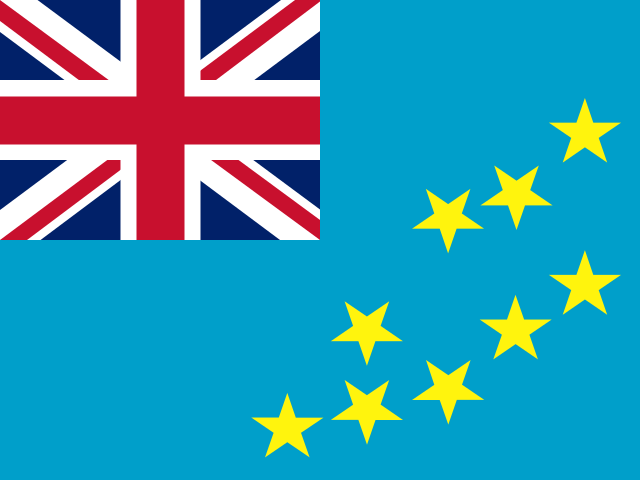
Tuvalu
Tuvalu is one of the world's smallest and most remote countries, consisting of nine low-lying coral islands and atolls scattered across the central Pacific. None rises more than a few metres above sea level, and the landscape is dominated by narrow strips of land, coconut palms, coastal scrub, lagoons and surrounding coral reefs. Funafuti, the capital atoll, contains most of the population and is considerably more developed than the outer islands. Freshwater and fertile soils are limited, and the country is particularly vulnerable to sea-level rise, coastal erosion, storm surges and saltwater intrusion. The climate is tropical and maritime, with warm temperatures throughout the year and a wetter period generally from November to April.
Overview
Tuvalu is primarily interesting for tropical seabirds and migratory shorebirds, rather than endemic land birds. The Funafuti Conservation Area, encompassing several uninhabited islets, lagoon and reef habitat, is the most important accessible birding area. Typical species include Black Noddy, Brown Noddy, White Tern, Brown Booby, Great Frigatebird and various terns, while Pacific Golden Plover, Wandering Tattler and Ruddy Turnstone are characteristic migrants. Remote outer islands can support additional seabird colonies but are considerably harder to reach. Dedicated birding tourism is virtually nonexistent, and transport between islands is limited, making a comprehensive visit logistically difficult. For birders, Tuvalu is mainly a remote Pacific seabird and shorebird destination, with Funafuti offering the most practical introduction to its birdlife.
Top 10 target species
| Species | Annual frequency | January | February | March | April | May | June | July | August | September | October | November | December |
|---|---|---|---|---|---|---|---|---|---|---|---|---|---|
| Blue-billed White-Tern Gygis candida | 18.2% | 27.5% | 0.0% | 0.0% | 12.5% | 46.9% | 48.0% | 0.0% | 41.7% | 25.0% | 10.0% | 6.3% | 0.0% |
| Pacific Golden-Plover Pluvialis fulva | 10.4% | 75.0% | 0.1% | 0.0% | 25.0% | 0.0% | 0.0% | 0.0% | 0.0% | 25.0% | 0.0% | 0.0% | 0.0% |
| Ruddy Turnstone Arenaria interpres | 9.0% | 70.0% | 0.0% | 0.0% | 12.5% | 0.0% | 0.0% | 0.0% | 0.0% | 25.0% | 0.0% | 0.0% | 0.0% |
| Black-naped Tern Sterna sumatrana | 8.7% | 40.0% | 0.1% | 0.0% | 12.5% | 8.8% | 9.8% | 0.0% | 33.3% | 0.0% | 0.0% | 0.0% | 0.0% |
| Red-footed Booby Sula sula | 8.4% | 6.3% | 0.0% | 0.0% | 0.0% | 35.9% | 33.4% | 25.0% | 0.0% | 0.0% | 0.0% | 0.0% | 0.0% |
| Pacific Reef-Heron Egretta sacra | 8.4% | 12.5% | 0.1% | 0.0% | 25.0% | 12.7% | 8.4% | 0.0% | 41.7% | 0.0% | 0.0% | 0.0% | 0.0% |
| Lesser Frigatebird Fregata ariel | 6.9% | 11.3% | 0.0% | 0.0% | 0.0% | 16.3% | 11.7% | 25.0% | 8.3% | 0.0% | 10.0% | 0.0% | 0.0% |
| Brown Noddy Anous stolidus | 6.9% | 10.0% | 0.0% | 0.0% | 0.0% | 11.7% | 16.0% | 0.0% | 33.3% | 0.0% | 5.0% | 6.3% | 0.0% |
| Wandering Tattler Tringa incana | 6.6% | 47.5% | 0.0% | 0.0% | 12.5% | 7.9% | 3.4% | 0.0% | 8.3% | 0.0% | 0.0% | 0.0% | 0.0% |
| Great Crested Tern Thalasseus bergii | 6.2% | 41.3% | 0.0% | 0.0% | 0.0% | 0.0% | 0.0% | 0.0% | 33.3% | 0.0% | 0.0% | 0.0% | 0.0% |