
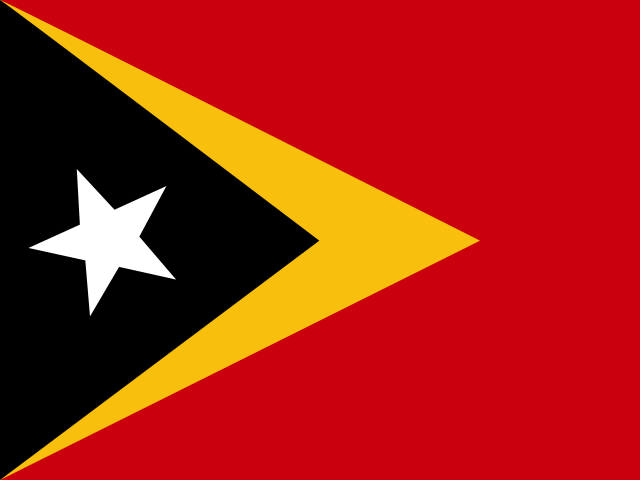
Timor-Leste
Timor-Leste occupies the eastern half of Timor, together with the Oecusse enclave and several smaller islands. The country is rugged and mountainous, with steep ranges rising rapidly from narrow coastal plains to Mount Ramelau, its highest peak. Habitats include tropical dry forest, monsoon woodland, montane forest, grasslands, mangroves and coral-fringed coasts. The north is generally much drier than the mountainous interior and south coast, with a strongly seasonal tropical climate. Atauro Island, lying north of Dili, adds dry forest, limestone landscapes and exceptionally rich surrounding marine ecosystems. Infrastructure outside Dili remains relatively limited, and mountain roads can be slow.
Overview
Timor-Leste is particularly important for Lesser Sunda endemics and restricted-range birds. Key targets include Timor Green Pigeon, Timor Imperial-Pigeon, Timor Sparrow, Timor Blue Flycatcher and Iris Lorikeet, alongside numerous species shared only with nearby islands. Important areas include Mount Ramelau, the forests around Maubisse and Same, Nino Konis Santana National Park and Atauro Island. Dry forest and montane habitats produce quite different bird communities, making several regions worthwhile. Birding tourism remains small, with relatively few specialist guides, and reaching productive forest sites often requires rough roads and local logistical arrangements. Timor-Leste is therefore especially attractive to adventurous birders seeking Wallacean specialties in a little-visited destination.
Top 10 target species
| Species | Annual frequency | January | February | March | April | May | June | July | August | September | October | November | December |
|---|---|---|---|---|---|---|---|---|---|---|---|---|---|
| Pied Bushchat Saxicola caprata | 35.5% | 38.2% | 36.5% | 31.2% | 31.6% | 38.7% | 36.0% | 38.0% | 37.5% | 28.3% | 34.5% | 35.4% | 40.5% |
| Streak-breasted Honeyeater Meliphaga reticulata | 34.1% | 33.0% | 37.9% | 30.5% | 34.8% | 40.9% | 35.8% | 38.1% | 43.4% | 24.2% | 29.2% | 33.7% | 27.5% |
| Plain Gerygone Gerygone inornata | 29.3% | 25.4% | 25.9% | 30.8% | 27.0% | 33.6% | 26.4% | 34.5% | 31.4% | 26.2% | 31.2% | 25.0% | 34.9% |
| Barred Dove Geopelia maugeus | 28.3% | 28.5% | 33.4% | 26.7% | 33.5% | 36.7% | 23.6% | 23.9% | 26.7% | 20.7% | 23.7% | 22.7% | 39.0% |
| Spotted Dove Spilopelia chinensis | 26.6% | 34.8% | 36.2% | 24.5% | 31.1% | 30.4% | 23.5% | 25.9% | 19.6% | 19.0% | 19.8% | 22.6% | 32.2% |
| Rainbow Bee-eater Merops ornatus | 24.7% | 24.2% | 30.5% | 20.0% | 21.9% | 30.7% | 26.9% | 22.9% | 32.3% | 18.1% | 21.7% | 19.7% | 28.0% |
| Fawn-breasted Whistler Pachycephala orpheus | 24.3% | 18.6% | 19.9% | 26.8% | 28.7% | 21.6% | 20.2% | 24.2% | 27.7% | 17.7% | 31.3% | 27.2% | 28.3% |
| White-shouldered Triller Lalage sueurii | 24.0% | 21.3% | 28.3% | 26.7% | 25.3% | 21.3% | 19.5% | 18.3% | 26.3% | 20.8% | 23.4% | 22.8% | 33.7% |
| Northern Fantail Rhipidura rufiventris | 23.1% | 21.3% | 25.6% | 29.4% | 22.2% | 23.3% | 23.7% | 30.6% | 28.9% | 16.6% | 20.6% | 17.6% | 17.4% |
| Eurasian Tree Sparrow Passer montanus | 21.4% | 21.0% | 20.7% | 14.1% | 14.5% | 31.0% | 21.1% | 22.7% | 24.8% | 16.9% | 22.3% | 18.2% | 29.2% |