
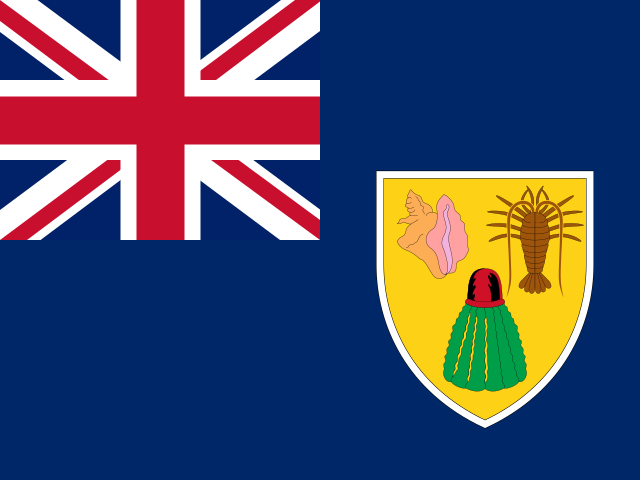
Turks and Caicos Islands
The Turks and Caicos Islands are a low-lying Atlantic archipelago southeast of the Bahamas, consisting of limestone islands, cays, extensive tidal flats, mangroves and shallow turquoise waters. The landscape is predominantly dry and flat, with scrub, coastal coppice and salt ponds rather than mountains or dense forest. North Caicos and Middle Caicos retain some of the largest areas of natural vegetation and wetlands, while Grand Turk and Salt Cay are smaller, drier and more exposed. The islands' shallow banks and extensive wetlands are among their defining geographical features, supporting both terrestrial and marine wildlife. Development is concentrated around Providenciales and Grand Turk, while several smaller islands remain comparatively undeveloped. The combination of dry Caribbean habitats and exceptionally extensive coastal wetlands gives the archipelago a character quite different from the mountainous islands farther south.
Overview
Turks and Caicos are particularly useful for wetland birds, Caribbean species and migrants. North Caicos is the main birding focus, with Flamingo Pond Natural Reserve supporting large concentrations of Caribbean Flamingos and nearby wetlands attracting ospreys, herons and shorebirds. Middle Caicos and its southern wetlands add further habitat, while Little Water Cay is useful for coastal birds including Osprey, Brown Pelican and shorebirds. The islands are not a major endemic-bird destination, but their position between the Bahamas, Caribbean and North America makes migrants and occasional vagrants interesting additions. North Caicos is accessible by daily ferry and boat connections from Providenciales, and rental cars and guided tours make the main reserves relatively easy to explore. For birders, the strongest attraction is the combination of flamingo concentrations, wetlands and accessible island birding rather than a very large species list.
Top 10 target species
| Species | Annual frequency | January | February | March | April | May | June | July | August | September | October | November | December |
|---|---|---|---|---|---|---|---|---|---|---|---|---|---|
| Common Ground Dove Columbina passerina | 35.3% | 28.7% | 32.0% | 29.5% | 32.9% | 35.9% | 37.2% | 38.1% | 49.4% | 53.1% | 35.5% | 23.8% | 27.6% |
| Northern Mockingbird Mimus polyglottos | 31.2% | 26.1% | 32.4% | 31.2% | 33.5% | 34.3% | 28.1% | 31.6% | 31.9% | 41.3% | 36.1% | 20.6% | 27.0% |
| Laughing Gull Leucophaeus atricilla | 30.1% | 5.4% | 3.0% | 10.5% | 41.9% | 59.5% | 73.2% | 69.2% | 63.4% | 24.6% | 3.6% | 3.7% | 3.0% |
| Gray Kingbird Tyrannus dominicensis | 27.6% | 0.7% | 0.4% | 1.2% | 17.5% | 54.9% | 51.3% | 57.4% | 57.8% | 60.6% | 24.9% | 3.5% | 1.4% |
| Bananaquit Coereba flaveola | 25.3% | 22.9% | 20.3% | 22.6% | 25.6% | 23.1% | 14.4% | 21.0% | 31.2% | 44.8% | 33.6% | 21.7% | 22.3% |
| Mourning Dove Zenaida macroura | 24.5% | 14.9% | 22.2% | 24.3% | 31.3% | 30.8% | 22.9% | 30.8% | 31.2% | 39.6% | 22.9% | 13.1% | 10.4% |
| American Kestrel Falco sparverius | 22.8% | 27.1% | 23.8% | 25.7% | 22.9% | 17.9% | 16.5% | 24.8% | 19.4% | 30.8% | 20.5% | 18.1% | 26.5% |
| Ruddy Turnstone Arenaria interpres | 21.5% | 33.0% | 24.9% | 25.6% | 25.5% | 19.1% | 12.8% | 11.4% | 19.1% | 21.9% | 15.9% | 25.3% | 24.0% |
| Green Heron Butorides virescens | 20.2% | 16.5% | 11.7% | 13.6% | 15.2% | 26.5% | 25.9% | 32.5% | 25.1% | 33.9% | 16.7% | 12.0% | 12.5% |
| Thick-billed Vireo Vireo crassirostris | 19.2% | 19.2% | 15.1% | 18.7% | 19.2% | 15.5% | 9.6% | 17.0% | 20.8% | 27.6% | 32.2% | 17.7% | 18.3% |