
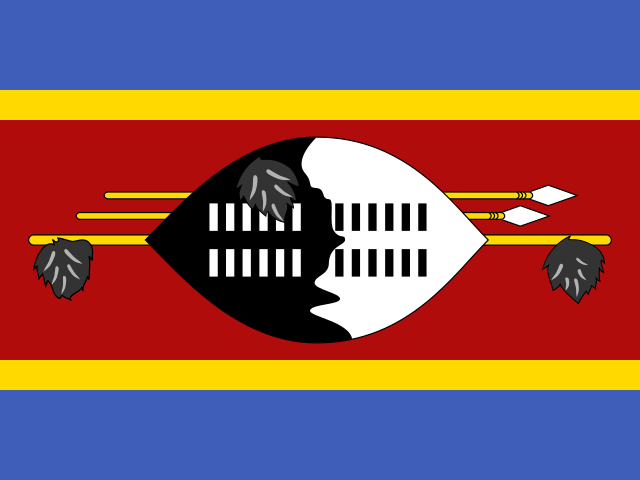
Eswatini
Eswatini is a small country with striking environmental variation across a short east–west distance. The western Highveld consists of cool, mountainous grasslands and forested valleys, descending through the rolling Middleveld to the warmer Lowveld, dominated by savanna and woodland. Along the eastern border, the Lubombo Mountains form a distinctive ridge of rocky slopes and forested gorges. Rivers, wetlands and scattered indigenous forests add further habitat diversity, while elevation strongly influences the country's subtropical climate.
Overview
Eswatini offers a compact mix of southern African highland, savanna and woodland birding. The Malolotja Nature Reserve protects extensive Highveld grassland where specialties include Blue Swallow, Ground Woodpecker and Buff-streaked Chat, while the Lubombo region supports species such as Pink-throated Twinspot, Narina Trogon and Eastern Nicator. Lowveld reserves including Hlane Royal National Park and Mlawula provide excellent savanna birding with Southern Ground Hornbill, vultures, eagles and numerous bushveld species. Eswatini's small size, good road connections and established reserves make birding relatively straightforward, and it can easily be incorporated into a wider South African birding trip. Specialist birding infrastructure is modest, but local guides are available and many productive sites are readily accessible.
Top 10 target species
| Species | Annual frequency | January | February | March | April | May | June | July | August | September | October | November | December |
|---|---|---|---|---|---|---|---|---|---|---|---|---|---|
| Common Bulbul Pycnonotus barbatus | 55.9% | 60.6% | 48.4% | 52.9% | 60.4% | 58.4% | 67.5% | 62.6% | 56.2% | 48.1% | 44.3% | 50.6% | 61.0% |
| Fork-tailed Drongo Dicrurus adsimilis | 33.4% | 38.2% | 21.2% | 43.0% | 34.2% | 30.6% | 35.6% | 44.8% | 36.1% | 33.0% | 30.3% | 26.7% | 27.6% |
| Hadada Ibis Bostrychia hagedash | 30.9% | 38.0% | 24.3% | 30.6% | 36.3% | 25.2% | 34.6% | 30.7% | 27.1% | 36.2% | 30.6% | 31.4% | 25.7% |
| Ring-necked Dove Streptopelia capicola | 28.6% | 35.4% | 32.8% | 27.4% | 40.3% | 26.9% | 30.6% | 30.2% | 21.4% | 30.6% | 24.8% | 24.7% | 17.5% |
| Red-eyed Dove Streptopelia semitorquata | 28.2% | 41.0% | 29.2% | 34.4% | 38.7% | 24.8% | 22.9% | 31.0% | 23.1% | 30.7% | 20.6% | 22.4% | 20.2% |
| Yellow-fronted Canary Crithagra mozambica | 28.1% | 43.7% | 24.6% | 23.7% | 36.3% | 20.4% | 29.4% | 34.8% | 20.3% | 31.0% | 23.6% | 23.4% | 26.3% |
| Emerald-spotted Wood-Dove Turtur chalcospilos | 26.1% | 36.2% | 19.7% | 26.3% | 33.1% | 22.6% | 27.7% | 35.6% | 20.4% | 22.0% | 20.7% | 20.4% | 28.4% |
| Sombre Greenbul Andropadus importunus | 25.2% | 36.3% | 15.9% | 29.9% | 18.0% | 28.6% | 32.3% | 35.6% | 16.1% | 18.7% | 18.9% | 16.2% | 36.4% |
| Black-collared Barbet Lybius torquatus | 23.9% | 31.0% | 18.4% | 23.8% | 32.1% | 25.1% | 28.3% | 28.8% | 20.6% | 23.1% | 18.1% | 21.4% | 15.9% |
| Kurrichane Thrush Turdus libonyana | 23.7% | 20.6% | 8.7% | 24.0% | 33.7% | 21.1% | 28.2% | 27.7% | 23.3% | 34.7% | 25.8% | 19.4% | 16.8% |