
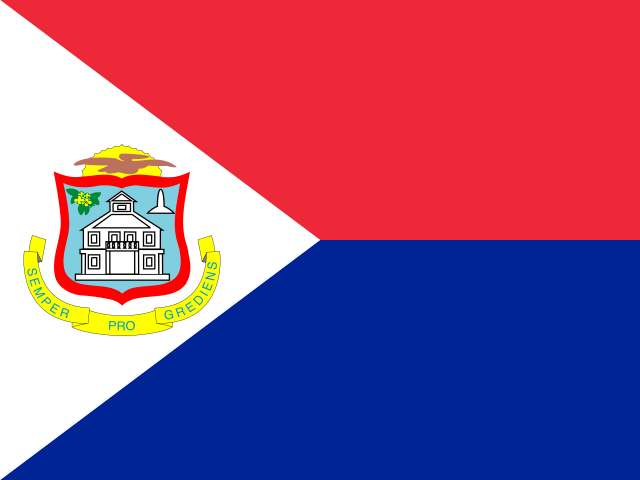
Sint Maarten
Sint Maarten occupies the southern half of the island of Saint Martin and is one of the most densely developed territories in the Caribbean. The landscape combines low volcanic hills, dry scrub and remaining woodland with an extensive coastline of beaches, rocky shores, lagoons and salt ponds. The Great Salt Pond near Philipsburg is the largest surviving natural pond and an important part of the island's remaining wetland system. Development has eliminated or heavily altered many former ponds and coastal habitats, leaving a fragmented natural landscape. The territory has a warm, relatively dry climate and strong trade-wind influence. Its Dutch Caribbean character and highly developed tourism sector make it very accessible, but the limited remaining natural habitat is an important consideration for nature-focused visitors.
Overview
Sint Maarten is mainly interesting for migrants, wetland birds and seabirds, with around 170 species recorded but no endemic bird species. The Great Salt Pond is the most notable terrestrial site, providing feeding habitat for pelicans, egrets and other waterbirds, while the remaining ponds and lagoons provide stopover habitat for migratory birds. Offshore rocky islets such as Pelican Rock are important seabird breeding sites and are recognised as Important Bird Areas. Sint Maarten is therefore best approached as a convenient Caribbean migrant and coastal-bird stopover, rather than an endemic destination. Birding is possible independently, but habitat fragmentation and extensive development mean that knowing the remaining productive ponds and coastal sites is useful.
Top 10 target species
| Species | Annual frequency | January | February | March | April | May | June | July | August | September | October | November | December |
|---|---|---|---|---|---|---|---|---|---|---|---|---|---|
| Zenaida Dove Zenaida aurita | 55.9% | 62.4% | 58.7% | 57.2% | 56.4% | 60.3% | 63.3% | 63.7% | 53.7% | 56.4% | 42.4% | 48.7% | 48.0% |
| Bananaquit Coereba flaveola | 53.1% | 51.2% | 53.0% | 67.7% | 65.0% | 63.2% | 49.9% | 43.0% | 40.7% | 32.9% | 64.9% | 65.6% | 39.9% |
| Carib Grackle Quiscalus lugubris | 53.0% | 58.9% | 54.1% | 49.3% | 54.8% | 51.8% | 69.2% | 52.5% | 48.4% | 40.6% | 50.9% | 49.2% | 56.2% |
| Magnificent Frigatebird Fregata magnificens | 50.2% | 54.7% | 49.9% | 34.6% | 46.1% | 50.2% | 63.7% | 58.8% | 59.0% | 48.2% | 35.7% | 46.6% | 54.6% |
| Brown Pelican Pelecanus occidentalis | 46.4% | 53.3% | 52.6% | 37.5% | 40.9% | 40.0% | 54.6% | 44.4% | 49.5% | 54.5% | 39.4% | 37.7% | 53.1% |
| Gray Kingbird Tyrannus dominicensis | 41.4% | 45.1% | 45.8% | 43.0% | 44.7% | 42.2% | 51.6% | 44.1% | 35.8% | 36.4% | 28.1% | 43.2% | 36.6% |
| Eurasian Collared-Dove Streptopelia decaocto | 38.4% | 45.6% | 42.6% | 34.8% | 37.9% | 39.6% | 48.3% | 42.3% | 30.6% | 37.8% | 34.9% | 30.6% | 35.6% |
| Great Egret Ardea alba | 35.8% | 41.5% | 40.1% | 31.9% | 37.9% | 33.0% | 33.5% | 31.9% | 41.9% | 41.0% | 27.1% | 31.0% | 38.3% |
| Snowy Egret Egretta thula | 29.8% | 30.3% | 31.1% | 22.0% | 31.0% | 26.3% | 36.4% | 25.5% | 41.5% | 39.3% | 19.4% | 22.2% | 32.3% |
| Laughing Gull Leucophaeus atricilla | 29.1% | 5.5% | 3.3% | 6.6% | 31.8% | 45.8% | 68.8% | 64.3% | 62.8% | 39.0% | 10.0% | 5.7% | 5.1% |