
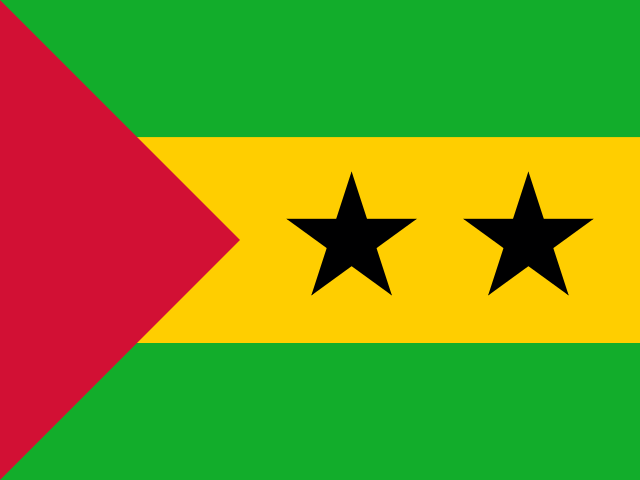
Sao Tome and Principe
São Tomé and Príncipe is a small volcanic island nation in the Gulf of Guinea, almost directly on the equator. Both main islands are mountainous remnants of ancient volcanoes, with steep peaks, deep valleys and exceptionally lush tropical vegetation. São Tomé rises above 2,000 metres at Pico de São Tomé, while smaller Príncipe has dramatic volcanic spires and extensive forest. Humid native rainforest survives particularly in the mountainous interiors, surrounded at lower elevations by plantations and secondary forest. Long isolation from mainland Africa has produced exceptionally high levels of endemism.
Overview
São Tomé and Príncipe is one of Africa's most remarkable destinations for island-endemic birds, with many species found nowhere else. São Tomé's forests hold extraordinary specialties including Giant Sunbird, Giant Weaver, São Tomé Oriole, São Tomé Short-tail and the critically endangered São Tomé Grosbeak, while Príncipe has endemics such as Príncipe Starling and Príncipe Speirops. The rare São Tomé Ibis is among the world's most threatened birds and is restricted to remaining lowland forest. Offshore islets also support breeding seabirds. Birding tourism is small but established, with local guides available for endemic-focused trips. Many species require forest hiking, sometimes on steep and muddy trails, and seeing the full endemic set requires visiting both main islands. The compact geography nevertheless makes the archipelago exceptionally rewarding for dedicated birders.
Top 10 target species
| Species | Annual frequency | January | February | March | April | May | June | July | August | September | October | November | December |
|---|---|---|---|---|---|---|---|---|---|---|---|---|---|
| Black Kite Milvus migrans | 59.3% | 45.7% | 53.7% | 68.8% | 56.3% | 65.2% | 64.3% | 53.5% | 58.7% | 65.7% | 69.6% | 64.7% | 45.9% |
| African Palm Swift Cypsiurus parvus | 47.9% | 29.8% | 40.0% | 52.2% | 40.2% | 57.6% | 67.9% | 48.5% | 44.4% | 47.5% | 52.6% | 55.6% | 38.7% |
| Sao Tome Prinia Prinia molleri | 47.1% | 38.8% | 49.4% | 41.5% | 37.6% | 41.2% | 63.3% | 40.1% | 43.1% | 48.0% | 59.3% | 51.9% | 50.8% |
| Newton's Sunbird Anabathmis newtonii | 40.4% | 35.9% | 48.2% | 33.6% | 31.0% | 37.9% | 53.5% | 32.8% | 39.2% | 44.7% | 46.6% | 35.7% | 45.5% |
| Laughing Dove Spilopelia senegalensis | 39.5% | 27.2% | 31.9% | 42.8% | 28.1% | 54.4% | 56.3% | 38.3% | 39.3% | 37.8% | 51.2% | 38.8% | 28.3% |
| Common Waxbill Estrilda astrild | 39.0% | 29.9% | 36.8% | 43.4% | 32.9% | 38.4% | 56.6% | 28.3% | 32.8% | 48.2% | 44.5% | 47.4% | 29.2% |
| Black-capped Speirops Zosterops lugubris | 33.0% | 24.8% | 35.8% | 26.2% | 24.5% | 32.4% | 44.9% | 30.5% | 37.4% | 35.7% | 38.4% | 26.0% | 39.2% |
| Principe Seedeater Crithagra rufobrunnea | 32.2% | 30.2% | 35.6% | 29.9% | 21.1% | 31.3% | 49.3% | 30.7% | 38.2% | 36.0% | 32.6% | 28.6% | 23.5% |
| Sao Tome Paradise-Flycatcher Terpsiphone atrochalybeia | 32.0% | 31.5% | 33.5% | 28.7% | 23.4% | 24.6% | 38.9% | 31.6% | 35.4% | 34.8% | 40.3% | 35.0% | 25.9% |
| Sao Tome Weaver Ploceus sanctithomae | 31.1% | 34.6% | 36.1% | 24.8% | 24.7% | 30.6% | 44.4% | 25.5% | 34.3% | 32.2% | 32.9% | 22.1% | 31.2% |