
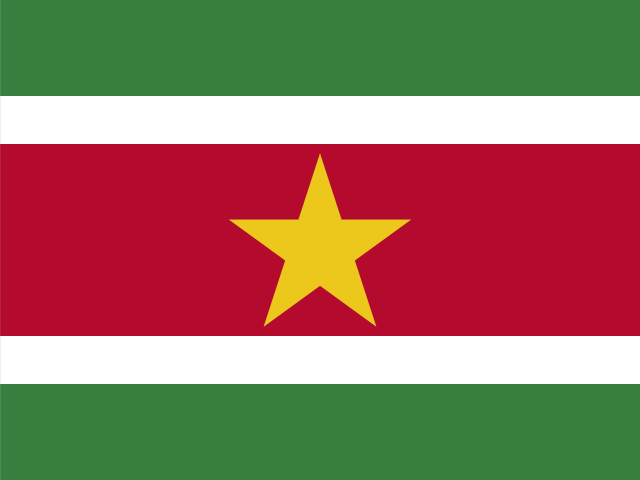
Suriname
Suriname occupies the northeastern corner of South America, with a flat Atlantic coastal plain giving way southwards to the forests and hills of the Guiana Shield. Most of the population is concentrated around Paramaribo and the narrow coastal zone, while much of the interior remains sparsely populated and heavily forested. The interior contains extensive lowland rainforest, savannas, rivers and isolated uplands, including the Tafelberg and Wilhelmina mountain ranges. The Central Suriname Nature Reserve protects about 1.6 million hectares of largely primary rainforest, with granite inselbergs, rivers and the easternmost tepui of the Guiana Shield. The coast is very different, consisting largely of mudflats, mangroves and wetlands shaped by sediment from the Amazon region.
Overview
Suriname combines Guiana Shield rainforest with exceptionally important coastal wetlands. Bigi Pan is the country's standout wetland site, attracting large numbers of resident and migratory birds; Scarlet Ibis and flamingos are among its highlights, while many northern migrants use the area during the boreal winter. Inland, Brownsberg Nature Reserve provides relatively accessible rainforest birding near Brokopondo Reservoir, while the remote Central Suriname Nature Reserve offers much more extensive forest habitat and Guiana Shield specialists. Suriname is less established as an international birding destination than Guyana, but its combination of coastal migration sites and largely intact interior forest makes it particularly interesting for birders exploring the Guianas. Access to the deeper interior can require boats, aircraft or organised trips.
Top 10 target species
| Species | Annual frequency | January | February | March | April | May | June | July | August | September | October | November | December |
|---|---|---|---|---|---|---|---|---|---|---|---|---|---|
| Great Kiskadee Pitangus sulphuratus | 41.1% | 36.2% | 39.4% | 44.5% | 38.0% | 48.4% | 43.9% | 59.7% | 49.6% | 32.1% | 34.1% | 26.5% | 40.2% |
| Silver-beaked Tanager Ramphocelus carbo | 34.8% | 33.3% | 40.0% | 36.9% | 29.0% | 33.2% | 28.7% | 44.8% | 40.8% | 30.1% | 31.7% | 27.7% | 41.1% |
| Tropical Kingbird Tyrannus melancholicus | 32.5% | 30.1% | 33.4% | 34.6% | 26.5% | 32.6% | 33.8% | 46.9% | 34.9% | 27.0% | 30.6% | 22.6% | 36.9% |
| Blue-gray Tanager Thraupis episcopus | 31.7% | 28.4% | 33.7% | 35.1% | 26.2% | 36.6% | 28.1% | 44.5% | 35.6% | 26.4% | 25.2% | 23.4% | 36.6% |
| Palm Tanager Thraupis palmarum | 30.4% | 28.8% | 33.6% | 31.5% | 25.7% | 31.5% | 36.0% | 37.7% | 34.7% | 25.2% | 24.1% | 23.8% | 31.9% |
| Gray-breasted Martin Progne chalybea | 27.6% | 23.3% | 26.4% | 27.5% | 24.2% | 26.0% | 35.4% | 46.7% | 30.2% | 21.7% | 20.5% | 21.2% | 28.7% |
| Black Vulture Coragyps atratus | 27.5% | 25.6% | 28.0% | 29.7% | 26.1% | 23.1% | 32.1% | 35.9% | 25.3% | 30.2% | 23.1% | 20.5% | 31.0% |
| Rusty-margined Flycatcher Myiozetetes cayanensis | 26.5% | 28.2% | 28.8% | 30.1% | 25.0% | 30.1% | 26.0% | 35.7% | 26.6% | 16.7% | 20.3% | 19.1% | 31.4% |
| Pale-breasted Thrush Turdus leucomelas | 23.6% | 23.0% | 21.9% | 26.6% | 19.2% | 33.6% | 31.1% | 33.7% | 23.7% | 14.6% | 15.3% | 15.8% | 24.7% |
| Tropical Mockingbird Mimus gilvus | 22.9% | 22.5% | 19.6% | 27.4% | 19.8% | 24.2% | 22.5% | 36.6% | 28.2% | 17.1% | 20.4% | 15.3% | 21.7% |