
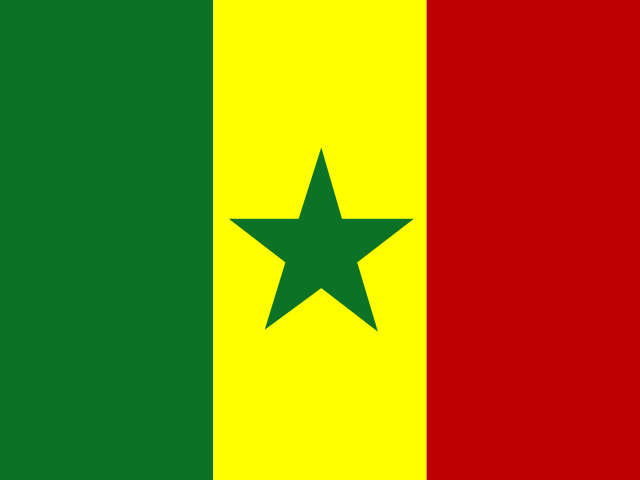
Senegal
Senegal lies at the transition between the Sahel and the wetter landscapes of coastal West Africa. Much of the country consists of dry savanna and open woodland, while the Senegal River forms extensive wetlands in the north. The coast includes sandy shores, lagoons, mangroves and the large Saloum Delta, while greener woodland and forest occur in the south around Casamance. Seasonal rainfall increases markedly from north to south.
Overview
Senegal is one of West Africa’s most accessible birding destinations, particularly renowned for wetlands, Sahel species and Palearctic migrants. The Djoudj National Bird Sanctuary in the Senegal River delta hosts enormous concentrations of waterbirds, including Great White Pelicans, flamingos, herons and wintering shorebirds. The Saloum Delta adds productive mangrove, mudflat and coastal birding, while dry areas support Arabian Bustard, Savile’s Bustard, Senegal Batis, rollers, bee-eaters and numerous raptors. The southeast around Niokolo-Koba introduces richer savanna and woodland communities. Established birding guides, relatively good infrastructure and easy access from Dakar make Senegal well suited to organized or independent trips, although reaching more remote southeastern sites requires longer overland travel.
Top 10 target species
| Species | Annual frequency | January | February | March | April | May | June | July | August | September | October | November | December |
|---|---|---|---|---|---|---|---|---|---|---|---|---|---|
| Laughing Dove Spilopelia senegalensis | 50.4% | 50.4% | 45.2% | 53.7% | 45.3% | 55.8% | 50.5% | 42.2% | 57.7% | 53.4% | 58.7% | 45.4% | 46.8% |
| Black Kite Milvus migrans | 43.0% | 41.1% | 36.3% | 44.0% | 41.9% | 53.3% | 49.3% | 40.0% | 45.1% | 46.1% | 41.8% | 36.6% | 40.3% |
| Common Bulbul Pycnonotus barbatus | 40.0% | 37.1% | 36.6% | 40.3% | 38.9% | 48.1% | 42.2% | 37.4% | 48.0% | 39.4% | 45.6% | 32.8% | 33.7% |
| Spur-winged Lapwing Vanellus spinosus | 34.9% | 32.8% | 30.4% | 36.2% | 34.2% | 40.4% | 41.7% | 33.2% | 33.1% | 31.3% | 36.9% | 34.1% | 34.7% |
| Western Red-billed Hornbill Tockus kempi | 33.4% | 33.8% | 29.4% | 33.7% | 28.1% | 34.6% | 39.1% | 28.2% | 42.5% | 36.0% | 30.7% | 31.3% | 34.1% |
| Pied Crow Corvus albus | 31.7% | 24.2% | 21.6% | 26.6% | 28.9% | 40.7% | 36.2% | 33.0% | 42.2% | 37.1% | 39.1% | 25.6% | 25.7% |
| Long-tailed Glossy Starling Lamprotornis caudatus | 28.7% | 26.1% | 26.4% | 24.4% | 18.4% | 24.9% | 31.7% | 24.7% | 36.6% | 40.3% | 37.3% | 27.0% | 26.1% |
| Western Cattle-Egret Ardea ibis | 28.1% | 30.7% | 27.6% | 27.6% | 27.1% | 31.7% | 27.0% | 27.2% | 27.2% | 23.4% | 28.1% | 29.6% | 30.7% |
| Speckled Pigeon Columba guinea | 27.5% | 28.2% | 23.4% | 26.8% | 23.2% | 30.1% | 27.1% | 22.7% | 30.1% | 31.8% | 33.7% | 24.6% | 28.1% |
| Reed Cormorant Microcarbo africanus | 27.1% | 24.5% | 25.4% | 27.2% | 34.5% | 37.5% | 30.3% | 22.9% | 19.2% | 18.7% | 28.4% | 27.1% | 29.5% |