
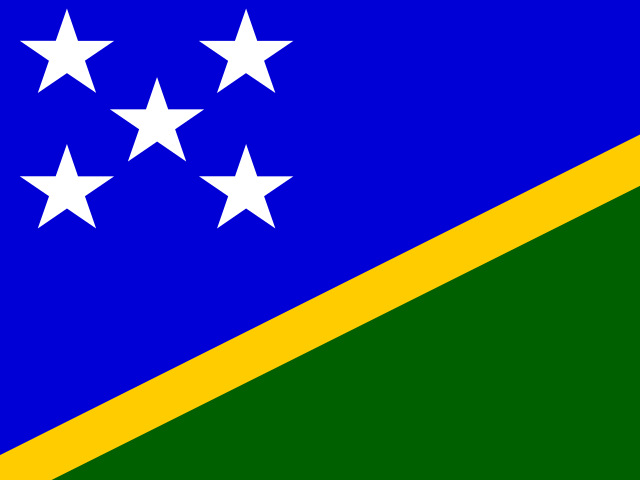
Solomon Islands
The Solomon Islands are a widely scattered Melanesian archipelago in the southwestern Pacific, stretching across hundreds of islands from volcanic mountains and dense rainforest to coral atolls, mangroves and coastal wetlands. The larger islands are rugged and heavily forested, while many smaller islands remain relatively undeveloped. Isolation between islands has produced strong island-level endemism, with different bird communities and subspecies often restricted to particular islands. Guadalcanal and the larger islands of the Central and Western Provinces contain extensive forest, while remote outer islands offer a much more intact tropical environment. Access between islands is an important part of travelling here, as roads are limited outside the main centres and many birding sites require boats or local guides.
Overview
The Solomon Islands are particularly rewarding for endemic Melanesian birds and island-restricted species. Key targets include Solomon Sea Eagle, Blyth's Hornbill, Cardinal Lory, Steel-blue Flycatcher and Midget Flowerpecker, alongside distinctive cuckoo-shrikes, monarchs, honeyeaters and imperial-pigeons. Kolombangara, Guadalcanal and Makira are among the most interesting islands for forest birding, with several species found only within the Solomon Islands or on individual islands. The archipelago is also important for seabirds and migratory shorebirds, particularly around less disturbed coastal habitats. Birding tourism is relatively small and much less developed than in Australia or New Zealand; local guides and flexible logistics are important, especially away from Honiara. For specialist birders, the attraction lies in the combination of high endemism, remote forests and genuinely difficult-to-see island species, making the Solomon Islands one of the more adventurous birding destinations in Melanesia.
Top 10 target species
| Species | Annual frequency | January | February | March | April | May | June | July | August | September | October | November | December |
|---|---|---|---|---|---|---|---|---|---|---|---|---|---|
| Willie-wagtail Rhipidura leucophrys | 36.6% | 45.3% | 38.0% | 33.5% | 33.1% | 32.2% | 35.5% | 31.7% | 24.4% | 39.9% | 35.1% | 44.7% | 46.1% |
| Cardinal Lory Chalcopsitta cardinalis | 35.2% | 24.5% | 26.3% | 24.2% | 37.6% | 36.4% | 51.2% | 40.2% | 29.9% | 51.2% | 37.5% | 29.0% | 34.7% |
| Sahul Sunbird Cinnyris frenatus | 31.2% | 22.7% | 27.4% | 21.3% | 30.6% | 27.2% | 42.2% | 33.7% | 23.8% | 40.4% | 32.5% | 28.0% | 44.5% |
| Solomons Corella Cacatua ducorpsii | 28.3% | 17.8% | 18.4% | 19.5% | 32.1% | 27.4% | 41.6% | 39.8% | 23.2% | 46.2% | 29.7% | 19.9% | 24.5% |
| Metallic Starling Aplonis metallica | 27.5% | 26.3% | 19.0% | 24.6% | 27.3% | 18.1% | 30.7% | 24.9% | 22.5% | 33.2% | 29.6% | 29.4% | 44.2% |
| Coconut Lorikeet Trichoglossus haematodus | 27.2% | 23.4% | 23.6% | 22.0% | 26.5% | 23.6% | 31.3% | 31.7% | 14.9% | 29.7% | 20.9% | 39.7% | 39.1% |
| Glossy Swiftlet Collocalia esculenta | 25.9% | 26.5% | 24.1% | 13.5% | 28.7% | 21.0% | 42.9% | 39.2% | 12.3% | 22.5% | 18.5% | 35.0% | 27.0% |
| Red-knobbed Imperial-Pigeon Ducula rubricera | 25.5% | 25.6% | 11.2% | 16.6% | 28.5% | 17.7% | 41.7% | 38.9% | 21.3% | 28.8% | 26.9% | 27.5% | 21.1% |
| Pacific Swallow Hirundo javanica | 25.1% | 38.2% | 14.5% | 21.9% | 36.9% | 25.4% | 30.0% | 17.5% | 21.7% | 25.7% | 15.8% | 29.0% | 25.4% |
| Long-tailed Myna Mino kreffti | 24.3% | 20.6% | 13.7% | 16.1% | 25.3% | 18.2% | 44.4% | 34.5% | 18.0% | 29.5% | 25.7% | 20.0% | 25.6% |