
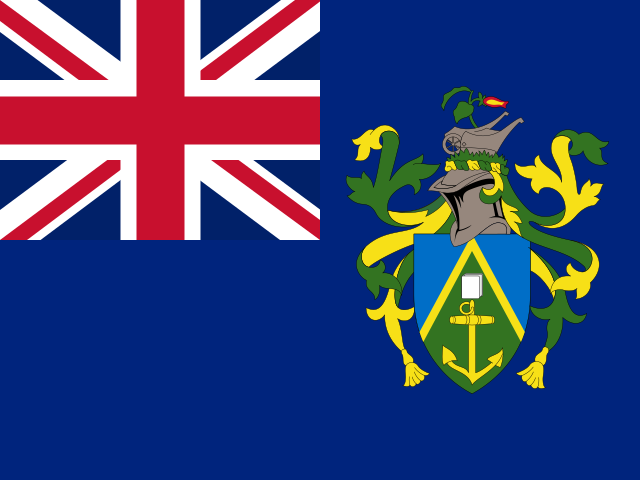
Pitcairn Islands
The Pitcairn Islands are a remote British territory in the southeastern Pacific, comprising Pitcairn, Henderson, Ducie and Oeno islands. Only Pitcairn Island is inhabited, with a population of only a few dozen people. It is a rugged volcanic island with steep coastal cliffs, fertile valleys and subtropical vegetation, while Oeno and Ducie are low coral atolls. Henderson Island is a raised coral island whose isolation has preserved an exceptionally intact ecosystem, earning it UNESCO World Heritage status. The group lies thousands of kilometres from any continent and has no airport; Pitcairn is reached by sea, usually via French Polynesia. This extreme isolation has shaped both its natural environment and its unusual human history, including settlement by the descendants of the Bounty mutineers and their Polynesian companions.
Overview
The Pitcairn group is internationally important for endemic land birds and huge seabird colonies. Henderson Island is the outstanding site, with four endemic land birds: Henderson Fruit Dove, Henderson Lorikeet, Henderson Reed Warbler and flightless Henderson Crake. The islands also support major populations of petrels, shearwaters, tropicbirds, boobies and terns; Henderson Petrel is another particularly important regional specialty. Pitcairn itself holds the endemic Pitcairn Reed Warbler, making even the inhabited island significant for specialist birders. Despite this exceptional birdlife, access is the major obstacle. There is no airport, voyages are infrequent, and landing conditions can be difficult. Henderson, Ducie and Oeno require further boat travel and are rarely visited. For birders, the Pitcairns are therefore an extreme expedition destination, offering remarkable endemism but among the most difficult logistics of any Pacific territory.
Top 10 target species
| Species | Annual frequency | January | February | March | April | May | June | July | August | September | October | November | December |
|---|---|---|---|---|---|---|---|---|---|---|---|---|---|
| Blue-billed White-Tern Gygis candida | 59.3% | 75.0% | 43.8% | 38.8% | 74.2% | 80.7% | 52.2% | 64.5% | 16.7% | 75.0% | 81.9% | 34.0% | 75.0% |
| Great Frigatebird Fregata minor | 48.2% | 37.5% | 31.3% | 27.5% | 61.9% | 80.7% | 49.0% | 77.7% | 20.8% | 33.3% | 65.0% | 30.6% | 62.5% |
| Red-tailed Tropicbird Phaethon rubricauda | 41.9% | 50.0% | 18.8% | 37.5% | 41.3% | 62.1% | 58.3% | 69.0% | 16.7% | 51.8% | 43.0% | 29.0% | 25.0% |
| Murphy's Petrel Pterodroma ultima | 40.6% | 37.5% | 0.0% | 25.4% | 41.6% | 33.6% | 63.9% | 79.5% | 16.7% | 64.3% | 65.3% | 34.2% | 25.0% |
| Masked Booby Sula dactylatra | 37.5% | 12.5% | 12.5% | 28.3% | 61.3% | 21.1% | 62.6% | 61.9% | 12.5% | 36.9% | 33.7% | 32.3% | 75.0% |
| Red-footed Booby Sula sula | 35.9% | 37.5% | 6.3% | 27.5% | 44.9% | 21.1% | 52.3% | 53.2% | 12.5% | 36.9% | 36.0% | 27.3% | 75.0% |
| Brown Noddy Anous stolidus | 24.9% | 50.0% | 18.8% | 22.5% | 27.4% | 3.6% | 0.8% | 6.6% | 12.5% | 36.3% | 41.8% | 16.5% | 62.5% |
| Henderson Petrel Pterodroma atrata | 24.3% | 12.5% | 0.0% | 14.6% | 22.4% | 17.1% | 57.7% | 50.4% | 4.2% | 33.3% | 10.0% | 6.5% | 62.5% |
| Herald Petrel Pterodroma heraldica | 24.2% | 12.5% | 0.0% | 23.3% | 45.5% | 70.7% | 20.5% | 17.0% | 12.5% | 44.6% | 13.8% | 18.0% | 12.5% |
| Kermadec Petrel Pterodroma neglecta | 23.1% | 0.0% | 0.0% | 26.7% | 27.3% | 12.1% | 56.1% | 52.0% | 12.5% | 41.1% | 19.1% | 17.5% | 12.5% |