
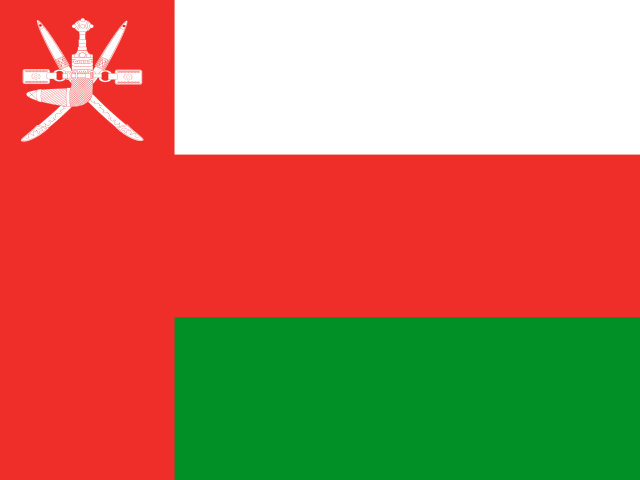
Oman
Oman occupies the southeastern corner of the Arabian Peninsula, with landscapes ranging from the rugged Hajar Mountains to vast gravel plains, sand deserts and more than 3,000 km of coastline. The Hajar rise above 3,000 metres and contain deep wadis and spectacular limestone canyons. In the south, Dhofar is transformed by the summer khareef monsoon, which creates mist-covered escarpments, grasslands and woodland strikingly different from Arabia's predominantly arid interior. Coastal lagoons, mangroves and extensive mudflats add further habitat diversity.
Overview
Oman is one of the Arabian Peninsula's leading birding destinations, combining Arabian specialties with migrants from Asia and Africa. Dhofar is particularly productive for Arabian Golden-winged Grosbeak, Yemen Serin, Arabian Partridge and Arabian Scops Owl, while its wadis and coastal wetlands attract numerous migrants. Barr Al Hikman is internationally important for huge concentrations of shorebirds, including Crab-plover and Great Knot. The desert interior offers Spotted Sandgrouse, larks and wheatears, and pelagic trips can produce Jouanin's Petrel, Persian Shearwater and other Arabian Sea seabirds. Oman has good roads and tourism infrastructure and is generally straightforward for independent birding, although remote desert sites require preparation and a suitable vehicle. The combination of accessibility, safety and diverse habitats makes it especially attractive to visiting birders.
Top 10 target species
| Species | Annual frequency | January | February | March | April | May | June | July | August | September | October | November | December |
|---|---|---|---|---|---|---|---|---|---|---|---|---|---|
| Laughing Dove Spilopelia senegalensis | 42.9% | 43.7% | 44.7% | 44.0% | 43.2% | 47.8% | 45.4% | 39.3% | 38.6% | 42.9% | 43.5% | 39.4% | 42.0% |
| House Sparrow Passer domesticus | 30.8% | 30.7% | 30.5% | 32.6% | 38.2% | 41.6% | 28.6% | 30.1% | 27.4% | 23.7% | 29.1% | 27.6% | 29.3% |
| Gray Heron Ardea cinerea | 25.0% | 29.4% | 26.5% | 26.6% | 18.9% | 16.0% | 18.1% | 18.1% | 22.1% | 28.8% | 31.6% | 31.3% | 32.5% |
| House Crow Corvus splendens | 24.8% | 20.3% | 20.4% | 22.4% | 25.2% | 34.6% | 27.3% | 31.2% | 28.3% | 22.1% | 24.9% | 18.2% | 22.1% |
| Sooty Gull Ichthyaetus hemprichii | 24.5% | 21.3% | 20.7% | 21.8% | 21.2% | 22.9% | 24.6% | 35.0% | 29.9% | 28.6% | 21.4% | 22.8% | 23.9% |
| Common Myna Acridotheres tristis | 23.7% | 18.7% | 17.4% | 19.3% | 23.9% | 33.6% | 29.5% | 30.1% | 30.8% | 23.0% | 23.5% | 15.1% | 19.3% |
| Eurasian Collared-Dove Streptopelia decaocto | 22.7% | 24.7% | 23.8% | 24.1% | 21.5% | 29.0% | 25.1% | 19.4% | 14.6% | 23.6% | 22.7% | 24.4% | 19.7% |
| White-spectacled Bulbul Pycnonotus xanthopygos | 22.6% | 24.3% | 22.9% | 26.3% | 21.1% | 23.1% | 24.6% | 17.3% | 21.1% | 18.8% | 25.4% | 22.1% | 24.4% |
| Common Sandpiper Actitis hypoleucos | 21.8% | 27.8% | 26.6% | 26.0% | 20.0% | 6.4% | 1.0% | 6.5% | 27.1% | 32.8% | 27.1% | 29.5% | 31.3% |
| Rock Pigeon Columba livia | 20.3% | 19.5% | 19.1% | 18.8% | 20.9% | 25.1% | 24.8% | 22.2% | 17.3% | 19.7% | 21.4% | 16.9% | 17.9% |