
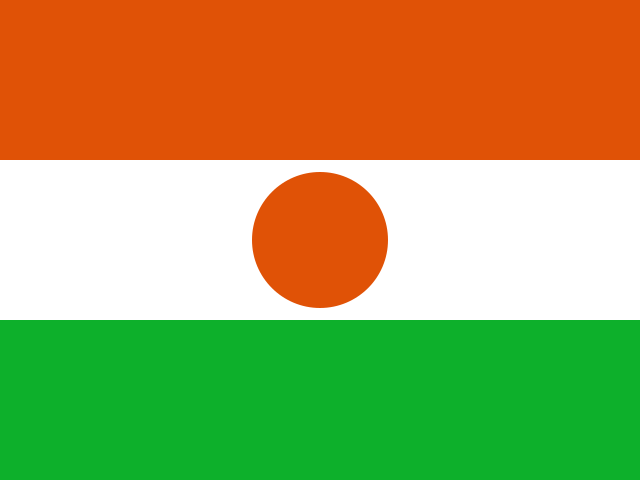
Niger
Niger is overwhelmingly arid, extending from the Sahara in the north through the Sahel to drier savannas in the southwest. The spectacular Aïr Mountains rise from the desert amid volcanic peaks, rocky valleys and surrounding dune seas, while the Ténéré Desert forms one of the Sahara’s most extreme landscapes. In the southwest, the Niger River creates a narrow corridor of wetlands, floodplains and comparatively lush vegetation.
Overview
Niger combines Saharan and Sahelian birdlife with important wetlands along the Niger River. Desert and semi-desert habitats support bustards, sandgrouse, coursers, larks and desert-adapted raptors, while southern savannas add a wider range of West African species. The Niger River wetlands attract herons, storks, ducks, shorebirds and large numbers of Palearctic migrants. W National Park, shared with Benin and Burkina Faso, is an important savanna ecosystem with diverse raptors and waterbirds. Despite its ornithological potential, Niger is currently extremely difficult for birding tourism because of armed conflict, terrorism and political instability. Many important areas, particularly remote desert regions and border zones, are unsuitable for conventional tourism, and specialist birding infrastructure is very limited.
Top 10 target species
| Species | Annual frequency | January | February | March | April | May | June | July | August | September | October | November | December |
|---|---|---|---|---|---|---|---|---|---|---|---|---|---|
| Laughing Dove Spilopelia senegalensis | 46.6% | 48.7% | 85.9% | 37.4% | 36.7% | 55.0% | 46.5% | 37.5% | 52.7% | 23.7% | 16.3% | 82.5% | 36.8% |
| Abyssinian Roller Coracias abyssinicus | 37.9% | 38.3% | 48.9% | 39.1% | 33.6% | 42.5% | 53.7% | 19.9% | 43.3% | 31.9% | 23.2% | 66.3% | 14.5% |
| Red-billed Firefinch Lagonosticta senegala | 36.2% | 43.3% | 66.1% | 23.6% | 47.2% | 30.0% | 22.5% | 23.7% | 49.8% | 17.5% | 30.6% | 50.0% | 30.3% |
| Black Kite Milvus migrans | 33.1% | 38.5% | 46.0% | 27.4% | 18.1% | 25.0% | 34.7% | 16.0% | 37.9% | 31.1% | 33.1% | 77.5% | 12.5% |
| Western Cattle-Egret Ardea ibis | 32.7% | 36.0% | 57.7% | 34.3% | 39.2% | 32.5% | 44.8% | 27.3% | 38.9% | 18.7% | 17.9% | 35.0% | 10.2% |
| Pied Crow Corvus albus | 32.7% | 41.0% | 59.2% | 35.5% | 35.2% | 45.0% | 53.9% | 31.2% | 23.5% | 15.1% | 11.3% | 20.1% | 21.0% |
| Long-tailed Glossy Starling Lamprotornis caudatus | 30.0% | 36.8% | 41.4% | 25.5% | 33.1% | 20.0% | 35.2% | 27.0% | 32.5% | 19.3% | 9.9% | 66.3% | 12.7% |
| African Silverbill Euodice cantans | 29.0% | 37.7% | 37.3% | 25.0% | 34.1% | 22.5% | 19.5% | 15.8% | 36.1% | 16.7% | 17.1% | 51.2% | 34.9% |
| Northern Red-billed Hornbill Tockus erythrorhynchus | 28.8% | 35.7% | 29.2% | 13.4% | 31.4% | 20.0% | 19.5% | 31.0% | 37.7% | 19.3% | 18.3% | 80.0% | 10.1% |
| Speckled Pigeon Columba guinea | 28.1% | 32.1% | 46.0% | 25.5% | 34.1% | 37.5% | 25.2% | 14.1% | 24.0% | 17.7% | 10.0% | 60.0% | 10.6% |