
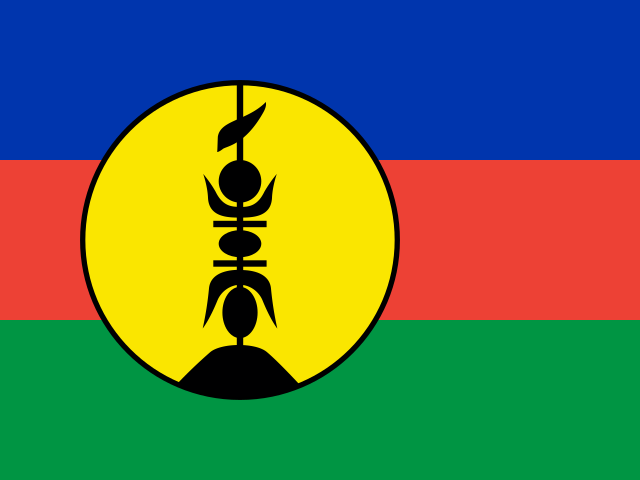
New Caledonia
New Caledonia is a French territory in the southwest Pacific, centred on the mountainous island of Grande Terre and surrounded by smaller islands and coral reefs. Its landscape ranges from humid tropical forest and dry woodland to distinctive ultramafic landscapes, whose mineral-rich soils support highly specialised vegetation found nowhere else. The interior mountains form a rugged spine, while the west is generally drier and the east wetter. Extensive lagoons and coral reefs surround much of the main island, forming one of the territory's defining natural features. New Caledonia is exceptionally rich in endemic plants and has a strong cultural and ecological identity distinct from neighbouring Melanesian islands.
Overview
New Caledonia is a major Pacific endemism hotspot, with the iconic Kagu its best-known bird. This flightless, almost unique forest bird is restricted to New Caledonia and is particularly associated with protected forests such as Parc Provincial de la Rivière Bleue. Other important targets include New Caledonian Imperial-Pigeon, New Caledonian Crow, Cloven-feathered Dove, Horned Parakeet and New Caledonian Whistler. The Grande Terre forests hold most of the key species, while the Isle of Pines and Loyalty Islands add further island-restricted birds. Birding tourism is relatively specialised but access is considerably easier than on many remote Pacific islands, with roads and established protected areas around Nouméa and the southern provinces. For visiting birders, the main attraction is the territory's exceptionally high level of endemism, particularly the chance to see the Kagu in its native forest.
Top 10 target species
| Species | Annual frequency | January | February | March | April | May | June | July | August | September | October | November | December |
|---|---|---|---|---|---|---|---|---|---|---|---|---|---|
| Gray-eared Honeyeater Lichmera incana | 52.5% | 52.3% | 51.7% | 33.7% | 51.1% | 46.6% | 49.0% | 52.0% | 61.7% | 57.0% | 53.2% | 52.6% | 69.3% |
| Green-backed White-eye Zosterops xanthochroa | 42.3% | 34.4% | 37.6% | 26.3% | 38.5% | 43.1% | 53.2% | 49.3% | 52.6% | 46.0% | 42.0% | 39.3% | 45.0% |
| Fan-tailed Gerygone Gerygone flavolateralis | 39.3% | 36.9% | 37.8% | 26.6% | 31.3% | 39.9% | 44.4% | 47.6% | 52.1% | 41.9% | 39.0% | 36.7% | 37.0% |
| Gray Fantail Rhipidura albiscapa | 39.0% | 29.9% | 29.1% | 21.6% | 38.3% | 44.1% | 50.4% | 48.6% | 46.7% | 45.7% | 39.7% | 32.2% | 41.9% |
| New Caledonian Friarbird Philemon diemenensis | 35.4% | 37.0% | 32.9% | 20.5% | 29.1% | 38.1% | 35.6% | 39.9% | 44.4% | 38.3% | 38.2% | 36.8% | 34.0% |
| Satin Swiftlet Collocalia uropygialis | 35.3% | 36.9% | 35.9% | 20.3% | 24.6% | 34.1% | 40.8% | 40.1% | 44.2% | 36.0% | 39.8% | 34.2% | 37.2% |
| Common Myna Acridotheres tristis | 31.1% | 31.1% | 27.2% | 17.7% | 34.7% | 21.0% | 35.2% | 33.4% | 33.9% | 32.3% | 33.7% | 24.5% | 48.4% |
| Sacred Kingfisher Todiramphus sanctus | 28.6% | 30.9% | 22.6% | 15.0% | 18.2% | 19.3% | 32.1% | 32.4% | 35.2% | 33.5% | 34.0% | 30.2% | 39.5% |
| Rufous Whistler Pachycephala rufiventris | 27.9% | 21.9% | 17.8% | 15.7% | 27.2% | 27.6% | 36.1% | 32.8% | 32.8% | 34.9% | 29.4% | 23.4% | 34.8% |
| Striated Starling Aplonis striata | 26.6% | 26.0% | 18.9% | 15.7% | 19.8% | 27.6% | 22.6% | 34.9% | 32.5% | 31.0% | 30.5% | 29.4% | 30.9% |