
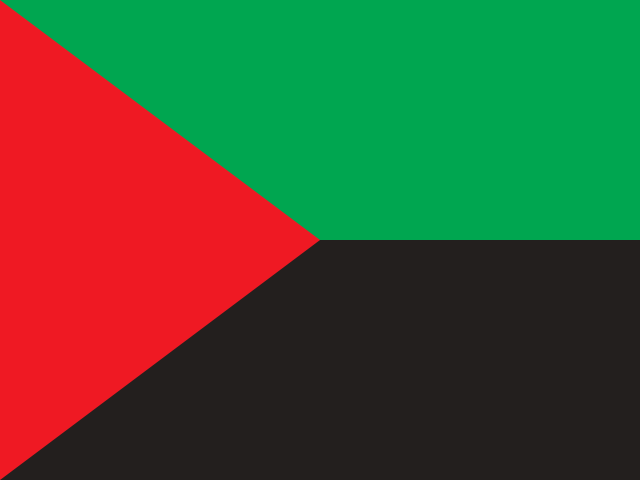
Martinique
Martinique is a volcanic island in the Lesser Antilles, with a striking contrast between its mountainous, humid north and drier, more settled south. Mount Pelée rises to almost 1,400 metres, while the Pitons du Carbet form another major volcanic massif. The northern slopes receive heavy rainfall and support dense tropical rainforest, rivers and waterfalls; the south is generally drier, with hills, scrub and coastal vegetation. Central Martinique contains broad lowlands and extensive agricultural areas, while mangroves form important wetlands along sheltered bays, particularly around Génipa Bay. The island's volcanic geology, steep relief and strong rainfall gradient create a surprisingly varied environment within a relatively small area. Martinique is an overseas region of France, with good roads and infrastructure that make most of the island relatively straightforward to explore.
Overview
Martinique is especially interesting for Lesser Antillean endemics, with one bird found nowhere else: the Martinique Oriole. The island also shares the White-breasted Thrasher with Saint Lucia and the Blue-headed Hummingbird with Dominica. The forests around Mount Pelée and the Pitons du Carbet are the main areas for montane and rainforest birds, while the Caravelle Peninsula is particularly important for the White-breasted Thrasher. Hummingbirds, Bananaquits, mockingbirds and other Caribbean species are widespread, and the mangroves and coastal wetlands add herons, terns and migrant birds. Martinique is not as famous among international birders as some neighbouring islands, but its French infrastructure, good roads and compact size make it relatively easy to explore independently, especially for birders targeting Lesser Antillean specialties.
Top 10 target species
| Species | Annual frequency | January | February | March | April | May | June | July | August | September | October | November | December |
|---|---|---|---|---|---|---|---|---|---|---|---|---|---|
| Carib Grackle Quiscalus lugubris | 66.4% | 75.7% | 69.6% | 74.3% | 75.2% | 58.2% | 63.2% | 69.9% | 64.5% | 54.2% | 64.6% | 61.3% | 66.9% |
| Bananaquit Coereba flaveola | 56.0% | 68.8% | 66.4% | 65.2% | 71.5% | 58.4% | 58.6% | 56.6% | 37.0% | 29.3% | 47.0% | 57.7% | 56.1% |
| Lesser Antillean Bullfinch Loxigilla noctis | 53.4% | 66.1% | 61.7% | 61.1% | 67.5% | 54.3% | 59.6% | 52.6% | 45.8% | 24.0% | 46.3% | 47.4% | 53.7% |
| Zenaida Dove Zenaida aurita | 52.7% | 62.8% | 58.9% | 60.6% | 65.0% | 52.5% | 58.9% | 59.2% | 47.8% | 26.5% | 51.9% | 39.9% | 48.8% |
| Gray Kingbird Tyrannus dominicensis | 45.8% | 45.6% | 39.9% | 36.2% | 48.5% | 40.9% | 53.7% | 59.9% | 47.8% | 42.6% | 52.9% | 42.5% | 39.0% |
| Black-faced Grassquit Melanospiza bicolor | 40.1% | 38.6% | 43.7% | 40.4% | 46.7% | 39.2% | 41.3% | 39.9% | 47.1% | 26.0% | 46.0% | 36.6% | 36.4% |
| Tropical Mockingbird Mimus gilvus | 34.8% | 32.0% | 41.0% | 35.7% | 46.7% | 36.7% | 37.9% | 40.8% | 31.3% | 24.6% | 32.7% | 28.2% | 29.5% |
| Antillean Crested Hummingbird Orthorhyncus cristatus | 31.3% | 38.9% | 38.8% | 27.9% | 41.0% | 31.4% | 30.2% | 25.8% | 27.4% | 17.0% | 27.2% | 35.5% | 33.8% |
| Caribbean Elaenia Elaenia martinica | 29.0% | 23.5% | 33.9% | 21.0% | 33.4% | 33.4% | 36.4% | 40.8% | 34.4% | 23.3% | 22.0% | 23.4% | 22.2% |
| Spectacled Thrush Turdus nudigenis | 24.1% | 12.7% | 17.2% | 17.6% | 31.6% | 28.5% | 41.0% | 36.0% | 33.3% | 22.6% | 18.6% | 14.4% | 15.4% |