
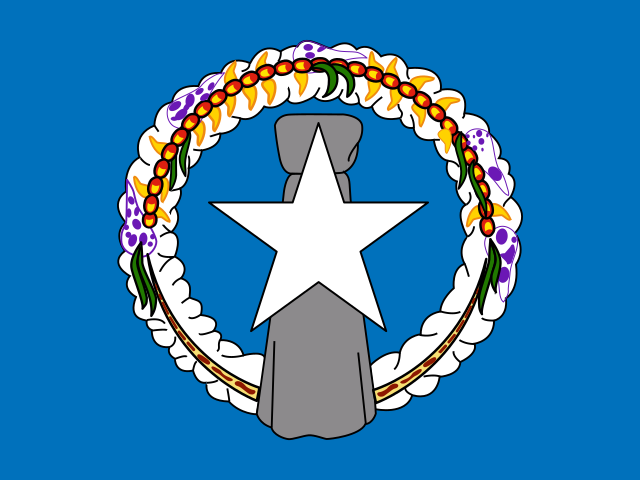
Northern Mariana Islands
The Northern Mariana Islands form a chain of volcanic and limestone islands in western Micronesia, extending north from Guam. Saipan, Tinian and Rota contain most of the population, while the northern islands are increasingly remote, mountainous and volcanic. Saipan combines limestone plateaus, forest, wetlands and heavily developed areas, whereas Rota retains larger areas of native limestone forest. Active volcanoes occur farther north in the archipelago, including on Anatahan and Pagan. The islands have a tropical maritime climate with a pronounced wetter season and are regularly affected by typhoons. Coral reefs and steep offshore waters surround much of the archipelago.
Overview
The Northern Marianas are particularly important for Micronesian endemics and restricted-range island birds. Key targets include Mariana Fruit Dove, Golden White-eye, Saipan Reed Warbler and Mariana Swiftlet, while Rota White-eye is restricted to Rota and is one of the archipelago's rarest birds. Rota's native forests are especially important for endemic species, while Saipan provides comparatively easy access to several specialties. The islands also support Micronesian Megapode and important seabird colonies, particularly on less disturbed northern islands. Saipan and Rota can be birded relatively independently, although local knowledge helps with scarce species. Reaching the remote northern islands is considerably harder and generally requires specialised boat arrangements. For visiting birders, the main attraction is the opportunity to find multiple Mariana endemics within a compact island system.
Top 10 target species
| Species | Annual frequency | January | February | March | April | May | June | July | August | September | October | November | December |
|---|---|---|---|---|---|---|---|---|---|---|---|---|---|
| Blue-billed White-Tern Gygis candida | 67.2% | 74.5% | 72.9% | 66.8% | 65.2% | 72.7% | 64.5% | 69.6% | 60.1% | 56.3% | 59.6% | 70.4% | 73.7% |
| Micronesian Starling Aplonis opaca | 62.8% | 68.2% | 71.0% | 68.0% | 53.3% | 69.6% | 66.1% | 67.9% | 54.7% | 54.9% | 56.8% | 60.9% | 62.0% |
| Mariana Kingfisher Todiramphus albicilla | 62.2% | 66.0% | 62.8% | 62.3% | 50.6% | 62.2% | 62.5% | 66.9% | 62.7% | 63.1% | 61.3% | 61.9% | 63.6% |
| Micronesian Myzomela Myzomela rubratra | 52.9% | 54.1% | 54.5% | 52.9% | 42.7% | 54.7% | 54.4% | 54.4% | 51.2% | 55.8% | 55.3% | 53.5% | 51.4% |
| Eurasian Tree Sparrow Passer montanus | 35.5% | 32.0% | 33.8% | 38.0% | 33.1% | 41.7% | 35.9% | 41.1% | 30.9% | 32.8% | 33.3% | 38.2% | 35.1% |
| Philippine Collared-Dove Streptopelia dusumieri | 34.2% | 39.8% | 38.9% | 35.7% | 26.3% | 32.3% | 32.1% | 32.0% | 29.8% | 33.5% | 36.2% | 35.7% | 38.6% |
| Mariana Fruit-Dove Ptilinopus roseicapilla | 33.2% | 42.5% | 36.4% | 37.4% | 28.6% | 30.7% | 37.8% | 26.9% | 29.3% | 33.2% | 32.7% | 30.5% | 32.0% |
| Micronesian Rufous Fantail Rhipidura versicolor | 32.3% | 34.2% | 34.5% | 29.9% | 24.7% | 37.1% | 41.2% | 34.3% | 27.2% | 29.3% | 34.0% | 31.1% | 30.3% |
| Bridled White-eye Zosterops conspicillatus | 25.9% | 21.2% | 20.9% | 19.1% | 18.1% | 35.9% | 38.9% | 35.4% | 25.5% | 22.7% | 26.0% | 22.1% | 24.8% |
| White-throated Ground Dove Pampusana xanthonura | 25.5% | 23.9% | 19.7% | 22.8% | 21.4% | 31.5% | 33.8% | 36.0% | 21.9% | 22.5% | 24.9% | 22.2% | 25.0% |