
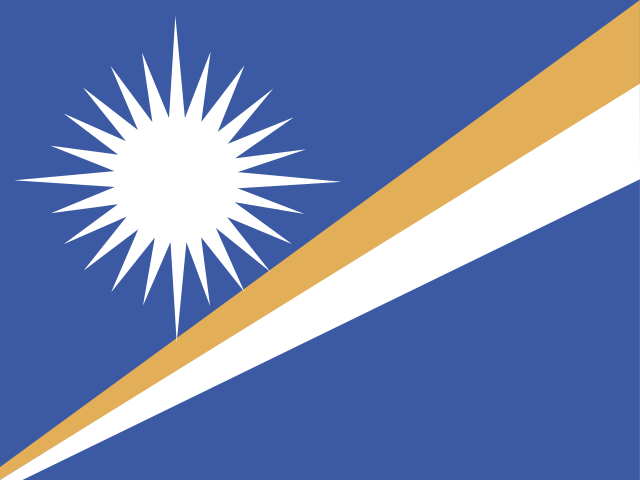
Marshall Islands
The Marshall Islands are a nation of 29 coral atolls and five individual islands scattered across a vast area of the central Pacific. Almost all land is extremely low-lying, typically only a few metres above sea level, with narrow strips of sand and coral surrounding shallow lagoons. Vegetation consists mainly of coconut woodland, coastal scrub and strand vegetation, with no mountains, rivers or extensive freshwater habitats. Majuro and Kwajalein are the principal population centres, while many outer atolls remain sparsely inhabited and comparatively undeveloped. The tropical maritime climate is warm throughout the year, with rainfall generally increasing from the drier northern atolls towards the south. The country's exceptionally low elevation makes it particularly vulnerable to sea-level rise, storm surges and coastal erosion.
Overview
The Marshall Islands are primarily interesting for seabirds, shorebirds and Pacific migrants, rather than endemic land birds. Remote atolls provide breeding habitat for Black Noddy, Brown Noddy, Sooty Tern, White Tern, Brown Booby and Great Frigatebird, while reef flats and lagoons attract Pacific Golden Plover, Wandering Tattler, Ruddy Turnstone and Bristle-thighed Curlew. The latter is a particularly notable Pacific migrant, wintering on remote tropical islands after breeding in Alaska. The relatively developed Majuro Atoll is the easiest place for casual birding, but many of the most intact seabird habitats occur on remote outer atolls. Reaching these can be difficult because domestic flights and boats are limited and irregular. Specialist birding tourism is minimal, so the Marshall Islands are best suited to birders interested in remote Pacific atolls, seabirds and migratory shorebirds rather than a dedicated endemic-focused trip.
Top 10 target species
| Species | Annual frequency | January | February | March | April | May | June | July | August | September | October | November | December |
|---|---|---|---|---|---|---|---|---|---|---|---|---|---|
| Blue-billed White-Tern Gygis candida | 75.6% | 93.7% | 86.3% | 69.8% | 62.6% | 75.4% | 93.1% | 71.7% | 71.4% | 84.5% | 67.4% | 66.4% | 65.3% |
| Pacific Golden-Plover Pluvialis fulva | 71.1% | 92.1% | 86.3% | 79.0% | 42.2% | 49.6% | 73.5% | 66.7% | 46.4% | 68.3% | 81.7% | 94.1% | 72.9% |
| Ruddy Turnstone Arenaria interpres | 63.8% | 79.2% | 72.0% | 64.8% | 38.0% | 53.5% | 74.2% | 59.7% | 32.4% | 72.3% | 78.1% | 78.3% | 62.5% |
| Pacific Reef-Heron Egretta sacra | 54.6% | 76.7% | 44.0% | 55.0% | 18.7% | 45.2% | 63.9% | 73.4% | 40.7% | 54.3% | 58.4% | 68.5% | 56.1% |
| Black Noddy Anous minutus | 49.4% | 31.7% | 34.5% | 41.8% | 66.9% | 60.6% | 39.3% | 68.0% | 55.2% | 80.0% | 48.1% | 31.8% | 35.3% |
| Eurasian Tree Sparrow Passer montanus | 42.9% | 59.6% | 56.5% | 55.9% | 24.8% | 38.6% | 41.9% | 43.0% | 47.5% | 15.4% | 41.7% | 48.7% | 41.1% |
| Brown Noddy Anous stolidus | 38.1% | 23.6% | 26.2% | 37.1% | 41.4% | 53.3% | 74.4% | 42.6% | 24.9% | 62.9% | 24.5% | 22.6% | 24.2% |
| Great Crested Tern Thalasseus bergii | 36.5% | 43.6% | 46.4% | 43.4% | 10.2% | 37.0% | 57.0% | 39.6% | 29.3% | 39.4% | 20.9% | 31.7% | 39.6% |
| Black-naped Tern Sterna sumatrana | 35.5% | 46.1% | 36.0% | 50.6% | 20.6% | 33.4% | 39.3% | 31.5% | 15.6% | 45.3% | 26.4% | 40.3% | 40.3% |
| Eurasian Whimbrel Numenius phaeopus | 32.5% | 52.9% | 44.3% | 46.1% | 10.2% | 17.2% | 29.4% | 20.4% | 12.8% | 13.2% | 52.0% | 57.1% | 34.2% |