
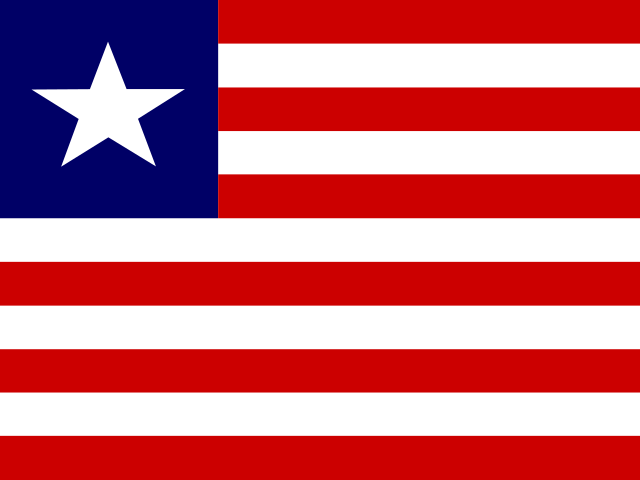
Liberia
Liberia lies at the heart of the Upper Guinea forest zone, with a humid tropical climate and some of West Africa’s largest remaining blocks of rainforest. Its landscape combines a long Atlantic coastline, mangroves and lagoons with rolling forested interior terrain and higher ground toward the Guinea border. Sapo National Park protects the country’s largest area of intact rainforest, while the Nimba Mountains in the north form part of a biologically exceptional transboundary massif.
Overview
Liberia is particularly important for Upper Guinea forest endemics and specialties. Sapo National Park supports rich rainforest communities including hornbills, turacos, greenbuls and elusive species such as Rufous Fishing Owl. The Nimba Mountains are important for restricted-range birds including Nimba Flycatcher and Yellow-bearded Greenbul, while White-necked Picathartes occurs at suitable rocky forest sites. Liberia remains a challenging birding destination with little developed specialist tourism. Local guides are especially valuable, and reaching key forests may require rough roads, long hikes and careful logistical planning. Heavy rains can make access considerably more difficult, but the extensive remaining forests give Liberia exceptional potential for dedicated West African birders.
Top 10 target species
| Species | Annual frequency | January | February | March | April | May | June | July | August | September | October | November | December |
|---|---|---|---|---|---|---|---|---|---|---|---|---|---|
| Common Bulbul Pycnonotus barbatus | 57.5% | 57.9% | 44.8% | 55.4% | 52.2% | 57.4% | 60.7% | 52.8% | 59.1% | 64.8% | 66.9% | 58.8% | 59.0% |
| Pied Crow Corvus albus | 50.3% | 40.8% | 35.0% | 53.4% | 41.9% | 58.2% | 47.1% | 58.4% | 62.9% | 43.5% | 52.9% | 52.7% | 56.8% |
| Red-eyed Dove Streptopelia semitorquata | 39.1% | 47.8% | 40.5% | 43.0% | 27.6% | 28.1% | 26.7% | 30.2% | 42.9% | 38.2% | 40.4% | 49.3% | 54.2% |
| Northern Fiscal Lanius humeralis | 29.4% | 35.9% | 21.4% | 29.5% | 29.3% | 36.0% | 23.0% | 12.6% | 24.6% | 31.9% | 33.1% | 30.8% | 44.1% |
| Black Kite Milvus migrans | 24.9% | 32.9% | 30.2% | 31.9% | 33.4% | 37.1% | 6.0% | 0.5% | 0.7% | 4.9% | 21.8% | 43.7% | 56.0% |
| Blue-spotted Wood-Dove Turtur afer | 23.9% | 29.6% | 18.1% | 24.4% | 20.5% | 26.2% | 15.1% | 9.5% | 24.0% | 23.7% | 33.4% | 34.4% | 27.4% |
| Northern Gray-headed Sparrow Passer griseus | 23.4% | 15.0% | 13.4% | 23.8% | 21.9% | 24.2% | 22.0% | 19.4% | 31.8% | 28.0% | 34.7% | 28.7% | 17.5% |
| Senegal Coucal Centropus senegalensis | 23.4% | 23.5% | 14.4% | 25.4% | 24.3% | 27.7% | 20.5% | 10.2% | 30.1% | 30.4% | 30.7% | 20.2% | 23.0% |
| Bronze Mannikin Spermestes cucullata | 23.1% | 26.1% | 12.6% | 22.9% | 18.3% | 32.9% | 27.3% | 14.7% | 27.6% | 23.2% | 28.8% | 19.6% | 23.1% |
| Village Weaver Ploceus cucullatus | 22.9% | 20.9% | 19.4% | 24.6% | 23.5% | 30.0% | 18.4% | 14.6% | 26.3% | 22.3% | 24.0% | 18.2% | 33.1% |