
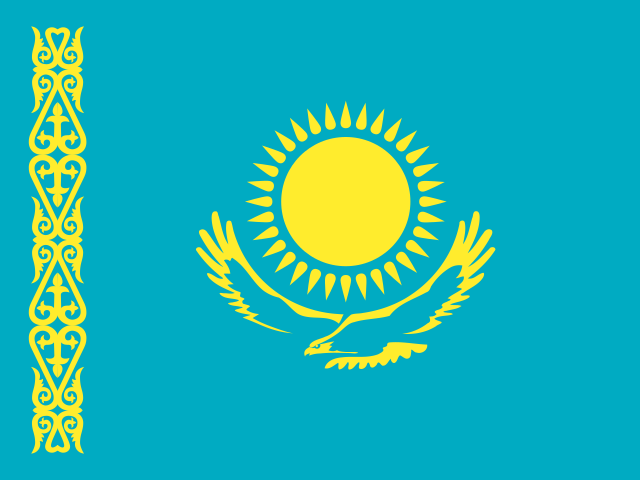
Kazakhstan
Kazakhstan is the world's largest landlocked country, stretching from the Caspian Sea to the Altai Mountains and forming a vast transition between Europe and Central Asia. Much of the country consists of open steppe and semi-desert, interrupted by major wetlands, salt lakes and extensive desert landscapes. The southeast rises dramatically into the Tien Shan Mountains, with alpine meadows, conifer forests and glaciers contrasting with the arid lowlands below. Kazakhstan has a strongly continental climate, with hot, dry summers and very cold winters. Its enormous size and low population density leave large areas sparsely settled, particularly across the central steppe and western deserts.
Overview
Kazakhstan is one of the classic destinations for Central Asian steppe, desert and mountain birds. The Tengiz–Korgalzhyn wetlands are internationally famous for huge waterbird concentrations and the world's northernmost major breeding population of Greater Flamingos. Open steppe supports Demoiselle Crane, Black Lark and Sociable Lapwing, while desert regions offer specialties such as Pallas's Sandgrouse and Macqueen's Bustard. Around Almaty, the Tien Shan provide accessible mountain birding for Himalayan Snowcock, Ibisbill, Guldenstadt's Redstart and various accentors and rosefinches. Kazakhstan has an established specialist birding-tour industry, and many trips combine wetlands, steppe, desert and mountains. Distances are considerable, however, and productive itineraries often involve long drives and specialised guides. Its major attraction is the ability to experience several distinctive Central Asian bird communities within one country.
Top 10 target species
| Species | Annual frequency | January | February | March | April | May | June | July | August | September | October | November | December |
|---|---|---|---|---|---|---|---|---|---|---|---|---|---|
| Eurasian Magpie Pica pica | 37.1% | 44.5% | 48.5% | 44.6% | 24.3% | 28.4% | 31.8% | 26.2% | 30.2% | 33.9% | 41.2% | 43.3% | 47.9% |
| Great Tit Parus major | 33.8% | 49.8% | 60.3% | 48.1% | 17.6% | 16.8% | 17.5% | 16.5% | 19.4% | 21.6% | 37.5% | 48.1% | 52.5% |
| Hooded Crow Corvus cornix | 32.6% | 52.2% | 55.2% | 45.3% | 19.6% | 11.2% | 13.8% | 13.8% | 21.2% | 11.6% | 36.3% | 56.0% | 55.1% |
| Rock Pigeon Columba livia | 29.3% | 31.8% | 34.0% | 31.0% | 23.9% | 22.9% | 25.5% | 25.7% | 30.4% | 29.4% | 29.0% | 32.5% | 35.3% |
| Common Chaffinch Fringilla coelebs | 24.2% | 46.2% | 48.3% | 36.2% | 11.2% | 2.4% | 1.8% | 4.2% | 2.0% | 7.0% | 37.8% | 44.8% | 48.6% |
| Rook Corvus frugilegus | 23.1% | 20.6% | 26.1% | 37.0% | 18.6% | 22.0% | 16.1% | 11.8% | 17.7% | 17.9% | 32.9% | 32.1% | 25.2% |
| Eurasian Tree Sparrow Passer montanus | 21.3% | 26.3% | 30.7% | 26.4% | 15.8% | 11.7% | 18.0% | 19.7% | 18.6% | 7.8% | 20.5% | 31.2% | 29.2% |
| Carrion Crow Corvus corone | 21.1% | 26.2% | 27.8% | 23.6% | 13.7% | 18.7% | 15.0% | 15.7% | 15.6% | 21.7% | 25.0% | 22.1% | 28.0% |
| Eurasian Blackbird Turdus merula | 20.1% | 35.2% | 36.2% | 26.6% | 9.9% | 9.8% | 11.8% | 8.2% | 8.4% | 7.1% | 20.7% | 33.6% | 33.7% |
| Caspian Gull Larus cachinnans | 19.6% | 14.0% | 14.7% | 26.7% | 21.6% | 12.6% | 14.5% | 16.9% | 25.3% | 18.0% | 24.0% | 26.8% | 20.3% |