
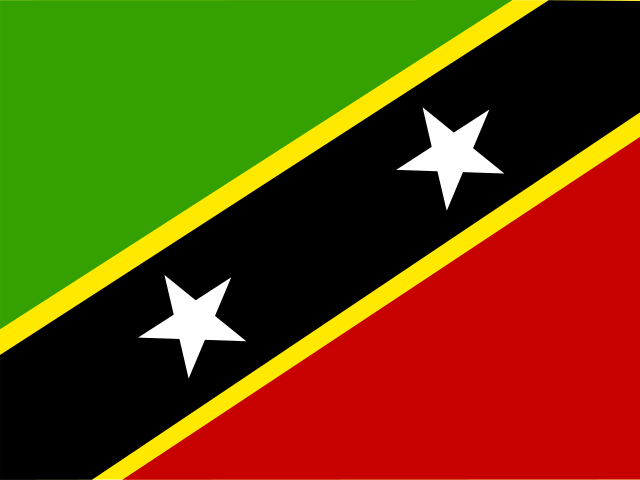
Saint Kitts and Nevis
Saint Kitts and Nevis is a small two-island federation in the Lesser Antilles, with both islands formed around volcanic peaks. Saint Kitts is dominated by Mount Liamuiga and the Central Forest Reserve, where rainforest climbs the central slopes before giving way to drier scrub and coastal landscapes. The Southeast Peninsula is notably drier, with salt ponds, beaches and low vegetation. Nevis is centred on the distinctive volcanic cone of Nevis Peak, surrounded by rainforest and steep upper slopes. The contrast between wet mountain forests and dry coastal habitats is particularly pronounced for such a compact country. Agriculture and tourism are concentrated around the lower elevations, while the higher forest remains comparatively undeveloped.
Overview
Saint Kitts and Nevis are most interesting for Lesser Antillean forest birds, wetlands and migrants rather than country endemics. The moist volcanic slopes support Bridled Quail-Dove, Purple-throated Carib, Lesser Antillean Flycatcher, Brown Trembler and Antillean Euphonia, while the southeast peninsula's salt ponds attract shorebirds and waders. Central Forest Reserve on Saint Kitts and the upper forests of Nevis Peak are the main areas for woodland birds. North American migrants and occasional rarities add interest, particularly during migration. Birding is relatively straightforward on Saint Kitts, with roads and local guides providing access to forest and coastal habitats; Nevis is compact enough to explore easily by car, although reaching its upper forest requires hiking. The islands are best suited to birders combining regional Caribbean species with relaxed island birding, rather than those seeking a large endemic list.
Top 10 target species
| Species | Annual frequency | January | February | March | April | May | June | July | August | September | October | November | December |
|---|---|---|---|---|---|---|---|---|---|---|---|---|---|
| Zenaida Dove Zenaida aurita | 63.7% | 55.7% | 61.5% | 68.1% | 65.4% | 65.7% | 71.4% | 67.8% | 69.8% | 70.6% | 59.1% | 51.6% | 57.8% |
| Gray Kingbird Tyrannus dominicensis | 62.5% | 53.6% | 53.3% | 61.8% | 63.0% | 61.2% | 70.3% | 69.8% | 74.7% | 79.3% | 53.0% | 52.8% | 57.6% |
| Bananaquit Coereba flaveola | 45.4% | 37.5% | 51.5% | 52.7% | 51.6% | 55.6% | 48.0% | 50.7% | 42.0% | 43.5% | 37.9% | 33.8% | 39.8% |
| Common Ground Dove Columbina passerina | 43.8% | 29.6% | 30.8% | 37.5% | 41.2% | 47.2% | 37.6% | 47.6% | 59.3% | 78.8% | 44.2% | 36.3% | 35.1% |
| Brown Pelican Pelecanus occidentalis | 41.3% | 35.4% | 33.3% | 34.8% | 38.8% | 33.7% | 38.5% | 37.8% | 47.7% | 71.0% | 36.3% | 48.3% | 40.5% |
| Lesser Antillean Bullfinch Loxigilla noctis | 40.8% | 29.0% | 39.4% | 42.6% | 41.9% | 51.5% | 47.5% | 50.6% | 45.4% | 47.6% | 32.5% | 30.3% | 31.4% |
| Western Cattle-Egret Ardea ibis | 40.7% | 38.9% | 32.6% | 30.5% | 36.2% | 36.4% | 45.3% | 43.4% | 51.0% | 68.0% | 36.0% | 33.9% | 36.1% |
| Magnificent Frigatebird Fregata magnificens | 39.0% | 37.1% | 33.5% | 27.9% | 36.4% | 35.9% | 36.0% | 42.9% | 49.3% | 52.3% | 38.6% | 42.4% | 36.2% |
| Black-faced Grassquit Melanospiza bicolor | 28.4% | 20.9% | 25.1% | 26.0% | 23.6% | 27.8% | 40.6% | 35.6% | 35.8% | 37.9% | 30.9% | 15.6% | 21.0% |
| Laughing Gull Leucophaeus atricilla | 27.9% | 8.7% | 3.8% | 5.4% | 30.8% | 39.1% | 49.6% | 43.8% | 62.4% | 61.4% | 10.9% | 9.7% | 9.6% |