
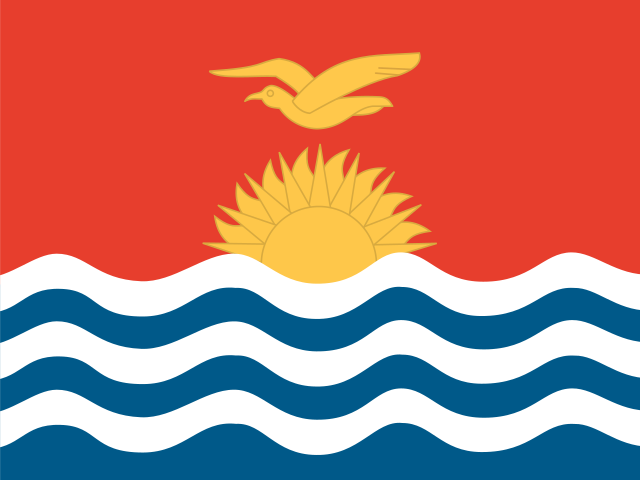
Kiribati
Kiribati is an exceptionally dispersed Pacific nation comprising 33 low-lying coral islands and atolls spread across more than 3 million km² of ocean. Its three island groups—the Gilbert, Phoenix and Line Islands—straddle both the equator and the International Date Line. Most islands consist of narrow strips of coral surrounding lagoons, with coconut palms, coastal scrub and salt-tolerant vegetation but little freshwater or fertile soil. The major exception is Banaba, a raised phosphate island. South Tarawa contains much of the population and is densely settled, contrasting strongly with the remote outer islands. Kiribati's very low elevation leaves it particularly exposed to sea-level rise, coastal erosion, drought and saltwater intrusion.
Overview
Kiribati is primarily a destination for seabirds and migratory shorebirds, with some of the Pacific's most important remote breeding islands. Kiritimati (Christmas Island) supports major colonies of Phoenix Petrel, White-throated Storm Petrel, Sooty Tern, frigatebirds and boobies, while its extensive lagoons and salt flats attract Pacific shorebirds. The Phoenix Islands Protected Area preserves exceptionally remote oceanic islands with internationally important seabird colonies, but access is extremely difficult. Bokikokiko (Kiritimati Reed Warbler), restricted to Kiritimati, is the country's standout endemic land bird. Kiritimati is the most practical destination for birders and has limited accommodation and road access, whereas many other islands require infrequent domestic flights or boat travel. Kiribati is therefore most rewarding for birders seeking remote seabird colonies, Pacific migrants and a highly localised island endemic rather than overall species diversity.
Top 10 target species
| Species | Annual frequency | January | February | March | April | May | June | July | August | September | October | November | December |
|---|---|---|---|---|---|---|---|---|---|---|---|---|---|
| Sooty Tern Onychoprion fuscatus | 45.8% | 19.8% | 57.6% | 42.6% | 47.2% | 37.8% | 43.8% | 75.6% | 47.0% | 62.4% | 35.4% | 51.1% | 29.3% |
| Blue-billed White-Tern Gygis candida | 45.1% | 43.8% | 38.2% | 43.4% | 47.8% | 59.0% | 46.9% | 74.5% | 59.5% | 45.0% | 48.9% | 33.6% | 0.9% |
| Brown Noddy Anous stolidus | 41.9% | 34.4% | 23.3% | 50.0% | 37.5% | 52.6% | 56.3% | 52.8% | 64.3% | 54.3% | 37.4% | 33.6% | 6.7% |
| Great Frigatebird Fregata minor | 39.8% | 45.8% | 34.0% | 79.2% | 46.5% | 26.6% | 53.1% | 26.2% | 47.7% | 42.5% | 30.0% | 37.7% | 8.4% |
| Masked Booby Sula dactylatra | 36.9% | 42.7% | 33.7% | 64.6% | 68.2% | 24.0% | 43.8% | 37.0% | 17.8% | 15.6% | 45.1% | 29.6% | 20.4% |
| Black Noddy Anous minutus | 36.4% | 18.8% | 26.0% | 48.3% | 37.5% | 58.3% | 40.6% | 35.5% | 56.4% | 31.4% | 31.3% | 39.0% | 12.9% |
| Red-footed Booby Sula sula | 36.2% | 31.3% | 31.3% | 36.3% | 29.9% | 47.6% | 46.9% | 53.2% | 44.5% | 40.3% | 37.7% | 28.4% | 6.7% |
| Red-tailed Tropicbird Phaethon rubricauda | 31.5% | 35.4% | 18.1% | 38.8% | 37.3% | 29.6% | 65.6% | 16.9% | 39.9% | 29.3% | 9.8% | 25.1% | 32.1% |
| Phoenix Petrel Pterodroma alba | 29.7% | 61.5% | 17.7% | 33.8% | 25.7% | 18.9% | 25.0% | 38.7% | 56.9% | 34.1% | 14.9% | 22.1% | 7.1% |
| Lesser Frigatebird Fregata ariel | 28.9% | 31.3% | 27.8% | 31.3% | 29.2% | 31.0% | 34.4% | 38.7% | 67.1% | 18.1% | 11.6% | 25.6% | 0.4% |