
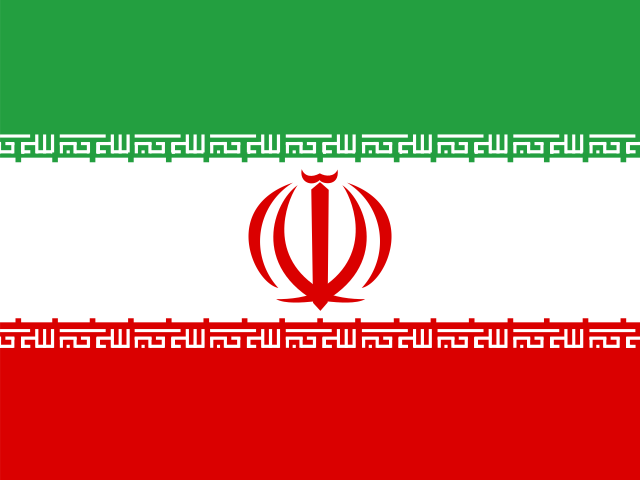
Iran
Iran is a vast country of high plateaus, rugged mountains and deserts between the Caspian Sea and Persian Gulf. The Zagros and Alborz Mountains contain alpine landscapes and extensive oak forests, while the interior includes the extremely arid Dasht-e Kavir and Dasht-e Lut. Along the Caspian coast, humid Hyrcanian forests form a striking contrast to the dry interior. Southern Iran adds subtropical coastlines, mangroves and islands. Climate varies enormously, from snowy mountain winters to some of the world's hottest desert conditions.
Overview
Iran is particularly interesting for Middle Eastern, Central Asian and desert specialties. Key targets include the endemic Pleske's Ground Jay, associated with desert scrub in central Iran, and Caspian Tit in the northern forests. The Zagros Mountains support Persian Wheatear, Eastern Rock Nuthatch and See-see Partridge, while wetlands around the Caspian and Persian Gulf are important for flamingos, pelicans, shorebirds and wintering waterfowl. Miankaleh Peninsula is among the best-known wetland areas. Iran has considerable birding potential but limited international birding infrastructure. Current security conditions, visa requirements and restrictions affecting some foreign travellers can make tourism complicated, so official travel advice is essential before planning a visit.
Top 10 target species
| Species | Annual frequency | January | February | March | April | May | June | July | August | September | October | November | December |
|---|---|---|---|---|---|---|---|---|---|---|---|---|---|
| House Sparrow Passer domesticus | 48.8% | 44.5% | 47.9% | 52.7% | 51.7% | 53.6% | 54.7% | 50.2% | 49.8% | 40.9% | 46.0% | 46.0% | 47.7% |
| Hooded Crow Corvus cornix | 46.3% | 42.4% | 37.2% | 44.7% | 49.4% | 48.1% | 46.9% | 44.3% | 47.5% | 43.9% | 50.3% | 52.0% | 49.2% |
| Eurasian Magpie Pica pica | 43.9% | 39.8% | 34.1% | 40.1% | 43.2% | 47.2% | 44.9% | 41.9% | 45.9% | 44.9% | 47.9% | 51.5% | 45.3% |
| Rock Pigeon Columba livia | 42.1% | 40.1% | 39.3% | 44.0% | 43.1% | 40.9% | 40.3% | 41.4% | 46.6% | 40.8% | 43.7% | 43.5% | 41.8% |
| Laughing Dove Spilopelia senegalensis | 34.9% | 32.1% | 38.8% | 40.1% | 36.7% | 32.9% | 32.3% | 33.2% | 37.4% | 33.6% | 35.0% | 34.3% | 32.2% |
| White Wagtail Motacilla alba | 34.8% | 42.1% | 35.7% | 37.4% | 29.9% | 26.4% | 27.8% | 29.6% | 26.9% | 28.7% | 39.3% | 48.0% | 46.4% |
| Great Tit Parus major | 27.5% | 25.2% | 22.4% | 26.0% | 29.4% | 28.1% | 25.6% | 23.5% | 25.7% | 30.6% | 31.7% | 32.0% | 29.6% |
| European Starling Sturnus vulgaris | 24.3% | 25.0% | 23.9% | 28.7% | 30.4% | 32.5% | 27.5% | 15.6% | 13.0% | 16.3% | 21.8% | 30.0% | 26.4% |
| White-eared Bulbul Pycnonotus leucotis | 23.7% | 26.9% | 30.9% | 31.2% | 25.3% | 18.5% | 15.1% | 18.4% | 19.1% | 19.8% | 24.6% | 26.8% | 27.1% |
| Eurasian Collared-Dove Streptopelia decaocto | 19.3% | 14.5% | 15.8% | 20.1% | 22.4% | 22.4% | 22.1% | 22.5% | 22.1% | 20.4% | 17.9% | 16.2% | 15.2% |