
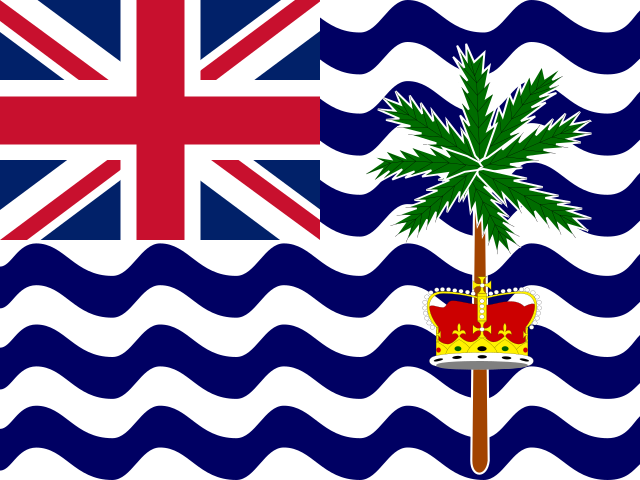
British Indian Ocean Territory
The British Indian Ocean Territory comprises the Chagos Archipelago, a remote group of tropical atolls and more than 50 small islands in the central Indian Ocean. The islands are low-lying and surrounded by extensive coral reefs, lagoons and exceptionally clear oceanic waters. Vegetation consists mainly of coastal scrub, coconut-dominated woodland and native strand vegetation. Diego Garcia, the largest atoll, contains a joint UK–US military facility, while most other islands are uninhabited. The territory is also subject to a sovereignty dispute with Mauritius and an ongoing process concerning its future administration.
Overview
The Chagos Archipelago is primarily important for its large and relatively undisturbed tropical seabird colonies. Outer islands support breeding Red-footed and Brown Boobies, Great and Lesser Frigatebirds, Red-tailed and White-tailed Tropicbirds, noddies, terns and shearwaters, while reefs and lagoons attract migratory shorebirds. Several islands have benefited from rat eradication and habitat restoration, strengthening their value as seabird breeding sites. There are no endemic landbird species, and terrestrial diversity is limited. For birders, the principal issue is access: the territory has no conventional tourism industry, Diego Garcia is a restricted military facility, and visits to the outer islands are tightly controlled. Consequently, despite its ornithological importance, the Chagos Archipelago is not normally accessible as a regular birding destination.
Top 10 target species
| Species | Annual frequency | January | February | March | April | May | June | July | August | September | October | November | December |
|---|---|---|---|---|---|---|---|---|---|---|---|---|---|
| Brown Noddy Anous stolidus | 71.9% | 92.7% | 71.9% | 93.5% | 80.4% | 67.4% | 73.6% | 72.3% | 75.0% | 0.1% | 87.0% | 74.2% | 75.0% |
| Blue-billed White-Tern Gygis candida | 70.6% | 92.7% | 71.9% | 91.4% | 73.2% | 75.1% | 58.3% | 83.0% | 62.5% | 0.0% | 78.4% | 85.7% | 75.0% |
| Red-footed Booby Sula sula | 67.2% | 69.9% | 60.0% | 64.1% | 92.9% | 61.4% | 52.8% | 78.0% | 75.0% | 25.1% | 83.4% | 68.9% | 75.0% |
| Red Fody Foudia madagascariensis | 61.9% | 75.3% | 77.5% | 78.6% | 60.7% | 47.8% | 52.8% | 60.1% | 50.0% | 0.1% | 64.5% | 75.6% | 100.0% |
| Lesser Noddy Anous tenuirostris | 53.3% | 74.0% | 51.9% | 45.6% | 72.0% | 76.9% | 59.0% | 55.7% | 37.5% | 0.1% | 37.1% | 54.8% | 75.0% |
| Great Crested Tern Thalasseus bergii | 49.8% | 72.1% | 86.9% | 55.1% | 48.8% | 25.0% | 43.8% | 34.8% | 75.0% | 0.1% | 46.1% | 52.2% | 58.3% |
| Eurasian Whimbrel Numenius phaeopus | 49.3% | 63.3% | 55.7% | 62.6% | 50.9% | 21.3% | 43.8% | 29.5% | 75.0% | 0.1% | 32.6% | 57.0% | 100.0% |
| Great Frigatebird Fregata minor | 46.4% | 64.2% | 66.7% | 50.7% | 64.3% | 36.8% | 35.4% | 35.1% | 37.5% | 0.0% | 42.3% | 48.6% | 75.0% |
| Little Heron Butorides atricapilla | 42.6% | 74.5% | 84.4% | 64.8% | 48.8% | 21.3% | 37.5% | 27.4% | 12.5% | 0.1% | 25.9% | 60.2% | 54.2% |
| Ruddy Turnstone Arenaria interpres | 40.8% | 54.9% | 50.0% | 58.4% | 57.1% | 20.0% | 23.6% | 22.4% | 37.6% | 0.1% | 32.6% | 63.9% | 68.8% |