
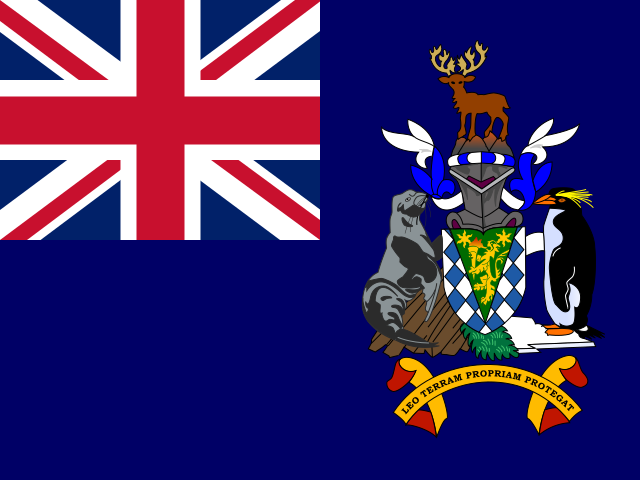
South Georgia and the South Sandwich Islands
South Georgia and the South Sandwich Islands form a remote sub-Antarctic island group in the South Atlantic, roughly halfway between South America and Antarctica. South Georgia is dominated by steep mountains, glaciers and ice-covered valleys, with a narrow coastal zone providing most of the accessible land. The South Sandwich Islands are a chain of volcanic islands farther east, many still covered by glaciers and largely inaccessible. The climate is cold, windy and strongly maritime, with frequent cloud and precipitation. South Georgia's rugged coastline contains numerous sheltered bays and beaches surrounded by mountains and glaciers, creating spectacular contrasts between land and sea. Permanent human settlement is absent, and the islands are managed primarily for conservation and scientific purposes.
Overview
South Georgia is one of the world's great seabird and penguin destinations, famous for enormous breeding colonies. King Penguins occur in huge numbers, particularly at St Andrews Bay, while Gentoo Penguins are widespread along the coast. The island is also a major breeding centre for Wandering and Black-browed Albatrosses, Antarctic Prions, petrels and shags. South Georgia Pipit, the world's southernmost songbird and an endemic species, is another major target. The South Sandwich Islands support important colonies of penguins and seabirds but are rarely visited. Birding tourism is almost entirely expedition-cruise based, with landings dependent on weather, sea conditions and strict conservation regulations. South Georgia is exceptionally rewarding for wildlife-focused birders, but reaching it requires a specialised trip and substantial travel time from South America.
Top 10 target species
| Species | Annual frequency | January | February | March | April | May | June | July | August | September | October | November | December |
|---|---|---|---|---|---|---|---|---|---|---|---|---|---|
| Southern Giant-Petrel Macronectes giganteus | 55.1% | 51.7% | 50.1% | 48.7% | 69.6% | 63.9% | 49.8% | 73.9% | 25.0% | 63.1% | 54.3% | 53.7% | 57.0% |
| Antarctic Tern Sterna vittata | 45.4% | 49.3% | 38.4% | 36.6% | 54.3% | 62.5% | 55.9% | 36.5% | 25.0% | 37.8% | 51.0% | 50.1% | 46.9% |
| Northern Giant-Petrel Macronectes halli | 42.6% | 53.1% | 46.7% | 49.9% | 36.1% | 40.0% | 36.7% | 45.6% | 25.0% | 41.9% | 48.9% | 45.0% | 41.9% |
| Pintado Petrel Daption capense | 41.4% | 33.9% | 18.7% | 8.9% | 43.8% | 58.9% | 44.0% | 67.0% | 25.1% | 61.0% | 41.8% | 50.1% | 43.3% |
| Imperial Cormorant Leucocarbo atriceps | 40.9% | 46.9% | 39.7% | 42.9% | 48.1% | 49.6% | 45.4% | 30.8% | 25.0% | 20.0% | 46.3% | 50.3% | 46.3% |
| Kelp Gull Larus dominicanus | 40.9% | 44.0% | 36.8% | 36.3% | 47.3% | 51.5% | 60.1% | 29.8% | 25.0% | 22.6% | 49.3% | 44.4% | 43.6% |
| King Penguin Aptenodytes patagonicus | 39.4% | 57.5% | 54.2% | 53.9% | 42.0% | 33.5% | 13.1% | 16.3% | 25.0% | 16.3% | 49.5% | 54.6% | 56.9% |
| White-chinned Petrel Procellaria aequinoctialis | 38.5% | 57.4% | 59.2% | 56.6% | 69.7% | 35.3% | 5.6% | 2.1% | 0.0% | 23.4% | 50.4% | 49.3% | 53.6% |
| Brown Skua Stercorarius antarcticus | 38.3% | 50.8% | 44.3% | 46.1% | 50.4% | 42.3% | 28.3% | 5.2% | 25.0% | 23.7% | 44.4% | 50.3% | 49.3% |
| Black-browed Albatross Thalassarche melanophris | 34.6% | 51.4% | 49.4% | 42.3% | 44.9% | 40.7% | 0.0% | 17.6% | 25.0% | 15.3% | 40.9% | 41.9% | 46.2% |