
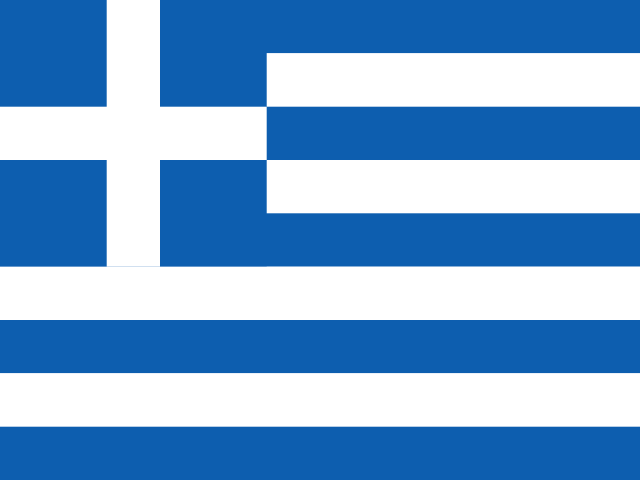
Greece
Greece occupies the southern Balkan Peninsula and thousands of islands scattered across the Aegean and Ionian seas. Much of the mainland is mountainous, with the Pindus range forming its rugged backbone and Mount Olympus reaching the country's highest point. Landscapes range from alpine meadows and extensive forests to Mediterranean scrub, dry rocky hills, agricultural plains, wetlands and long coastlines. Northern Greece contains major river deltas and freshwater lakes, while islands such as Crete have distinctive mountain and Mediterranean ecosystems. The climate is predominantly Mediterranean, with hot, dry summers and wetter winters, becoming cooler and more continental in northern and mountainous regions.
Overview
Greece is particularly rewarding for raptors, Mediterranean specialties, wetlands and migration. Northern sites such as the Evros Delta, Lake Kerkini and Dadia support Dalmatian Pelican, Pygmy Cormorant, eagles and vultures, while spring and autumn bring large numbers of migrants. Crete is famous for Griffon Vultures, Lammergeier and Eleonora's Falcon, and the Aegean islands provide excellent migration birding alongside Rüppell's Warbler, Cinereous Bunting and other eastern Mediterranean specialties. Mountain regions add Rock Partridge, Alpine Chough and Golden Eagle. Greece has good tourism infrastructure and many sites are readily explored independently, although a car is valuable for remote wetlands and mountains. Its location between Europe, Asia and Africa makes migration one of the country's major birding attractions.
Top 10 target species
| Species | Annual frequency | January | February | March | April | May | June | July | August | September | October | November | December |
|---|---|---|---|---|---|---|---|---|---|---|---|---|---|
| Hooded Crow Corvus cornix | 47.4% | 51.9% | 54.1% | 51.2% | 45.8% | 44.9% | 45.4% | 41.1% | 39.2% | 42.3% | 47.4% | 53.2% | 51.9% |
| House Sparrow Passer domesticus | 46.2% | 45.5% | 47.3% | 52.1% | 45.1% | 46.7% | 50.3% | 48.2% | 44.8% | 41.5% | 41.6% | 45.8% | 45.5% |
| Eurasian Collared-Dove Streptopelia decaocto | 45.2% | 46.2% | 47.9% | 50.1% | 43.9% | 40.6% | 44.7% | 44.6% | 47.1% | 44.0% | 41.3% | 45.0% | 47.5% |
| Yellow-legged Gull Larus michahellis | 44.8% | 53.4% | 53.4% | 53.5% | 49.5% | 46.6% | 43.5% | 38.8% | 33.0% | 32.0% | 33.9% | 48.0% | 52.3% |
| Eurasian Magpie Pica pica | 42.3% | 58.3% | 58.0% | 57.5% | 33.3% | 28.8% | 30.2% | 24.6% | 28.6% | 32.0% | 42.6% | 54.4% | 59.4% |
| Common Chaffinch Fringilla coelebs | 35.3% | 58.8% | 57.7% | 48.2% | 23.7% | 24.7% | 21.8% | 12.9% | 13.4% | 14.5% | 31.4% | 56.4% | 60.3% |
| Great Tit Parus major | 34.3% | 38.5% | 42.9% | 43.5% | 35.3% | 31.0% | 25.9% | 21.4% | 25.2% | 32.1% | 38.7% | 38.8% | 38.5% |
| Eurasian Blackbird Turdus merula | 32.6% | 39.9% | 43.7% | 38.5% | 35.1% | 34.8% | 32.6% | 20.8% | 20.5% | 21.8% | 27.6% | 36.8% | 39.3% |
| Rock Pigeon Columba livia | 29.8% | 30.3% | 31.3% | 32.5% | 26.2% | 22.0% | 28.5% | 28.3% | 28.0% | 28.5% | 31.1% | 36.1% | 34.9% |
| Common Buzzard Buteo buteo | 29.0% | 41.7% | 40.7% | 33.7% | 23.5% | 20.3% | 16.9% | 17.8% | 22.7% | 23.5% | 29.1% | 37.5% | 40.7% |