
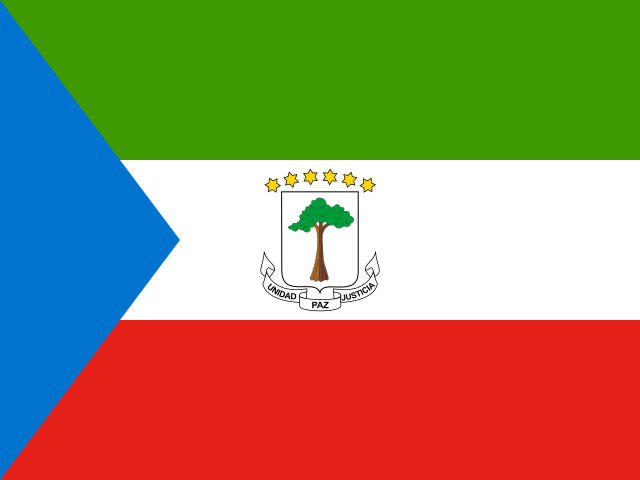
Equatorial Guinea
Equatorial Guinea consists of a mainland region, Río Muni, and several volcanic islands in the Gulf of Guinea. The mainland is dominated by humid Congo Basin rainforest, rivers and low mountains, while Bioko rises steeply from the sea to volcanic peaks above 3,000 metres. Its elevation creates habitats ranging from lowland rainforest to montane forest and high-altitude grassland. The remote island of Annobón, far to the southwest, is another extinct volcano with steep forested slopes and a crater lake. The climate is tropical and generally very wet.
Overview
Equatorial Guinea is particularly important for Gulf of Guinea island endemics and Central African forest birds. Bioko is the principal birding highlight, with specialties including Fernando Po Speirops, Bioko Batis and Bioko Speirops, alongside rich montane and lowland forest communities. Remote Annobón adds highly localized birds such as Annobón White-eye and Annobón Paradise Flycatcher, as well as important seabird colonies. Mainland Río Muni supports typical Congo Basin groups including hornbills, turacos, forest kingfishers and sunbirds. Despite its exceptional potential, Equatorial Guinea has very limited specialist birding tourism. Visa procedures, permits, limited information and difficult access to some protected or remote areas can complicate trips, and Annobón is particularly challenging to reach. Local logistical support is therefore valuable for birders targeting the island endemics.
Top 10 target species
| Species | Annual frequency | January | February | March | April | May | June | July | August | September | October | November | December |
|---|---|---|---|---|---|---|---|---|---|---|---|---|---|
| Pied Crow Corvus albus | 42.0% | 26.0% | 39.7% | 66.7% | 25.0% | 58.8% | 46.3% | 60.7% | 44.8% | 33.1% | 33.4% | 50.5% | 18.9% |
| Village Weaver Ploceus cucullatus | 35.9% | 16.6% | 28.6% | 41.7% | 25.0% | 48.3% | 44.0% | 40.8% | 23.0% | 56.7% | 33.4% | 61.7% | 10.8% |
| Palm-nut Vulture Gypohierax angolensis | 30.2% | 23.0% | 28.6% | 39.9% | 16.7% | 32.5% | 55.8% | 29.7% | 35.9% | 23.1% | 33.4% | 25.2% | 18.8% |
| Bronze Mannikin Spermestes cucullata | 29.6% | 22.2% | 42.0% | 29.2% | 0.0% | 31.8% | 38.1% | 32.8% | 34.8% | 45.6% | 16.7% | 51.7% | 10.6% |
| Black-and-white Mannikin Spermestes bicolor | 28.1% | 11.3% | 16.7% | 25.1% | 19.4% | 31.8% | 53.9% | 26.0% | 15.9% | 48.4% | 41.7% | 36.1% | 10.4% |
| Northern Gray-headed Sparrow Passer griseus | 27.4% | 12.8% | 28.6% | 36.9% | 0.0% | 42.2% | 31.8% | 44.6% | 22.9% | 35.6% | 33.3% | 29.9% | 10.4% |
| Gray Parrot Psittacus erithacus | 27.3% | 39.0% | 28.9% | 50.6% | 25.0% | 6.8% | 36.6% | 25.8% | 31.5% | 7.8% | 8.4% | 18.7% | 48.4% |
| Olive Sunbird Cyanomitra olivacea | 27.0% | 41.4% | 36.9% | 46.4% | 22.2% | 6.1% | 23.0% | 18.7% | 37.2% | 0.0% | 25.0% | 18.7% | 48.9% |
| Red-eyed Dove Streptopelia semitorquata | 26.2% | 19.7% | 33.0% | 29.2% | 25.0% | 6.8% | 24.7% | 37.8% | 38.1% | 28.6% | 25.0% | 22.4% | 24.6% |
| Yellow-billed Turaco Tauraco macrorhynchus | 25.7% | 43.4% | 45.7% | 42.3% | 19.4% | 7.4% | 43.4% | 18.0% | 42.9% | 2.8% | 0.0% | 18.4% | 24.3% |