
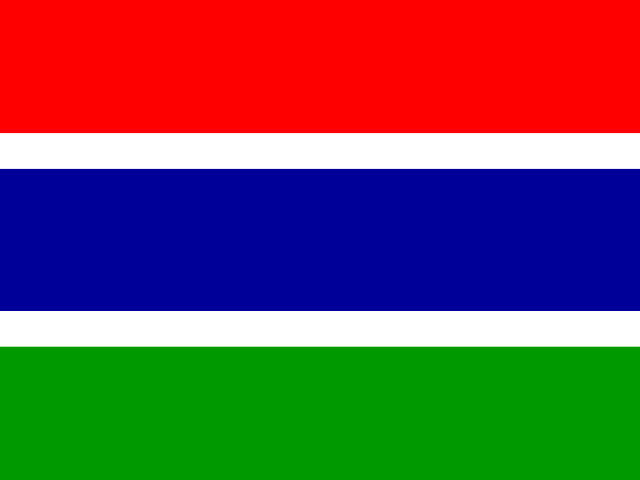
Gambia
The Gambia is a narrow country following the Gambia River inland from the Atlantic coast. Despite its small size, it contains a varied mosaic of mangroves, tidal wetlands, gallery forest, open woodland and savanna. The river and its tributaries dominate the landscape, with vegetation becoming progressively drier toward the east. Its compact geography makes transitions between coastal, wetland and inland habitats particularly accessible.
Overview
The Gambia is one of West Africa’s best-known and most accessible birding destinations, with a long-established network of local bird guides. Productive sites near the coast include Abuko Nature Reserve, Tanji and the Kotu wetlands, where kingfishers, bee-eaters, rollers, sunbirds, waders and raptors can be seen within a small area. Trips upriver add species such as Egyptian Plover, Northern Carmine Bee-eater and African Finfoot, while Marabou Storks and raptors gather around wetlands and savannas. The country is particularly popular for introductory West African birding because many sites are close to tourist accommodation and easily reached. Longer river trips and excursions into eastern Gambia broaden the species list considerably without the logistical difficulties typical of many regional destinations.
Top 10 target species
| Species | Annual frequency | January | February | March | April | May | June | July | August | September | October | November | December |
|---|---|---|---|---|---|---|---|---|---|---|---|---|---|
| Hooded Vulture Necrosyrtes monachus | 52.1% | 49.8% | 43.7% | 48.0% | 45.7% | 64.6% | 70.7% | 56.0% | 50.6% | 56.4% | 51.7% | 44.6% | 43.4% |
| Common Bulbul Pycnonotus barbatus | 49.4% | 42.7% | 39.2% | 42.6% | 45.9% | 64.0% | 68.2% | 57.2% | 47.6% | 57.9% | 43.9% | 41.2% | 41.7% |
| Black Kite Milvus migrans | 47.1% | 51.9% | 47.0% | 48.9% | 41.9% | 65.7% | 67.2% | 48.8% | 36.9% | 41.3% | 32.9% | 36.6% | 46.3% |
| Laughing Dove Spilopelia senegalensis | 46.5% | 38.7% | 36.9% | 41.1% | 36.9% | 57.0% | 56.7% | 47.1% | 58.6% | 50.7% | 55.3% | 40.4% | 38.6% |
| Pied Crow Corvus albus | 46.5% | 38.5% | 33.7% | 40.3% | 42.1% | 62.6% | 65.8% | 52.3% | 48.2% | 55.3% | 47.0% | 35.2% | 36.5% |
| Western Plantain-eater Crinifer piscator | 46.1% | 37.5% | 35.2% | 38.5% | 42.6% | 64.9% | 64.1% | 52.8% | 48.9% | 51.7% | 43.6% | 36.6% | 37.4% |
| Village Weaver Ploceus cucullatus | 44.4% | 30.8% | 30.6% | 33.3% | 41.2% | 61.8% | 60.7% | 60.5% | 52.9% | 51.2% | 45.2% | 35.2% | 30.0% |
| Red-eyed Dove Streptopelia semitorquata | 43.8% | 36.0% | 31.7% | 36.9% | 40.6% | 62.9% | 61.4% | 51.1% | 46.5% | 48.3% | 41.7% | 33.9% | 34.8% |
| Speckled Pigeon Columba guinea | 40.8% | 32.0% | 29.5% | 34.1% | 31.8% | 54.7% | 54.2% | 45.1% | 44.9% | 55.6% | 41.2% | 34.7% | 31.3% |
| Beautiful Sunbird Cinnyris pulchellus | 36.0% | 36.7% | 34.3% | 32.7% | 29.4% | 34.9% | 35.6% | 37.0% | 41.1% | 44.1% | 42.0% | 31.4% | 32.7% |