
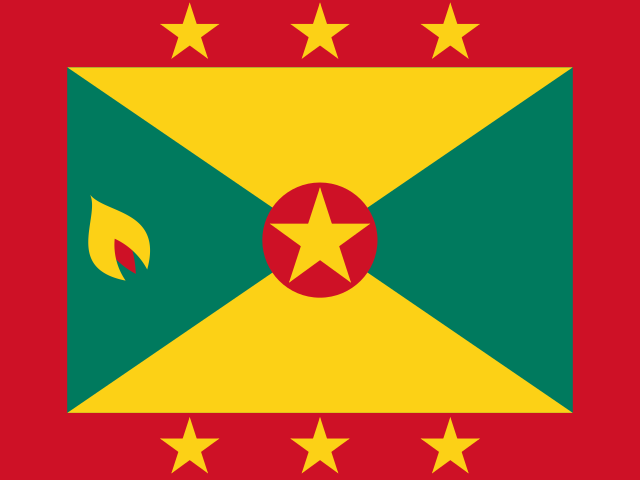
Grenada
Grenada is the southernmost of the Windward Islands, a volcanic island group that also includes Carriacou and Petite Martinique. The main island rises from dry coastal lowlands into a mountainous, forested interior, with Mount St. Catherine reaching 840 metres. Ancient volcanic craters, rainforest, mangroves and sheltered coastal bays create considerable variety despite the country's compact size. The northern islands are generally drier and more exposed, while the interior of Grenada receives substantially more rainfall. Grand Etang is the centre of the island's upland landscape, surrounding a crater lake and extensive forest reserve. Grenada's tropical climate is moderated by trade winds, with a relatively dry period from January to May and wetter conditions later in the year.
Overview
Grenada is particularly interesting for Lesser Antillean birds and its critically endangered endemic Grenada Dove. The dove is restricted to Grenada and is most closely associated with remaining dry-forest habitat around Mount Hartman and the southwest. Another island endemic is the Grenada Hook-billed Kite, while Grenada Flycatcher and Grenada Wren are also distinctive targets. Grand Etang National Park provides accessible rainforest birding, with species including Rufous-breasted Hermit, Antillean Crested Hummingbird, Lesser Antillean Tanager and Cocoa Thrush. Levera National Park adds coastal wetlands and migratory waterbirds. Grenada has a relatively small but established birding infrastructure, with trails and visitor facilities at Grand Etang and local guides available. For serious birders, the main attraction is the chance to combine Lesser Antillean forest birds with one of the Caribbean's rarest endemic species.
Top 10 target species
| Species | Annual frequency | January | February | March | April | May | June | July | August | September | October | November | December |
|---|---|---|---|---|---|---|---|---|---|---|---|---|---|
| Bananaquit Coereba flaveola | 68.7% | 68.4% | 70.8% | 70.2% | 69.4% | 79.9% | 65.1% | 67.9% | 69.6% | 64.0% | 65.2% | 68.1% | 66.0% |
| Tropical Mockingbird Mimus gilvus | 60.6% | 55.2% | 53.2% | 54.2% | 57.0% | 63.2% | 66.0% | 71.9% | 66.4% | 64.5% | 59.2% | 62.0% | 55.2% |
| Gray Kingbird Tyrannus dominicensis | 59.1% | 54.7% | 53.9% | 54.1% | 59.3% | 67.2% | 59.8% | 62.9% | 64.1% | 62.6% | 58.2% | 58.9% | 54.0% |
| Scaly-naped Pigeon Patagioenas squamosa | 49.1% | 35.5% | 28.2% | 33.3% | 41.9% | 64.0% | 71.3% | 72.4% | 65.8% | 56.7% | 50.1% | 35.7% | 34.6% |
| Antillean Crested Hummingbird Orthorhyncus cristatus | 43.9% | 46.3% | 46.7% | 43.1% | 41.3% | 50.8% | 44.3% | 39.4% | 46.4% | 37.3% | 41.4% | 43.9% | 46.3% |
| Common Ground Dove Columbina passerina | 42.6% | 37.1% | 33.5% | 38.3% | 38.4% | 44.4% | 47.5% | 48.4% | 54.0% | 49.8% | 47.4% | 38.1% | 34.6% |
| Eared Dove Zenaida auriculata | 42.6% | 39.0% | 39.7% | 38.7% | 39.8% | 41.6% | 49.4% | 54.0% | 48.4% | 49.5% | 43.5% | 36.0% | 31.5% |
| Spectacled Thrush Turdus nudigenis | 39.9% | 34.7% | 37.3% | 37.0% | 39.4% | 51.9% | 46.2% | 44.0% | 49.1% | 37.1% | 34.0% | 35.1% | 33.6% |
| Magnificent Frigatebird Fregata magnificens | 39.3% | 38.0% | 28.3% | 32.9% | 34.8% | 29.0% | 43.1% | 49.4% | 44.8% | 42.8% | 50.5% | 38.8% | 39.5% |
| Black-faced Grassquit Melanospiza bicolor | 38.4% | 41.7% | 39.9% | 35.7% | 35.4% | 36.4% | 38.4% | 39.3% | 43.1% | 42.6% | 38.5% | 35.5% | 33.6% |