
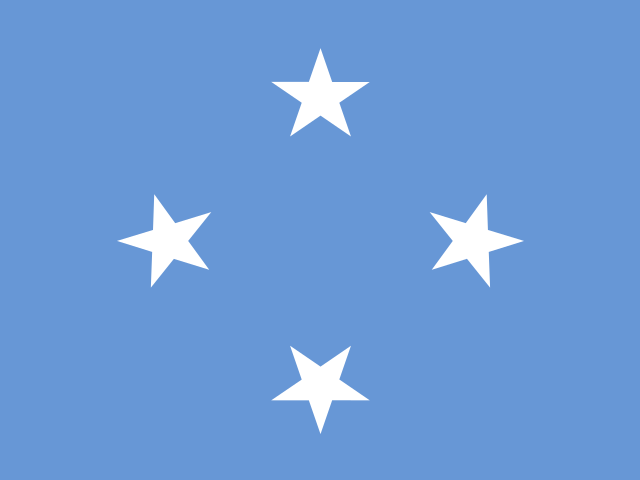
Micronesia
The Federated States of Micronesia stretch across a vast area of the western Pacific, comprising more than 600 islands grouped into the states of Yap, Chuuk, Pohnpei and Kosrae. The islands vary from tiny coral atolls to steep, volcanic high islands covered in tropical rainforest. Pohnpei and Kosrae are particularly mountainous and exceptionally wet, with dense forests, rivers and mangroves, while Yap combines rolling forested terrain with extensive coastal mangroves. Chuuk is centred on a large lagoon surrounded by volcanic islands and barrier reefs. Despite the country's enormous ocean territory, its total land area is small and highly fragmented. Travel between the four states generally requires flights, and reaching outer islands can involve infrequent boats or small aircraft.
Overview
Micronesia is particularly rewarding for island endemics, with each major island group contributing different specialties. Pohnpei holds Pohnpei Lorikeet, Pohnpei Kingfisher and Pohnpei Flycatcher, while Kosrae is home to the Kosrae White-eye and other distinctive island forms. Yap adds Yap Monarch and Yap Cicadabird, making inter-island travel necessary for birders seeking the country's full endemic complement. Forests also support fruit doves, honeyeaters and swiftlets, while atolls and coastal areas provide seabirds and migratory shorebirds. Birding tourism is limited, and there are relatively few specialist services compared with Palau or more established Pacific destinations. The main challenge is logistics rather than difficult terrain: flights between states can be limited, and outer islands are much harder to reach. For dedicated birders, the attraction lies in collecting a series of highly localised Micronesian specialties across several isolated island groups.
Top 10 target species
| Species | Annual frequency | January | February | March | April | May | June | July | August | September | October | November | December |
|---|---|---|---|---|---|---|---|---|---|---|---|---|---|
| Micronesian Starling Aplonis opaca | 60.1% | 29.7% | 68.9% | 67.4% | 51.9% | 66.4% | 86.3% | 51.2% | 65.2% | 43.4% | 48.8% | 60.9% | 80.6% |
| Micronesian Myzomela Myzomela rubratra | 59.0% | 55.3% | 74.2% | 56.4% | 53.8% | 64.4% | 72.3% | 43.8% | 62.0% | 45.9% | 47.5% | 57.1% | 75.9% |
| Blue-billed White-Tern Gygis candida | 44.1% | 35.4% | 47.5% | 58.3% | 56.9% | 55.1% | 25.7% | 32.5% | 49.0% | 35.0% | 46.6% | 48.6% | 38.3% |
| Caroline Islands Swiftlet Aerodramus inquietus | 41.7% | 30.6% | 49.2% | 37.7% | 38.1% | 30.8% | 61.7% | 41.3% | 43.0% | 43.4% | 46.0% | 33.1% | 46.1% |
| Brown Noddy Anous stolidus | 31.3% | 14.4% | 40.7% | 55.3% | 49.9% | 40.4% | 26.0% | 22.5% | 23.8% | 26.7% | 10.5% | 29.1% | 36.4% |
| Pohnpei Lorikeet Trichoglossus rubiginosus | 31.0% | 15.0% | 22.1% | 25.8% | 13.4% | 21.3% | 55.2% | 47.5% | 27.2% | 35.0% | 6.5% | 40.5% | 62.6% |
| Pacific Golden-Plover Pluvialis fulva | 28.2% | 33.2% | 30.4% | 34.3% | 26.7% | 14.7% | 7.2% | 17.5% | 13.9% | 40.0% | 42.9% | 35.0% | 42.1% |
| White-tailed Tropicbird Phaethon lepturus | 28.0% | 21.2% | 18.6% | 36.2% | 27.2% | 22.9% | 16.4% | 32.5% | 36.1% | 36.7% | 11.2% | 31.3% | 45.5% |
| Purple-capped Fruit-Dove Ptilinopus ponapensis | 25.2% | 6.8% | 33.4% | 19.3% | 26.7% | 13.0% | 38.1% | 41.3% | 18.3% | 25.0% | 9.3% | 22.6% | 49.0% |
| Eurasian Tree Sparrow Passer montanus | 25.0% | 18.6% | 9.4% | 25.3% | 12.7% | 43.0% | 36.9% | 27.5% | 19.5% | 32.5% | 6.3% | 31.3% | 37.3% |