
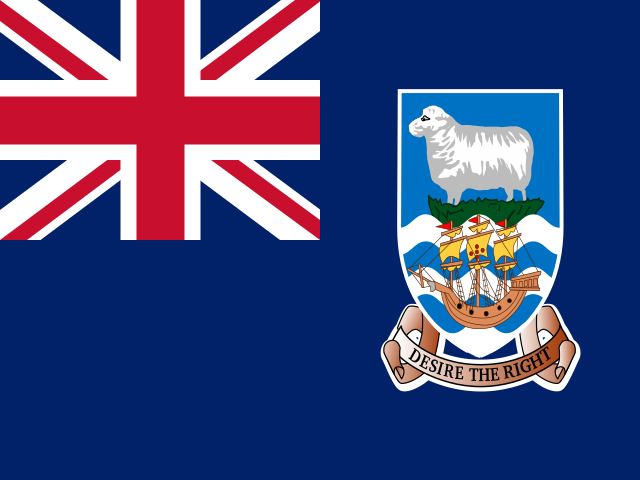
Falkland Islands
The Falkland Islands are a remote South Atlantic archipelago of more than 700 islands, lying about 500 km east of southern Patagonia. The landscape is predominantly open, with windswept grasslands, peatlands, rocky hills, sandy beaches and sheltered bays rather than forests. East and West Falkland are the two principal islands and contain most of the population and infrastructure. The cool maritime climate is strongly influenced by the surrounding ocean, with frequent winds and relatively small seasonal temperature differences. Much of the interior remains sparsely populated, while the coastline is deeply indented and supports extensive wildlife habitat. The islands' isolation has produced a distinctive sub-Antarctic environment, while their position between South America and Antarctica gives them a strong maritime character.
Overview
The Falklands are exceptional for penguins and other South Atlantic seabirds, with several species breeding in spectacular colonies. King Penguin is the major attraction at sites such as Volunteer Point, while Rockhopper, Gentoo and Magellanic Penguins are also widespread. Black-browed Albatross forms major breeding colonies, particularly on Steeple Jason and Grand Jason, and Imperial Shag, Falkland Steamer Duck and Falkland Grass Wren add distinctive local species. Saunders Island and Sea Lion Island are among the best-known wildlife destinations. Birding is highly accessible at established wildlife sites, but reaching remote islands usually requires small aircraft or boat transfers and organised accommodation. For a birder interested in penguins, albatrosses and South Atlantic seabirds, the Falklands are one of the region's standout destinations.
Top 10 target species
| Species | Annual frequency | January | February | March | April | May | June | July | August | September | October | November | December |
|---|---|---|---|---|---|---|---|---|---|---|---|---|---|
| Upland Goose Chloephaga picta | 64.9% | 51.7% | 58.3% | 58.4% | 67.1% | 73.2% | 65.3% | 69.8% | 66.4% | 70.6% | 72.3% | 64.7% | 60.8% |
| Kelp Gull Larus dominicanus | 60.2% | 50.8% | 54.5% | 49.1% | 53.9% | 64.2% | 67.8% | 69.9% | 76.1% | 65.1% | 60.2% | 57.9% | 53.1% |
| Southern Giant-Petrel Macronectes giganteus | 58.8% | 55.9% | 57.3% | 55.3% | 61.0% | 60.7% | 56.0% | 63.0% | 55.5% | 65.7% | 53.8% | 61.2% | 59.7% |
| Turkey Vulture Cathartes aura | 45.8% | 40.1% | 41.7% | 38.8% | 40.2% | 52.4% | 48.2% | 51.7% | 54.4% | 45.9% | 45.4% | 46.6% | 44.5% |
| Austral Thrush Turdus falcklandii | 44.3% | 32.6% | 33.5% | 35.7% | 51.9% | 54.4% | 43.8% | 47.2% | 46.2% | 51.1% | 46.7% | 46.0% | 42.2% |
| Falkland Steamer-Duck Tachyeres brachypterus | 44.1% | 44.6% | 44.6% | 42.2% | 39.3% | 51.3% | 46.4% | 45.4% | 40.3% | 39.6% | 42.4% | 47.8% | 45.2% |
| Magellanic Cormorant Leucocarbo magellanicus | 41.7% | 36.9% | 41.8% | 42.6% | 45.7% | 51.7% | 42.6% | 48.3% | 36.8% | 37.1% | 37.4% | 42.0% | 38.0% |
| Dark-faced Ground-Tyrant Muscisaxicola maclovianus | 40.8% | 28.9% | 34.4% | 36.4% | 44.6% | 51.8% | 48.9% | 49.5% | 44.3% | 41.6% | 37.3% | 37.3% | 33.9% |
| Dolphin Gull Leucophaeus scoresbii | 37.7% | 37.1% | 38.6% | 32.1% | 36.2% | 45.5% | 38.0% | 44.0% | 36.4% | 35.0% | 32.8% | 36.8% | 39.4% |
| Imperial Cormorant Leucocarbo atriceps | 37.6% | 35.5% | 41.3% | 38.7% | 44.6% | 42.7% | 40.8% | 40.7% | 30.9% | 26.1% | 32.3% | 40.8% | 36.5% |