
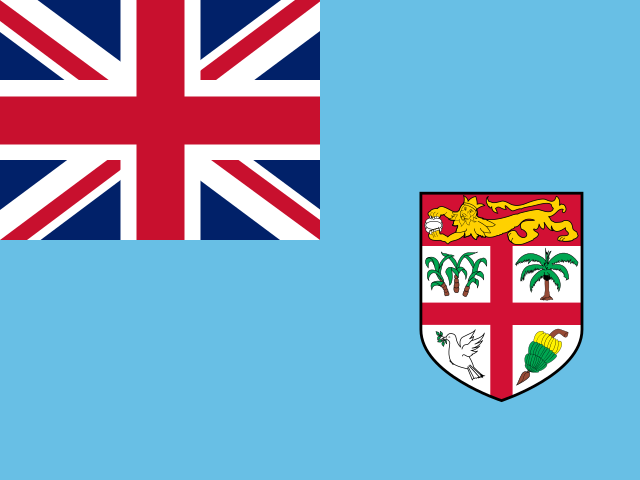
Fiji
Fiji is a Melanesian archipelago of more than 300 islands, centred on the larger volcanic islands of Viti Levu and Vanua Levu. The landscape ranges from rugged mountains and dense tropical rainforest to mangroves, coastal plains and extensive coral reefs. Smaller islands and offshore cays add considerable geographical variety, with many surrounded by shallow lagoons and reef systems. Fiji has a warm tropical maritime climate, moderated by the surrounding ocean, with a wetter season generally from November to April and a drier period during the southern winter. Its isolated position in the southwest Pacific has produced a distinctive natural environment and strong island-to-island variation. Tourism is an important part of the economy, particularly around the main islands and resort areas, while many smaller islands remain sparsely populated.
Overview
Fiji's main birding attraction is its endemic Pacific island birdlife. Notable targets include Collared Lory, Orange Fruit Dove, Fiji Parrotfinch, Pink-billed Parrotfinch, Kadavu Shining Parrot and Kadavu Honeyeater. Taveuni is particularly important for forest birds, while Kadavu holds several species restricted to that island. Viti Levu offers the broadest range of accessible birding sites, including forest around the central highlands. Coastal wetlands and smaller islands add seabirds and migratory shorebirds. Fiji has a modest but growing birding-tourism infrastructure, with local guides available, although specialist species often require early starts and forest trails. Inter-island travel can be necessary for island endemics, making Fiji particularly rewarding for birders interested in restricted-range species rather than sheer species numbers.
Top 10 target species
| Species | Annual frequency | January | February | March | April | May | June | July | August | September | October | November | December |
|---|---|---|---|---|---|---|---|---|---|---|---|---|---|
| Common Myna Acridotheres tristis | 43.9% | 41.9% | 50.6% | 51.9% | 49.1% | 32.6% | 49.2% | 34.2% | 41.2% | 45.2% | 43.7% | 39.2% | 47.5% |
| Red-vented Bulbul Pycnonotus cafer | 42.7% | 41.4% | 47.9% | 44.7% | 43.6% | 32.9% | 47.3% | 36.3% | 37.8% | 43.9% | 46.7% | 40.2% | 49.1% |
| Vanikoro Flycatcher Myiagra vanikorensis | 34.7% | 31.3% | 32.7% | 29.9% | 38.0% | 25.8% | 37.7% | 34.5% | 40.7% | 39.8% | 32.5% | 37.5% | 35.5% |
| White-rumped Swiftlet Aerodramus spodiopygius | 33.8% | 28.1% | 29.8% | 31.6% | 33.4% | 25.9% | 41.7% | 34.9% | 43.5% | 38.5% | 33.4% | 34.9% | 29.4% |
| Sulphur-breasted Myzomela Myzomela jugularis | 33.5% | 31.5% | 34.0% | 30.3% | 31.5% | 25.6% | 34.7% | 34.8% | 41.5% | 35.9% | 36.7% | 36.7% | 29.2% |
| Jungle Myna Acridotheres fuscus | 32.1% | 36.8% | 32.1% | 30.5% | 32.8% | 21.4% | 33.0% | 23.4% | 28.0% | 33.5% | 34.9% | 36.9% | 41.3% |
| Pacific Kingfisher Todiramphus sacer | 27.8% | 32.5% | 30.5% | 26.0% | 30.6% | 17.6% | 24.6% | 23.0% | 32.8% | 28.0% | 26.9% | 31.6% | 29.7% |
| Barking Imperial-Pigeon Ducula latrans | 26.5% | 23.7% | 26.4% | 22.4% | 24.8% | 21.9% | 28.0% | 25.1% | 34.8% | 29.2% | 27.5% | 31.2% | 23.4% |
| Polynesian Triller Lalage maculosa | 25.4% | 21.3% | 19.6% | 19.7% | 22.6% | 18.5% | 28.3% | 24.3% | 34.1% | 31.3% | 27.8% | 33.9% | 23.1% |
| Spotted Dove Spilopelia chinensis | 25.2% | 25.9% | 23.4% | 26.8% | 28.6% | 21.1% | 29.5% | 21.3% | 25.7% | 27.9% | 23.6% | 23.1% | 25.8% |