
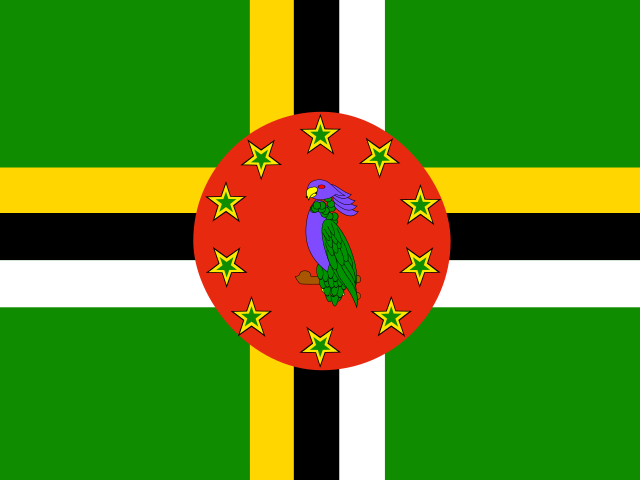
Dominica
Dominica is one of the most mountainous and heavily forested islands in the Caribbean, earning its reputation as the “Nature Island.” Volcanic peaks dominate the interior, including Morne Diablotins, the country's highest point, while steep valleys, rivers and waterfalls descend towards a rugged coastline. Much of the interior remains covered by humid rainforest, with Morne Trois Pitons National Park protecting a particularly extensive and intact landscape. The island's high rainfall and volcanic soils support lush vegetation, while the coast and lower valleys become somewhat drier. Dominica has relatively little flat land and less intensive development than many neighbouring islands, giving its natural landscapes an unusually continuous character. Its steep terrain also means that many of the best habitats are reached on foot rather than by road.
Overview
Dominica is particularly important for Lesser Antillean rainforest birds, with the Imperial Parrot and Red-necked Parrot the two standout species. Both are endemic to Dominica and associated with the island's mountainous forests; the Imperial Parrot is especially rare and difficult to find. Morne Diablotins National Park and the Syndicate Nature Trail are among the best-known areas for forest birding and are particularly important for the parrots. Dominica also supports Blue-headed Hummingbird, Purple-throated Carib, Brown Trembler and Lesser Antillean Flycatcher, while coastal habitats add seabirds and migrants. Birding tourism is relatively small, but specialist local guides can greatly improve the chances of finding the endemic parrots. The steep, wet terrain makes this a destination where hiking is an important part of birding, and conditions can be muddy even during otherwise favourable periods. For serious Caribbean birders, Dominica is one of the most rewarding islands for endemic montane species.
Top 10 target species
| Species | Annual frequency | January | February | March | April | May | June | July | August | September | October | November | December |
|---|---|---|---|---|---|---|---|---|---|---|---|---|---|
| Bananaquit Coereba flaveola | 59.6% | 63.6% | 62.6% | 65.5% | 65.7% | 65.9% | 56.2% | 56.3% | 59.1% | 34.5% | 60.5% | 63.4% | 62.2% |
| Lesser Antillean Bullfinch Loxigilla noctis | 51.1% | 51.4% | 55.9% | 55.6% | 55.1% | 51.2% | 49.2% | 60.6% | 43.7% | 39.3% | 47.1% | 51.1% | 52.6% |
| Gray Kingbird Tyrannus dominicensis | 43.6% | 47.6% | 42.3% | 42.4% | 46.6% | 48.4% | 39.9% | 44.9% | 53.0% | 32.4% | 34.6% | 45.1% | 46.2% |
| Black-faced Grassquit Melanospiza bicolor | 39.5% | 36.2% | 32.5% | 34.9% | 41.8% | 50.0% | 38.0% | 42.7% | 49.6% | 41.2% | 35.9% | 37.5% | 33.2% |
| Antillean Crested Hummingbird Orthorhyncus cristatus | 36.3% | 44.9% | 42.7% | 41.7% | 40.8% | 31.2% | 31.5% | 35.7% | 27.2% | 24.0% | 34.2% | 42.7% | 38.7% |
| Magnificent Frigatebird Fregata magnificens | 32.8% | 28.6% | 26.6% | 30.1% | 39.3% | 40.7% | 29.2% | 33.1% | 40.6% | 25.3% | 35.5% | 31.8% | 32.9% |
| Zenaida Dove Zenaida aurita | 32.1% | 25.4% | 29.7% | 34.6% | 41.4% | 49.8% | 31.9% | 32.1% | 37.2% | 28.8% | 29.3% | 20.2% | 25.0% |
| Caribbean Elaenia Elaenia martinica | 30.1% | 29.6% | 28.4% | 31.8% | 36.2% | 33.4% | 32.1% | 37.3% | 32.9% | 36.2% | 16.5% | 19.9% | 26.8% |
| Broad-winged Hawk Buteo platypterus | 29.3% | 30.8% | 33.6% | 38.1% | 32.5% | 29.0% | 26.3% | 28.0% | 18.2% | 20.3% | 35.8% | 29.0% | 30.4% |
| Purple-throated Carib Eulampis jugularis | 26.2% | 24.9% | 24.7% | 28.7% | 27.5% | 22.1% | 34.2% | 28.7% | 25.0% | 18.4% | 29.5% | 25.9% | 25.1% |