
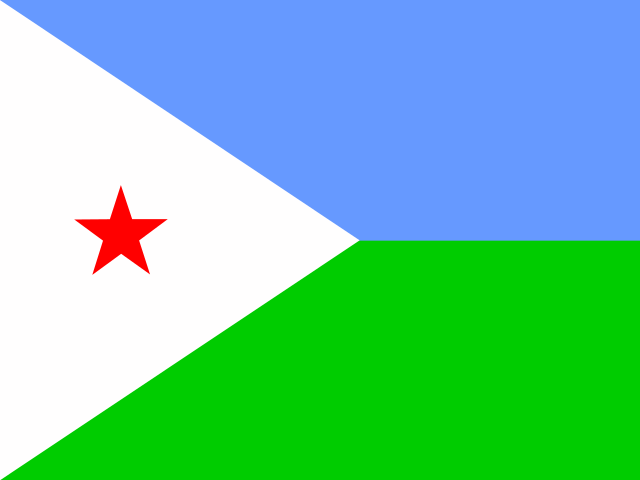
Djibouti
Djibouti lies at the junction of the Red Sea and Gulf of Aden, where the African and Arabian tectonic plates are pulling apart. Its stark landscapes include volcanic mountains, lava fields, salt flats and extremely arid desert. Lake Assal, more than 150 metres below sea level, occupies a dramatic volcanic basin, while the Goda Mountains rise above 1,700 metres and retain isolated patches of woodland. The coastline includes bays, mangroves, mudflats and coral reefs. Djibouti is among the world's hottest and driest countries, with permanent vegetation concentrated mainly in mountains, wadis and coastal areas.
Overview
Djibouti's standout bird is the Djibouti Francolin, an endangered endemic restricted to remnant woodland in the Forêt du Day in the Goda Mountains. These highlands also support other regional specialties, while the surrounding deserts hold larks, wheatears, coursers and sandgrouse. Djibouti's position beside the Bab-el-Mandeb Strait makes it important for migration between Eurasia and Africa, particularly for soaring raptors. Coastal wetlands and mangroves attract flamingos, herons, shorebirds and seabirds. Birding tourism is limited, but the country's small size makes several habitats reachable from Djibouti City. Finding the francolin generally requires local knowledge and travel into rugged mountain terrain, while extreme heat, rough roads and restrictions or security concerns near some border areas can complicate exploration.
Top 10 target species
| Species | Annual frequency | January | February | March | April | May | June | July | August | September | October | November | December |
|---|---|---|---|---|---|---|---|---|---|---|---|---|---|
| House Crow Corvus splendens | 52.2% | 55.5% | 53.9% | 45.9% | 55.6% | 52.4% | 77.8% | 40.5% | 68.3% | 37.8% | 43.8% | 53.3% | 42.0% |
| Speckled Pigeon Columba guinea | 33.4% | 35.5% | 33.0% | 42.9% | 23.5% | 25.0% | 42.3% | 27.4% | 31.3% | 42.0% | 37.5% | 43.8% | 17.2% |
| Rock Pigeon Columba livia | 30.0% | 23.5% | 45.4% | 26.5% | 24.2% | 28.4% | 46.7% | 34.9% | 40.5% | 26.9% | 24.2% | 14.7% | 24.5% |
| Rose-ringed Parakeet Psittacula krameri | 27.0% | 35.8% | 37.0% | 22.9% | 19.6% | 18.3% | 34.3% | 26.5% | 30.7% | 19.8% | 22.8% | 26.7% | 29.6% |
| Common Bulbul Pycnonotus barbatus | 26.2% | 30.5% | 28.9% | 24.0% | 26.2% | 29.8% | 13.3% | 14.3% | 24.1% | 36.1% | 36.4% | 20.5% | 30.6% |
| Rüppell's Weaver Ploceus galbula | 24.6% | 22.6% | 29.1% | 23.9% | 21.9% | 25.2% | 13.6% | 24.7% | 20.1% | 25.6% | 26.8% | 30.7% | 31.0% |
| Namaqua Dove Oena capensis | 23.3% | 6.9% | 20.2% | 24.0% | 22.5% | 28.5% | 26.5% | 37.5% | 33.5% | 33.9% | 19.3% | 14.3% | 12.9% |
| Laughing Dove Spilopelia senegalensis | 21.4% | 18.1% | 29.0% | 21.4% | 18.3% | 18.3% | 18.3% | 12.2% | 22.0% | 26.2% | 29.5% | 24.0% | 19.0% |
| Nile Valley Sunbird Hedydipna metallica | 20.8% | 9.5% | 34.7% | 26.8% | 22.1% | 27.0% | 12.5% | 16.1% | 9.8% | 30.4% | 25.7% | 22.1% | 13.5% |
| Graceful Prinia Prinia gracilis | 20.2% | 17.1% | 24.9% | 21.0% | 21.3% | 27.4% | 9.9% | 11.6% | 26.0% | 18.2% | 18.5% | 28.6% | 18.4% |