
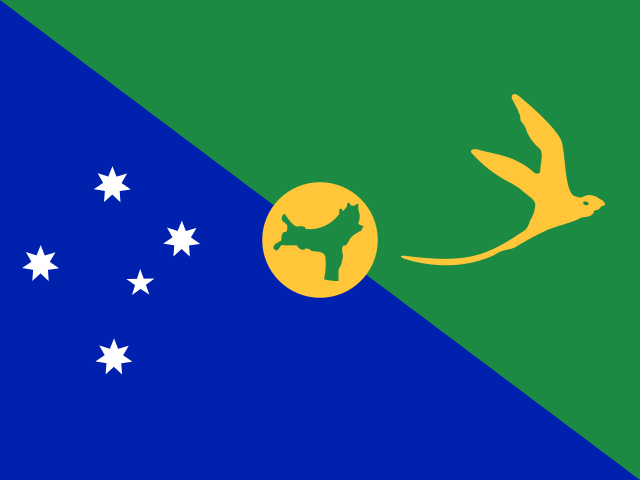
Christmas Island
Christmas Island is a remote Australian territory in the eastern Indian Ocean, famous for its steep volcanic-limestone cliffs, dense tropical rainforest and exceptionally high level of endemism. Much of the island is protected within Christmas Island National Park, where rainforest covers the central plateau and extends towards rugged coastal cliffs and caves. The island's isolation has produced a distinctive fauna, including several endemic mammals, reptiles and birds. Its tropical environment is strongly influenced by the northwest monsoon, with a pronounced wet season and a generally drier period later in the year. The surrounding ocean and deep-water setting also contribute to its isolation from mainland Australia and nearby Indonesia.
Overview
Christmas Island is one of Australia's most distinctive birding destinations, particularly for its endemic and restricted-range rainforest birds. The headline species is the Christmas Island Frigatebird, found only here and critically endangered. Other key targets include Christmas Island Imperial-Pigeon, Christmas Island Thrush, Christmas Island White-eye and Christmas Island Emerald Dove, with Abbott's Booby breeding in tall rainforest trees and representing another major speciality. The island's coastal cliffs and forest also support large seabird colonies, including Red-footed Booby and Brown Booby. Christmas Island National Park provides extensive road and trail access to suitable habitat, making many species relatively accessible. Birding tourism is established but remains small-scale, with local guides particularly valuable for locating the rarer endemics. Its combination of multiple endemic species in a compact tropical island environment makes Christmas Island one of the most rewarding speciality destinations in the Australian region.
Top 10 target species
| Species | Annual frequency | January | February | March | April | May | June | July | August | September | October | November | December |
|---|---|---|---|---|---|---|---|---|---|---|---|---|---|
| Christmas Island-Thrush Turdus erythropleurus | 55.0% | 63.8% | 50.2% | 53.9% | 62.6% | 56.6% | 47.6% | 68.3% | 54.9% | 37.5% | 44.7% | 56.0% | 64.0% |
| Christmas Island Imperial-Pigeon Ducula whartoni | 51.6% | 55.8% | 43.6% | 52.3% | 58.5% | 56.0% | 43.0% | 56.0% | 46.5% | 42.0% | 40.0% | 58.4% | 66.8% |
| Red-footed Booby Sula sula | 51.0% | 53.7% | 24.0% | 54.2% | 56.6% | 54.6% | 52.5% | 65.0% | 49.3% | 43.6% | 57.9% | 52.2% | 48.6% |
| Great Frigatebird Fregata minor | 48.0% | 43.6% | 23.0% | 44.4% | 63.8% | 52.1% | 64.4% | 64.6% | 48.4% | 48.5% | 37.8% | 43.1% | 42.7% |
| White-tailed Tropicbird Phaethon lepturus | 46.6% | 50.6% | 34.5% | 43.0% | 59.4% | 57.0% | 53.5% | 55.4% | 31.0% | 39.5% | 40.7% | 42.5% | 52.3% |
| Christmas Island White-eye Zosterops natalis | 46.5% | 58.1% | 40.7% | 44.4% | 55.8% | 41.8% | 45.6% | 52.5% | 44.4% | 37.0% | 44.3% | 41.3% | 52.5% |
| Christmas Island Frigatebird Fregata andrewsi | 44.8% | 50.5% | 25.0% | 43.3% | 65.4% | 49.0% | 59.2% | 50.5% | 32.2% | 36.2% | 30.5% | 45.2% | 50.7% |
| Brown Booby Sula leucogaster | 44.7% | 43.5% | 25.9% | 40.4% | 47.7% | 44.3% | 63.9% | 61.3% | 42.4% | 42.2% | 50.8% | 40.6% | 33.6% |
| Christmas Island Swiftlet Collocalia natalis | 41.9% | 58.8% | 41.1% | 44.5% | 56.3% | 43.9% | 27.0% | 36.8% | 30.3% | 28.6% | 36.3% | 46.1% | 53.6% |
| Nankeen Kestrel Falco cenchroides | 33.4% | 44.7% | 32.3% | 33.5% | 35.0% | 30.8% | 26.5% | 38.3% | 31.0% | 32.2% | 21.0% | 33.6% | 41.8% |