
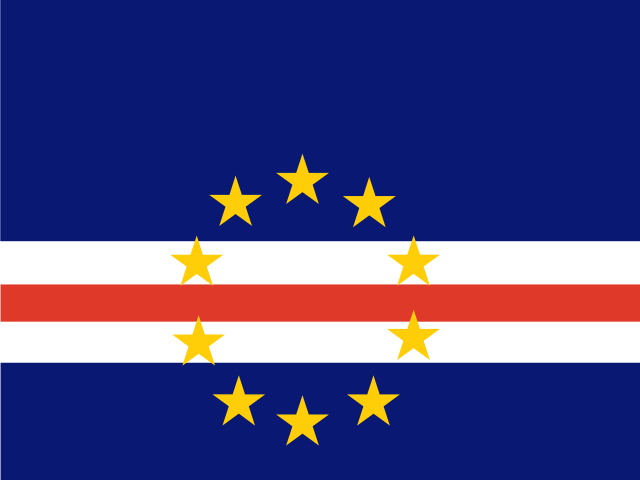
Cabo Verde
Cabo Verde is a volcanic Atlantic archipelago off West Africa, characterized by rugged mountains, steep valleys, barren lava landscapes and arid coastal plains. Rainfall is scarce and highly variable, although the highest islands, particularly Santo Antão, support greener montane valleys. Fogo is dominated by its active volcano, Pico do Fogo, rising dramatically from a vast caldera. The islands’ long isolation has produced distinctive endemic plants and animals.
Overview
Cabo Verde is especially notable for island endemics and breeding seabirds. Key specialties include Raso Lark, confined to tiny Raso and nearby Branco following recent colonization, Cabo Verde Warbler and Cabo Verde Sparrow, while the endemic Cabo Verde Shearwater breeds widely around the archipelago. Fea’s Petrel breeds in the mountains of Fogo and nearby islands, and remote islets hold important colonies of boobies, tropicbirds and storm-petrels. Seeing the full range of specialties requires travel between several islands, with boat access to remote islets sometimes dependent on sea conditions. General tourism infrastructure and inter-island flights are well developed, but specialist seabird sites can require local guides and chartered boats.
Top 10 target species
| Species | Annual frequency | January | February | March | April | May | June | July | August | September | October | November | December |
|---|---|---|---|---|---|---|---|---|---|---|---|---|---|
| Cape Verde Sparrow Passer iagoensis | 50.5% | 47.7% | 49.2% | 47.6% | 41.2% | 47.2% | 57.4% | 64.9% | 47.8% | 47.8% | 53.4% | 48.1% | 53.6% |
| Eurasian Kestrel Falco tinnunculus | 31.0% | 29.4% | 34.0% | 33.8% | 30.9% | 29.1% | 35.2% | 25.9% | 32.4% | 27.0% | 31.9% | 29.7% | 32.1% |
| Eurasian Collared-Dove Streptopelia decaocto | 29.9% | 33.1% | 39.7% | 29.2% | 27.8% | 33.0% | 27.9% | 27.1% | 36.1% | 20.2% | 23.3% | 33.5% | 27.8% |
| Brown-necked Raven Corvus ruficollis | 26.5% | 23.4% | 30.6% | 31.3% | 21.4% | 20.4% | 33.7% | 24.7% | 31.7% | 28.4% | 28.1% | 20.4% | 23.7% |
| Kentish Plover Anarhynchus alexandrinus | 25.8% | 22.4% | 30.3% | 24.3% | 15.6% | 27.3% | 18.6% | 24.4% | 32.6% | 22.4% | 31.4% | 34.8% | 25.3% |
| Rock Pigeon Columba livia | 25.7% | 31.2% | 27.3% | 23.1% | 29.1% | 26.8% | 26.2% | 16.1% | 21.6% | 26.4% | 20.4% | 26.8% | 33.1% |
| Ruddy Turnstone Arenaria interpres | 24.4% | 30.7% | 31.2% | 27.9% | 20.2% | 16.5% | 8.5% | 17.4% | 24.6% | 25.5% | 30.0% | 33.9% | 25.9% |
| Western Cattle-Egret Ardea ibis | 22.6% | 30.6% | 37.5% | 31.1% | 30.2% | 30.8% | 15.9% | 7.9% | 11.6% | 5.0% | 15.4% | 27.4% | 27.4% |
| Little Egret Egretta garzetta | 21.8% | 33.7% | 31.1% | 26.3% | 21.8% | 15.0% | 22.2% | 8.6% | 16.6% | 12.3% | 19.1% | 26.8% | 28.2% |
| Spectacled Warbler Curruca conspicillata | 21.8% | 24.3% | 29.5% | 29.4% | 21.4% | 18.0% | 17.2% | 8.8% | 30.4% | 22.9% | 20.9% | 23.3% | 15.2% |