
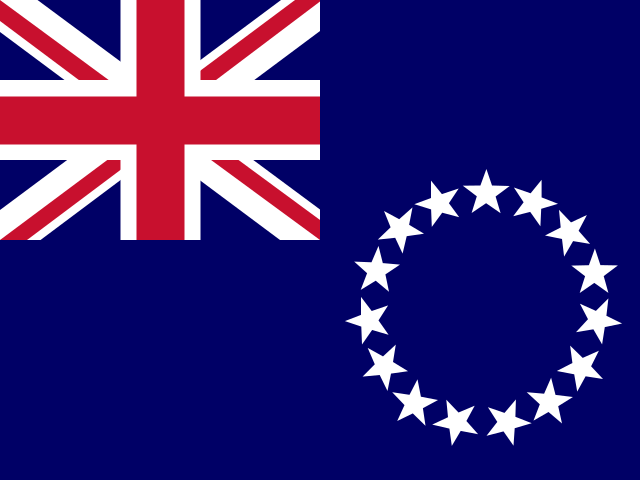
Cook Islands
The Cook Islands are a self-governing Polynesian nation of 15 islands scattered across a vast area of the South Pacific. The southern group includes the mountainous volcanic island of Rarotonga, where steep forested ridges rise from a narrow coastal plain, and Aitutaki, famous for its broad lagoon and coral islets. The northern islands are mostly low coral atolls with limited freshwater and vegetation dominated by coconut palms and coastal scrub. The tropical maritime climate is warm year-round, with a wetter and more cyclone-prone period from roughly November to April. Most of the population lives on Rarotonga, while several outer islands are sparsely inhabited and reached only by limited flights or boats.
Overview
The Cook Islands are especially interesting for highly localised Polynesian endemics. Rarotonga's key species is the Rarotonga Monarch (Kakerori), which recovered dramatically after intensive conservation and can be seen in the Takitumu Conservation Area. Atiu is another major birding island, holding Cook Islands Fruit Dove, Atiu Swiftlet and a reintroduced population of the Rimatara Lorikeet. The remote island of Mangaia adds further distinctive island forms, while uninhabited islets and atolls support tropicbirds, boobies, noddies and terns. Rarotonga and Atiu are relatively straightforward to visit, and local nature guides are available, but reaching more remote islands can require infrequent domestic flights. For birders, the Cook Islands offer accessible conservation success stories and island endemics, with relatively few species but several highly distinctive targets.
Top 10 target species
| Species | Annual frequency | January | February | March | April | May | June | July | August | September | October | November | December |
|---|---|---|---|---|---|---|---|---|---|---|---|---|---|
| Blue-billed White-Tern Gygis candida | 59.4% | 82.2% | 78.4% | 75.5% | 55.8% | 31.3% | 32.5% | 62.9% | 41.1% | 51.9% | 66.6% | 60.4% | 74.8% |
| Common Myna Acridotheres tristis | 57.7% | 61.1% | 78.5% | 63.1% | 44.3% | 32.1% | 46.1% | 74.0% | 64.3% | 52.1% | 55.2% | 65.8% | 56.2% |
| Pacific Reef-Heron Egretta sacra | 35.1% | 27.8% | 45.6% | 41.8% | 31.3% | 28.8% | 36.5% | 42.7% | 33.3% | 28.1% | 38.2% | 42.5% | 24.5% |
| Brown Noddy Anous stolidus | 31.1% | 51.7% | 50.3% | 44.3% | 33.3% | 14.1% | 12.5% | 25.5% | 12.1% | 16.2% | 45.0% | 35.0% | 33.7% |
| Pacific Imperial-Pigeon Ducula pacifica | 30.7% | 41.4% | 30.9% | 34.9% | 23.1% | 9.7% | 18.5% | 46.0% | 24.7% | 32.9% | 33.5% | 44.2% | 28.7% |
| Pacific Golden-Plover Pluvialis fulva | 23.4% | 29.9% | 41.5% | 28.3% | 25.1% | 4.8% | 6.1% | 12.8% | 5.3% | 17.0% | 30.8% | 46.4% | 33.1% |
| White-tailed Tropicbird Phaethon lepturus | 23.1% | 21.7% | 20.8% | 34.3% | 22.5% | 9.0% | 15.8% | 45.8% | 19.2% | 22.9% | 23.9% | 24.6% | 17.2% |
| Wandering Tattler Tringa incana | 22.3% | 22.5% | 37.6% | 27.5% | 25.3% | 11.0% | 4.9% | 20.5% | 15.7% | 20.1% | 26.8% | 32.8% | 23.4% |
| Cook Islands Fruit-Dove Ptilinopus rarotongensis | 19.5% | 30.3% | 15.1% | 18.3% | 22.9% | 4.1% | 10.2% | 19.8% | 13.0% | 16.9% | 19.2% | 23.8% | 40.8% |
| Red Junglefowl Gallus gallus | 16.3% | 3.5% | 16.3% | 14.6% | 5.2% | 16.2% | 8.5% | 8.9% | 30.9% | 41.7% | 21.6% | 18.1% | 10.5% |