
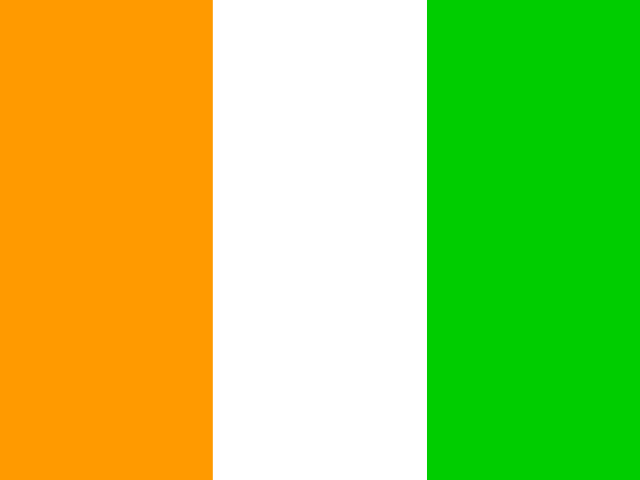
Côte d'Ivoire
Côte d'Ivoire extends from the Gulf of Guinea northward through humid tropical forest into woodland and Guinea savanna. The wetter southwest contains some of West Africa's most important surviving rainforest, while the north is dominated by more open, seasonally dry landscapes. The west becomes mountainous along the borders with Guinea and Liberia, including Mount Nimba, part of a biologically rich highland region. Extensive agriculture, particularly cocoa cultivation, has transformed much of the original lowland forest.
Overview
Côte d'Ivoire is especially important for the Upper Guinea forest bird community. Taï National Park protects one of West Africa's largest remaining tracts of primary rainforest and supports specialties including Yellow-casqued Hornbill, Rufous Fishing Owl, Nimba Flycatcher and various forest guineafowl, turacos and greenbuls. Banco National Park, beside Abidjan, provides unusually accessible rainforest birding, while northern parks add Guinea savanna species. The country has considerable birding potential but a less-developed specialist tourism industry than Ghana, and finding difficult forest species often benefits greatly from knowledgeable local guides. Travel to remote forest areas can involve poor roads and more complicated logistics, particularly during the rainy season.
Top 10 target species
| Species | Annual frequency | January | February | March | April | May | June | July | August | September | October | November | December |
|---|---|---|---|---|---|---|---|---|---|---|---|---|---|
| Common Bulbul Pycnonotus barbatus | 53.5% | 42.8% | 27.7% | 42.5% | 44.6% | 52.8% | 57.1% | 72.5% | 79.0% | 67.7% | 57.3% | 60.0% | 38.4% |
| Red-eyed Dove Streptopelia semitorquata | 43.2% | 31.8% | 16.0% | 33.1% | 34.2% | 49.3% | 52.0% | 61.0% | 72.7% | 53.5% | 45.5% | 46.4% | 23.2% |
| Pied Crow Corvus albus | 40.2% | 34.6% | 12.4% | 32.6% | 34.9% | 49.1% | 49.3% | 61.3% | 62.0% | 44.9% | 40.0% | 38.9% | 21.9% |
| West African Pied Hornbill Lophoceros semifasciatus | 32.9% | 30.6% | 27.1% | 30.3% | 33.9% | 32.7% | 33.1% | 34.3% | 41.8% | 37.4% | 30.0% | 32.6% | 30.6% |
| Western Cattle-Egret Ardea ibis | 32.5% | 30.2% | 13.4% | 33.0% | 33.6% | 35.4% | 34.6% | 44.3% | 44.5% | 36.9% | 24.1% | 38.8% | 21.8% |
| Black Kite Milvus migrans | 31.9% | 41.0% | 19.5% | 44.6% | 48.7% | 48.5% | 18.1% | 6.3% | 10.5% | 26.6% | 35.3% | 48.8% | 34.9% |
| Laughing Dove Spilopelia senegalensis | 31.4% | 19.2% | 10.5% | 26.4% | 30.6% | 32.6% | 39.3% | 49.7% | 58.9% | 38.9% | 25.8% | 31.3% | 13.2% |
| Western Plantain-eater Crinifer piscator | 30.3% | 19.6% | 10.2% | 23.8% | 26.2% | 33.0% | 33.0% | 46.0% | 55.4% | 42.9% | 28.3% | 29.5% | 15.9% |
| Senegal Coucal Centropus senegalensis | 28.3% | 21.6% | 10.4% | 22.4% | 24.1% | 22.6% | 34.3% | 50.4% | 56.7% | 37.8% | 27.1% | 20.6% | 11.9% |
| Village Weaver Ploceus cucullatus | 27.7% | 18.0% | 9.0% | 18.8% | 26.8% | 27.6% | 34.8% | 47.4% | 51.6% | 39.1% | 24.2% | 23.6% | 11.9% |