
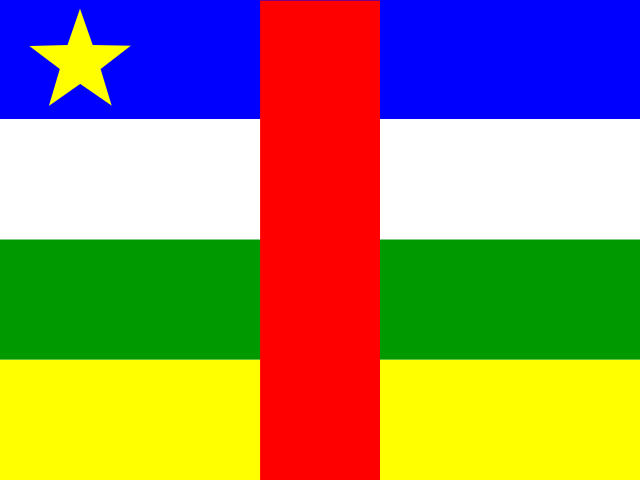
Central African Republic
The Central African Republic lies in the transition between the Congo Basin forests and the savannas of north-central Africa. Southern regions contain dense tropical rainforest and river systems, while much of the centre is covered by woodland and moist savanna, becoming progressively drier toward the north. Numerous rivers drain toward either the Congo or Lake Chad basins. The remote southwest contains some of the country's richest rainforest, while the northeast is characterized by broad open plains and seasonal wetlands. Much of the country remains sparsely populated and has limited transport infrastructure.
Overview
The Central African Republic offers exceptionally rich Congo Basin forest and northern savanna birding, but remains little explored. Dzanga-Sangha in the southwest is the best-known wildlife destination, with rainforest supporting hornbills, turacos, African Grey Parrot, forest kingfishers and numerous understory specialists, alongside famous forest-elephant clearings and western lowland gorillas. Northern savannas historically supported Black Crowned Crane, bustards, vultures, raptors and large flocks of seed-eating birds. The country's position between major biogeographic regions gives it a particularly diverse avifauna. However, conventional birding tourism is currently extremely difficult. Armed groups, political instability, poor roads and very limited infrastructure make large areas unsafe or inaccessible. Dzanga-Sangha has had more organized tourism than most of the country, but access and security conditions must be checked carefully before any visit.
Top 10 target species
| Species | Annual frequency | January | February | March | April | May | June | July | August | September | October | November | December |
|---|---|---|---|---|---|---|---|---|---|---|---|---|---|
| Common Bulbul Pycnonotus barbatus | 37.1% | 46.0% | 36.2% | 43.0% | 27.2% | 14.4% | 24.2% | 23.0% | 26.8% | 65.7% | 52.8% | 39.1% | 47.1% |
| Gray Parrot Psittacus erithacus | 31.1% | 22.9% | 35.0% | 28.7% | 25.9% | 35.4% | 31.6% | 37.1% | 42.8% | 35.3% | 19.4% | 33.0% | 26.4% |
| Great Blue Turaco Corythaeola cristata | 28.3% | 17.4% | 38.8% | 29.2% | 16.6% | 39.4% | 39.3% | 45.0% | 40.1% | 21.9% | 8.3% | 21.5% | 22.8% |
| Blue-spotted Wood-Dove Turtur afer | 25.4% | 38.4% | 21.2% | 20.4% | 6.8% | 13.6% | 26.4% | 13.3% | 21.8% | 38.0% | 40.3% | 30.0% | 34.1% |
| African Green-Pigeon Treron calvus | 25.3% | 31.9% | 27.4% | 24.3% | 12.5% | 17.5% | 30.6% | 32.2% | 34.9% | 31.8% | 16.7% | 19.0% | 25.2% |
| White-thighed Hornbill Bycanistes albotibialis | 24.7% | 17.4% | 46.4% | 37.8% | 13.4% | 26.9% | 27.8% | 25.5% | 40.7% | 26.2% | 5.6% | 15.1% | 13.5% |
| Western Black-headed Oriole Oriolus brachyrynchus | 23.6% | 12.8% | 25.8% | 24.1% | 9.9% | 28.7% | 25.3% | 27.6% | 44.9% | 29.0% | 19.4% | 15.9% | 19.4% |
| Olive Sunbird Cyanomitra olivacea | 23.3% | 17.4% | 33.1% | 24.2% | 19.3% | 45.8% | 22.4% | 19.7% | 29.4% | 21.5% | 19.4% | 14.2% | 13.7% |
| Little Greenbul Eurillas virens | 22.1% | 16.0% | 29.3% | 14.0% | 19.2% | 45.9% | 41.2% | 32.2% | 34.6% | 7.2% | 5.6% | 6.2% | 13.9% |
| Black Kite Milvus migrans | 20.1% | 40.8% | 17.7% | 46.6% | 38.4% | 7.7% | 1.1% | 2.5% | 0.0% | 10.3% | 31.9% | 24.3% | 20.1% |