
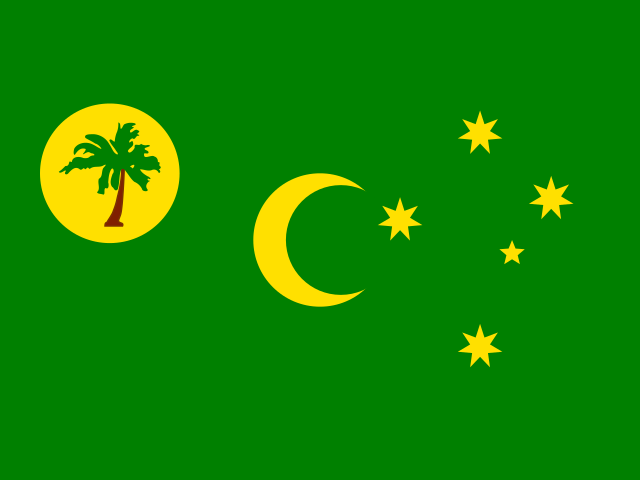
Cocos (Keeling) Islands
The Cocos (Keeling) Islands are a remote Australian territory of 27 low-lying coral islands forming two atolls in the eastern Indian Ocean, more than 2,700 km northwest of Perth. Only West Island and Home Island are permanently inhabited, while the surrounding lagoon, reef flats, coconut forest and small sand cays remain largely undeveloped. The northern atoll, North Keeling Island, is protected as Pulu Keeling National Park, an unusually intact tropical atoll with a central lagoon and dense Pisonia forest. Its isolation has produced a distinctive mix of Indian and Pacific Ocean wildlife and makes the islands an important refuge for seabirds.
Overview
Cocos is a particularly interesting destination for seabirds, migratory shorebirds and Indian Ocean vagrants. The islands sit at an unusual meeting point of major migration routes, and their isolation makes them a magnet for birds far outside their normal ranges. Resident species include White-breasted Waterhen, White Tern, Western Reef Heron and Green Junglefowl, while Pulu Keeling National Park supports one of the world's largest breeding colonies of Red-footed Boobies, alongside frigatebirds, noddies, terns and tropicbirds. The islands are particularly famous among Australian birders for Asian vagrants and rarities, with over 150 species recorded. November–April is considered the strongest period for birding. Local guides can reach otherwise difficult parts of the atoll, while access to Pulu Keeling itself is highly restricted and generally requires special arrangements.
Top 10 target species
| Species | Annual frequency | January | February | March | April | May | June | July | August | September | October | November | December |
|---|---|---|---|---|---|---|---|---|---|---|---|---|---|
| Blue-billed White-Tern Gygis candida | 56.1% | 53.3% | 59.8% | 63.3% | 80.6% | 53.9% | 25.1% | 75.0% | 25.0% | 78.4% | 41.8% | 64.3% | 53.1% |
| White-breasted Waterhen Amaurornis phoenicurus | 48.4% | 48.9% | 63.2% | 64.5% | 70.4% | 62.2% | 25.0% | 56.3% | 8.3% | 75.0% | 12.5% | 43.6% | 50.8% |
| Nankeen Night Heron Nycticorax caledonicus | 42.5% | 49.9% | 74.8% | 69.8% | 61.4% | 41.4% | 0.0% | 18.8% | 0.0% | 75.0% | 25.0% | 48.7% | 45.7% |
| Green Junglefowl Gallus varius | 41.5% | 41.8% | 52.0% | 56.6% | 57.9% | 62.2% | 25.1% | 31.3% | 8.3% | 73.9% | 13.4% | 35.1% | 40.1% |
| Pacific Reef-Heron Egretta sacra | 38.2% | 35.3% | 51.4% | 56.7% | 74.4% | 25.9% | 0.1% | 31.3% | 8.3% | 79.5% | 15.0% | 40.6% | 40.1% |
| Pacific Black Duck Anas superciliosa | 28.8% | 28.2% | 24.0% | 44.7% | 56.4% | 16.1% | 0.0% | 25.0% | 0.0% | 64.8% | 23.3% | 38.0% | 24.8% |
| Lesser Frigatebird Fregata ariel | 22.1% | 23.8% | 16.3% | 15.3% | 46.7% | 18.8% | 0.0% | 18.8% | 8.3% | 34.1% | 47.1% | 17.5% | 18.2% |
| Brown Noddy Anous stolidus | 20.5% | 23.1% | 26.4% | 13.6% | 50.1% | 28.0% | 0.0% | 6.3% | 0.0% | 29.5% | 43.8% | 11.4% | 14.0% |
| Red-footed Booby Sula sula | 19.9% | 21.4% | 13.6% | 21.0% | 48.5% | 33.3% | 0.0% | 12.5% | 0.0% | 28.4% | 32.5% | 12.1% | 16.0% |
| Medium Egret Ardea intermedia | 17.6% | 21.4% | 9.7% | 6.3% | 51.0% | 29.5% | 25.0% | 12.5% | 8.3% | 10.3% | 4.5% | 18.4% | 14.5% |