
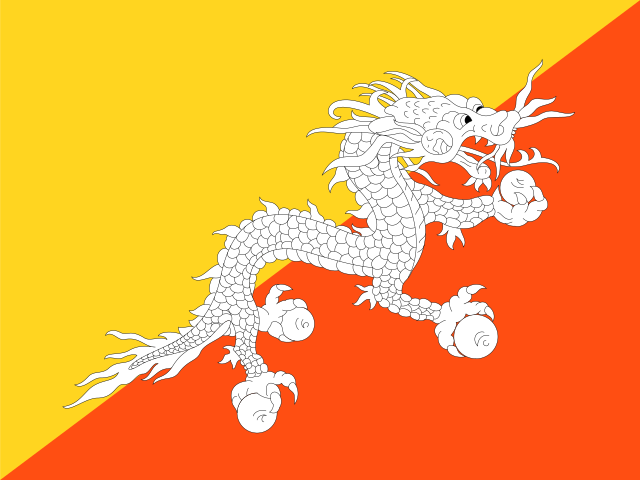
Bhutan
Bhutan occupies the eastern Himalayas, rising from subtropical foothills near India to snow-covered peaks above 7,000 metres. Deep river valleys cut through extensive forests ranging from tropical broadleaf woodland to temperate oak, rhododendron and conifer forest, with alpine meadows and high mountain environments above the treeline. Around 70% of Bhutan remains forested, and a large network of protected areas and biological corridors preserves unusually continuous natural habitats. Climate varies dramatically with elevation, from humid subtropical conditions in the south to severe alpine conditions in the high Himalayas.
Overview
Bhutan is one of Asia's premier destinations for Himalayan forest birds, especially pheasants, laughingthrushes, parrotbills and other eastern Himalayan specialties. Major targets include Satyr Tragopan, Himalayan Monal, Ward's Trogon, Beautiful Nuthatch and Rufous-necked Hornbill, while the rare Black-necked Crane winters in valleys such as Phobjikha. The forested roads around Trongsa, Zhemgang and Trashigang provide exceptional birding across different elevations. Bhutan has a well-established specialist birding-tour industry, and organised trips with local guides are the normal way to visit. Mountain roads are often slow and winding, but the combination of extensive intact forest, dramatic elevation gradients and relatively low development makes Bhutan one of the Himalayas' most rewarding birding destinations.
Top 10 target species
| Species | Annual frequency | January | February | March | April | May | June | July | August | September | October | November | December |
|---|---|---|---|---|---|---|---|---|---|---|---|---|---|
| Oriental Turtle-Dove Streptopelia orientalis | 25.1% | 12.3% | 26.0% | 22.3% | 27.4% | 29.2% | 28.9% | 29.5% | 33.9% | 36.5% | 27.6% | 15.4% | 11.7% |
| Blue Whistling-Thrush Myophonus caeruleus | 22.0% | 21.3% | 28.7% | 23.3% | 24.9% | 21.2% | 20.2% | 21.2% | 13.0% | 19.6% | 24.2% | 24.7% | 21.8% |
| Red-vented Bulbul Pycnonotus cafer | 21.7% | 21.4% | 25.7% | 22.2% | 21.8% | 23.3% | 22.1% | 24.0% | 22.3% | 20.8% | 19.2% | 19.1% | 19.1% |
| Large-billed Crow Corvus macrorhynchos | 19.6% | 15.0% | 22.3% | 20.1% | 24.9% | 20.6% | 17.2% | 15.8% | 13.1% | 18.1% | 24.3% | 25.6% | 18.4% |
| Rufous Sibia Heterophasia capistrata | 18.7% | 17.0% | 20.0% | 16.9% | 21.3% | 18.9% | 16.8% | 22.4% | 21.4% | 18.7% | 16.9% | 19.7% | 14.8% |
| Green-backed Tit Parus monticolus | 18.5% | 12.3% | 20.5% | 17.0% | 21.8% | 19.4% | 16.3% | 17.4% | 19.3% | 17.6% | 20.8% | 23.4% | 16.1% |
| Black Bulbul Hypsipetes leucocephalus | 16.4% | 6.1% | 14.1% | 15.2% | 23.2% | 27.0% | 28.2% | 30.9% | 21.4% | 13.5% | 5.9% | 7.2% | 4.4% |
| Common Myna Acridotheres tristis | 13.4% | 12.8% | 15.7% | 12.4% | 11.7% | 14.8% | 13.4% | 12.5% | 12.9% | 19.0% | 13.8% | 11.0% | 11.2% |
| Gray-backed Shrike Lanius tephronotus | 13.0% | 12.0% | 13.5% | 9.0% | 13.6% | 16.4% | 12.4% | 14.2% | 11.7% | 19.8% | 13.5% | 10.4% | 10.0% |
| Ashy Drongo Dicrurus leucophaeus | 12.9% | 7.3% | 7.5% | 9.2% | 21.6% | 18.7% | 18.8% | 18.2% | 16.9% | 13.8% | 12.0% | 5.6% | 5.4% |