
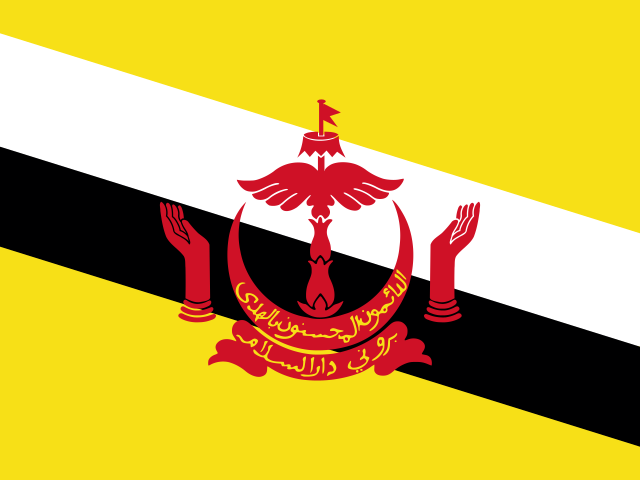
Brunei Darussalam
Brunei is a small, wealthy state on the northwestern coast of Borneo, divided into two separate sections by Malaysian territory. Despite its limited size, much of the country remains covered by lowland tropical rainforest, peat swamp and mangroves, particularly in the sparsely populated interior. The remote Temburong District contains some of Brunei's best-preserved rainforest, including the protected forests of Ulu Temburong National Park. Coastal lowlands contain most settlements and development, while rivers provide important routes into the forested interior. Brunei has a hot, humid equatorial climate with heavy rainfall throughout the year. Its extensive forest cover contrasts with the much more heavily modified landscapes found across many other parts of Borneo.
Overview
Brunei provides excellent opportunities to experience Bornean lowland rainforest birds in relatively intact habitat. Ulu Temburong National Park is the premier destination, with canopy and forest birding for hornbills, broadbills, pittas, trogons and babblers. Notable possibilities include Rhinoceros and Helmeted Hornbills, Black-and-red Broadbill and Bornean Bristlehead, although the latter can be difficult to find. Peat swamp, mangrove and coastal habitats add kingfishers, raptors and waterbirds. Brunei has far less dedicated birding tourism than neighbouring Sabah, but good infrastructure makes the country relatively easy to visit. Access to Ulu Temburong typically involves boat travel and organised accommodation or guiding, while other forest sites can be reached by road. For birders, Brunei's main attraction is accessible, well-preserved Bornean rainforest without the visitor numbers of better-known Malaysian sites.
Top 10 target species
| Species | Annual frequency | January | February | March | April | May | June | July | August | September | October | November | December |
|---|---|---|---|---|---|---|---|---|---|---|---|---|---|
| Zebra Dove Geopelia striata | 37.5% | 36.4% | 38.0% | 40.0% | 44.5% | 29.5% | 32.0% | 38.3% | 38.8% | 46.0% | 29.1% | 33.1% | 44.7% |
| Yellow-vented Bulbul Pycnonotus goiavier | 33.8% | 31.9% | 30.8% | 31.0% | 43.0% | 30.6% | 28.1% | 34.4% | 34.9% | 39.3% | 29.4% | 32.4% | 40.0% |
| Asian Glossy Starling Aplonis panayensis | 31.5% | 33.2% | 32.8% | 34.6% | 36.0% | 29.2% | 27.0% | 37.7% | 29.3% | 28.5% | 22.9% | 26.1% | 40.7% |
| Eurasian Tree Sparrow Passer montanus | 30.6% | 29.8% | 36.9% | 26.1% | 39.7% | 28.9% | 28.7% | 32.1% | 21.1% | 26.7% | 19.7% | 38.6% | 38.7% |
| Pacific Swallow Hirundo javanica | 25.5% | 22.8% | 24.6% | 28.3% | 27.4% | 20.4% | 27.0% | 33.7% | 22.8% | 25.7% | 29.0% | 18.6% | 25.3% |
| Chestnut Munia Lonchura atricapilla | 24.5% | 22.9% | 29.7% | 25.9% | 28.9% | 27.4% | 23.6% | 25.2% | 24.5% | 32.1% | 13.5% | 19.3% | 20.7% |
| Little Egret Egretta garzetta | 22.8% | 35.8% | 34.5% | 17.0% | 23.7% | 13.8% | 17.3% | 16.3% | 15.5% | 21.5% | 27.8% | 24.3% | 26.3% |
| Collared Kingfisher Todiramphus chloris | 21.7% | 21.3% | 21.8% | 23.0% | 35.3% | 24.0% | 19.4% | 22.7% | 17.2% | 24.4% | 19.2% | 15.0% | 16.7% |
| White-breasted Waterhen Amaurornis phoenicurus | 20.2% | 20.7% | 26.5% | 20.5% | 23.7% | 19.9% | 13.1% | 17.0% | 17.6% | 23.4% | 16.1% | 23.6% | 20.5% |
| Medium Egret Ardea intermedia | 19.3% | 35.8% | 26.3% | 19.9% | 18.5% | 10.2% | 13.8% | 13.6% | 18.3% | 21.6% | 21.3% | 14.1% | 18.4% |