
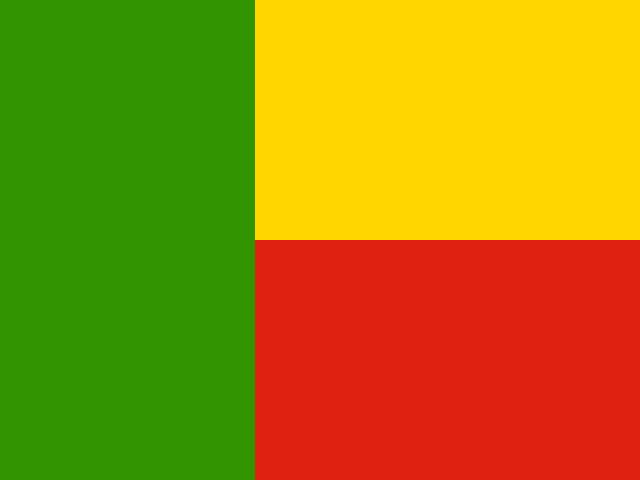
Benin
Benin stretches from the Gulf of Guinea northward through a narrow coastal plain into increasingly dry woodland and savanna. Southern Benin contains lagoons, wetlands and the large Lake Nokoué, while the central region forms a mosaic of farmland and woodland. In the northwest, the Atakora Mountains and surrounding savannas create a more rugged landscape. The climate ranges from humid tropical conditions in the south to strongly seasonal and drier conditions toward the Sahel.
Overview
Benin is particularly interesting for Guinea savanna and wetland birding, with its strongest wildlife areas in the north. Pendjari National Park, part of the vast W-Arly-Pendjari complex, supports rich savanna birdlife including Northern Ground Hornbill, Abyssinian Ground Hornbill, Saddle-billed Stork, vultures, eagles and numerous bee-eaters and rollers, alongside major populations of large mammals. Southern wetlands around Lake Nokoué add herons, terns, kingfishers and migratory waterbirds. Specialist birding tourism is relatively limited, and northern parks can involve long overland journeys. Security concerns near Benin's northern borders have significantly affected access to Pendjari and W National Parks, so current travel conditions should be checked carefully before planning a birding trip.
Top 10 target species
| Species | Annual frequency | January | February | March | April | May | June | July | August | September | October | November | December |
|---|---|---|---|---|---|---|---|---|---|---|---|---|---|
| Common Bulbul Pycnonotus barbatus | 52.0% | 56.4% | 52.7% | 42.3% | 49.7% | 52.8% | 61.9% | 54.3% | 49.0% | 38.3% | 58.8% | 53.0% | 54.3% |
| Laughing Dove Spilopelia senegalensis | 45.8% | 45.4% | 46.5% | 39.7% | 44.0% | 39.7% | 44.9% | 53.2% | 67.4% | 36.4% | 47.1% | 45.8% | 39.7% |
| Senegal Coucal Centropus senegalensis | 38.4% | 37.5% | 45.2% | 39.3% | 25.6% | 44.5% | 57.6% | 40.7% | 38.0% | 23.3% | 37.4% | 27.7% | 43.6% |
| Black Kite Milvus migrans | 34.1% | 65.5% | 50.2% | 41.3% | 47.7% | 50.2% | 18.5% | 2.1% | 0.0% | 4.2% | 39.0% | 52.1% | 38.3% |
| Village Weaver Ploceus cucullatus | 31.1% | 36.1% | 40.4% | 23.9% | 30.1% | 40.3% | 41.3% | 30.2% | 33.7% | 21.2% | 30.1% | 24.5% | 21.3% |
| Western Cattle-Egret Ardea ibis | 30.9% | 52.3% | 47.1% | 38.1% | 37.9% | 22.6% | 23.9% | 19.6% | 18.0% | 15.0% | 20.2% | 33.4% | 42.4% |
| African Palm Swift Cypsiurus parvus | 30.7% | 45.7% | 27.0% | 24.5% | 32.7% | 35.8% | 43.5% | 29.0% | 30.4% | 10.6% | 30.1% | 19.5% | 39.2% |
| Red-eyed Dove Streptopelia semitorquata | 29.8% | 28.8% | 37.6% | 22.3% | 16.7% | 37.4% | 59.0% | 34.4% | 15.0% | 23.1% | 31.3% | 22.4% | 29.3% |
| African Thrush Turdus pelios | 28.7% | 35.8% | 43.7% | 32.0% | 23.0% | 41.2% | 46.5% | 42.1% | 25.7% | 0.0% | 16.8% | 11.9% | 25.2% |
| Bronze Mannikin Spermestes cucullata | 28.5% | 34.4% | 30.1% | 22.4% | 31.3% | 33.6% | 45.1% | 23.6% | 19.3% | 18.9% | 35.1% | 19.4% | 28.3% |