
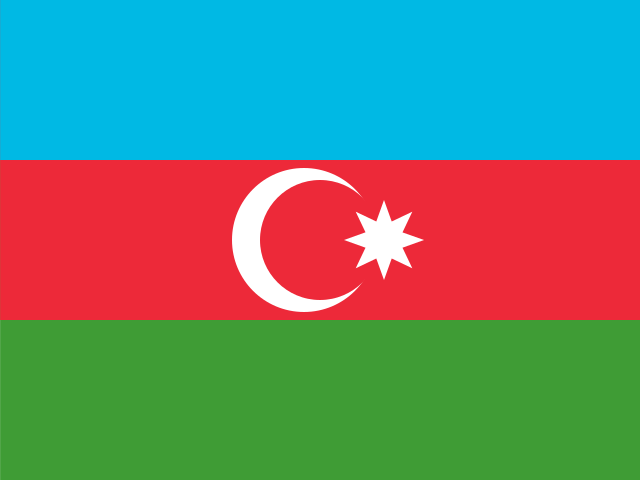
Azerbaijan
Azerbaijan lies between the Caspian Sea and the Caucasus Mountains, combining dramatic elevation changes with unusually varied landscapes. The Greater Caucasus rises above 4,000 metres in the north, while central and eastern areas contain dry steppe, semi-desert and mud-volcano landscapes. The Talysh Mountains in the southeast support humid broadleaf forests related to the Caspian Hyrcanian forests of Iran. The extensive Kura-Aras Lowland and Caspian coastline add wetlands, lagoons and coastal plains. The climate ranges from alpine conditions to warm, dry lowlands and humid subtropical areas.
Overview
Azerbaijan offers a distinctive combination of Caucasian mountain specialties, Caspian waterbirds and semi-desert species. The Greater Caucasus around Khinalug is particularly important for Caucasian Snowcock, Caucasian Grouse, Great Rosefinch and Güldenstädt's Redstart. Dry lowlands, especially Gobustan and Shirvan, hold larks, wheatears, sandgrouse and raptors, while the Caspian coast provides major migration and wintering habitat for flamingos, pelicans, ducks and shorebirds. The Talysh forests add a contrasting woodland avifauna. Azerbaijan has a developing birding-tourism sector, and the diversity of habitats makes a productive circuit possible within a relatively compact area. Some mountain roads are difficult or seasonal, and border areas, particularly near Armenia, may have access or security restrictions that should be checked before travel.
Top 10 target species
| Species | Annual frequency | January | February | March | April | May | June | July | August | September | October | November | December |
|---|---|---|---|---|---|---|---|---|---|---|---|---|---|
| Hooded Crow Corvus cornix | 37.2% | 38.8% | 33.9% | 48.9% | 29.2% | 31.4% | 20.0% | 32.3% | 25.1% | 31.2% | 49.6% | 60.7% | 45.6% |
| White Wagtail Motacilla alba | 32.0% | 28.2% | 24.3% | 42.5% | 22.4% | 24.2% | 18.3% | 26.0% | 18.1% | 38.7% | 65.1% | 42.4% | 34.1% |
| European Starling Sturnus vulgaris | 31.6% | 28.0% | 29.4% | 39.2% | 21.0% | 32.7% | 23.1% | 20.3% | 12.9% | 36.0% | 55.0% | 47.9% | 33.5% |
| Western Marsh Harrier Circus aeruginosus | 29.8% | 31.5% | 34.9% | 35.6% | 15.3% | 13.6% | 7.5% | 8.0% | 13.9% | 45.3% | 57.7% | 52.2% | 42.2% |
| Common Chaffinch Fringilla coelebs | 27.1% | 40.5% | 31.3% | 37.5% | 20.6% | 13.6% | 11.9% | 6.2% | 6.3% | 4.2% | 44.8% | 65.2% | 43.4% |
| Gray Heron Ardea cinerea | 25.9% | 22.2% | 25.2% | 33.4% | 7.1% | 7.7% | 4.0% | 9.9% | 24.8% | 50.8% | 56.8% | 40.0% | 29.3% |
| Barn Swallow Hirundo rustica | 25.0% | 0.0% | 0.2% | 22.0% | 29.8% | 39.2% | 32.8% | 32.8% | 42.1% | 43.0% | 47.8% | 9.6% | 0.8% |
| Eurasian Blackbird Turdus merula | 24.8% | 30.6% | 24.3% | 31.0% | 34.2% | 29.3% | 23.0% | 27.9% | 10.7% | 5.7% | 16.8% | 41.0% | 23.1% |
| Rock Pigeon Columba livia | 24.7% | 27.0% | 23.8% | 27.2% | 12.8% | 17.8% | 11.0% | 27.2% | 23.9% | 26.6% | 33.1% | 39.7% | 25.8% |
| Great Cormorant Phalacrocorax carbo | 24.3% | 22.1% | 28.1% | 27.5% | 4.6% | 4.7% | 2.2% | 8.8% | 17.3% | 33.5% | 52.6% | 54.6% | 36.1% |