
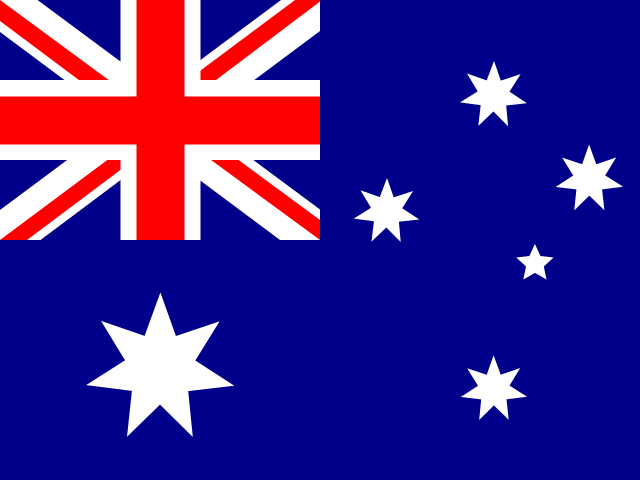
Australia
Australia is defined by its isolation and enormous ecological variety, from tropical rainforests and savannas in the north to temperate forests, deserts and alpine environments in the southeast. The interior is dominated by arid and semi-arid landscapes, while the eastern and southwestern coasts contain much of the country's population and forest habitat. The Great Dividing Range creates a major ecological spine along the east, while Tasmania forms a distinct temperate island environment. Northern Australia has a strong tropical character, including extensive wetlands around Kakadu and the Top End, whereas southwestern Australia is notable for its exceptionally high plant endemism. Australia's long isolation has produced a bird fauna unlike anywhere else, with many ancient lineages and highly distinctive groups.
Overview
Australia is one of the world's major birding destinations, particularly for endemics and distinctive Australasian groups. It is home to emus, cassowaries, lyrebirds, bowerbirds, fairywrens, honeyeaters and numerous parrots, with iconic species ranging from Southern Cassowary and Superb Lyrebird to Laughing Kookaburra and Wedge-tailed Eagle. Northern Queensland's Atherton Tablelands, the Top End, and southwestern Western Australia are particularly productive, while Tasmania adds several island endemics. Christmas Island and other offshore territories provide additional highly restricted species. Birding tourism is well established, with extensive reserves, birding lodges and good road access, but Australia's distances can be a major practical constraint. Some of the best sites require long drives or domestic flights, and remote northern or inland birding can involve considerable planning.
Top 10 target species
| Species | Annual frequency | January | February | March | April | May | June | July | August | September | October | November | December |
|---|---|---|---|---|---|---|---|---|---|---|---|---|---|
| Australian Magpie Gymnorhina tibicen | 48.1% | 47.1% | 49.8% | 51.5% | 51.7% | 50.9% | 48.1% | 46.0% | 46.1% | 46.9% | 46.3% | 45.0% | 47.2% |
| Magpie-lark Grallina cyanoleuca | 37.1% | 36.5% | 37.1% | 37.6% | 37.8% | 38.1% | 37.1% | 36.8% | 37.6% | 38.0% | 37.2% | 34.8% | 35.9% |
| Rainbow Lorikeet Trichoglossus moluccanus | 34.0% | 32.8% | 34.2% | 34.3% | 35.2% | 37.3% | 36.5% | 34.8% | 34.8% | 32.1% | 31.7% | 31.1% | 32.8% |
| Welcome Swallow Hirundo neoxena | 31.9% | 29.9% | 28.6% | 31.4% | 34.6% | 31.8% | 27.5% | 26.8% | 32.4% | 35.8% | 35.6% | 34.6% | 33.8% |
| Willie-wagtail Rhipidura leucophrys | 30.1% | 29.2% | 27.8% | 29.3% | 32.6% | 32.5% | 30.8% | 29.8% | 30.0% | 32.3% | 30.0% | 28.2% | 29.1% |
| Noisy Miner Manorina melanocephala | 28.2% | 27.8% | 29.7% | 29.5% | 29.8% | 30.1% | 28.8% | 27.6% | 28.5% | 27.4% | 27.0% | 25.7% | 26.7% |
| Superb Fairywren Malurus cyaneus | 26.1% | 30.1% | 28.5% | 26.1% | 25.4% | 24.7% | 23.4% | 22.1% | 24.4% | 26.1% | 27.1% | 26.9% | 28.9% |
| Pacific Black Duck Anas superciliosa | 25.2% | 27.9% | 27.1% | 26.0% | 24.4% | 24.2% | 23.1% | 22.6% | 23.8% | 25.3% | 25.5% | 25.6% | 26.5% |
| Masked Lapwing Vanellus miles | 24.7% | 26.6% | 27.0% | 26.2% | 24.5% | 24.6% | 24.5% | 24.0% | 23.4% | 23.1% | 23.3% | 23.8% | 25.2% |
| Sulphur-crested Cockatoo Cacatua galerita | 24.5% | 23.9% | 24.4% | 24.3% | 24.9% | 23.9% | 22.9% | 23.6% | 26.0% | 25.6% | 25.5% | 24.3% | 24.6% |