
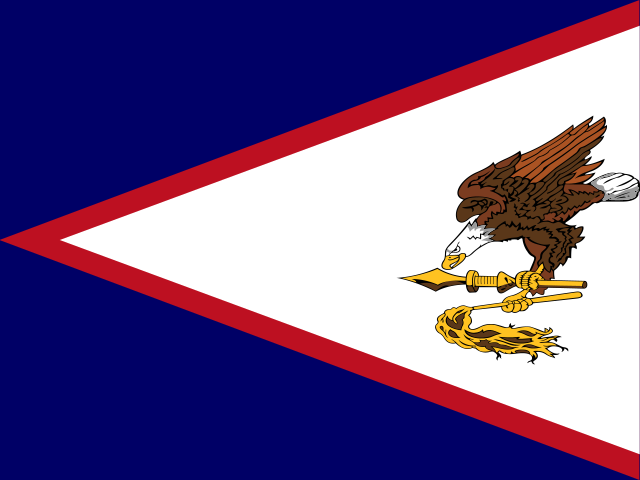
American Samoa
American Samoa is a U.S. territory in the South Pacific, consisting of five volcanic islands and two coral atolls. The main island, Tutuila, is dominated by steep forested ridges and deeply indented bays, with most settlements squeezed onto narrow coastal lowlands. The Manuʻa Islands are smaller and less developed, with rugged volcanic terrain and extensive native forest, while Rose Atoll is a remote coral atoll. A warm, humid tropical climate supports lush vegetation throughout the year, with particularly heavy rainfall on mountainous Tutuila. National Park of American Samoa protects rainforest, coastline and coral reefs across Tutuila and the Manuʻa Islands, preserving some of the territory's most intact landscapes.
Overview
American Samoa is particularly interesting for Polynesian forest birds and tropical seabirds. Characteristic land birds include Samoan Starling, Wattled Honeyeater, Many-colored Fruit Dove and Blue-crowned Lorikeet, while the Mao is a scarcer regional specialty. National Park forests on Tutuila provide the easiest access to native bird communities, while the less-developed Manuʻa Islands offer more extensive forest habitat. Offshore islets and Rose Atoll support breeding boobies, frigatebirds, noddies, terns and tropicbirds, although remote colonies are difficult to reach. Birding infrastructure is limited, but Tutuila has roads and hiking trails that make independent exploration practical. Travel to Manuʻa requires domestic flights or boats and can be weather-dependent. American Samoa is best suited to birders interested in Samoan regional specialties and remote Pacific seabirds rather than a large endemic list.
Top 10 target species
| Species | Annual frequency | January | February | March | April | May | June | July | August | September | October | November | December |
|---|---|---|---|---|---|---|---|---|---|---|---|---|---|
| Blue-billed White-Tern Gygis candida | 57.1% | 73.5% | 82.6% | 76.8% | 54.1% | 35.5% | 34.1% | 29.3% | 42.1% | 43.4% | 67.9% | 68.6% | 77.8% |
| Eastern Wattled-Honeyeater Foulehaio carunculatus | 49.6% | 67.0% | 73.8% | 62.7% | 29.0% | 30.3% | 31.7% | 59.4% | 46.8% | 31.4% | 48.9% | 56.5% | 57.9% |
| Samoan Starling Aplonis atrifusca | 44.8% | 57.0% | 55.6% | 52.9% | 36.2% | 35.8% | 33.2% | 57.5% | 44.8% | 25.9% | 37.6% | 48.9% | 51.6% |
| White-rumped Swiftlet Aerodramus spodiopygius | 42.4% | 51.1% | 63.4% | 45.5% | 16.8% | 28.4% | 51.3% | 53.3% | 32.0% | 25.7% | 44.9% | 42.5% | 53.5% |
| White-tailed Tropicbird Phaethon lepturus | 40.8% | 38.5% | 48.0% | 42.0% | 32.2% | 15.7% | 59.3% | 56.8% | 39.6% | 24.5% | 54.0% | 37.9% | 41.2% |
| Pacific Kingfisher Todiramphus sacer | 40.7% | 55.5% | 58.6% | 45.7% | 36.1% | 30.6% | 42.2% | 41.0% | 22.4% | 15.1% | 36.8% | 50.7% | 54.2% |
| Great Frigatebird Fregata minor | 34.3% | 48.0% | 46.8% | 38.0% | 29.5% | 24.0% | 39.5% | 17.1% | 24.6% | 10.0% | 56.3% | 45.4% | 32.9% |
| Common Myna Acridotheres tristis | 32.5% | 20.5% | 37.6% | 18.9% | 38.5% | 40.1% | 42.2% | 29.4% | 42.4% | 9.6% | 43.1% | 41.5% | 26.6% |
| Pacific Imperial-Pigeon Ducula pacifica | 30.9% | 38.8% | 32.4% | 38.8% | 27.9% | 25.5% | 43.6% | 16.8% | 24.9% | 11.1% | 37.9% | 36.3% | 36.3% |
| Brown Noddy Anous stolidus | 28.7% | 20.6% | 28.9% | 31.2% | 16.9% | 17.6% | 10.7% | 28.9% | 28.0% | 42.3% | 40.7% | 42.7% | 36.2% |