
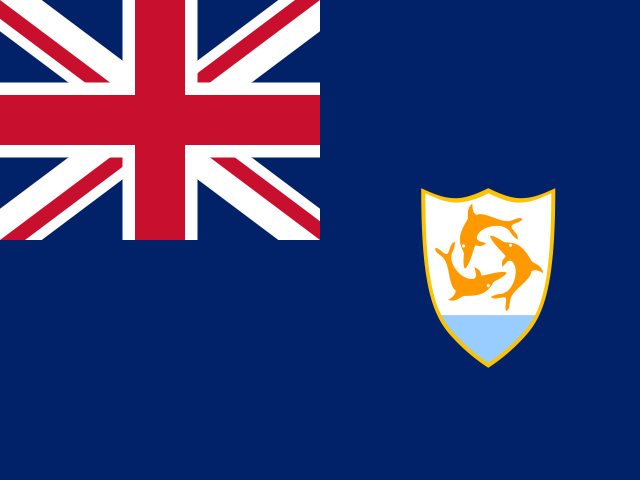
Anguilla
Anguilla is a low-lying limestone island in the northern Lesser Antilles, with a dry landscape of scrub, thorny vegetation, salt ponds and exposed rocky coastline. Unlike the volcanic islands farther south, it has no mountains or permanent rivers; its highest point is only about 65 metres. Around 30 salt ponds are scattered across the island, remnants of the salt industry that once played an important role in the local economy. The surrounding waters are shallow, with extensive seagrass beds, reefs and sandy beaches, while numerous offshore cays add rugged cliffs and largely undisturbed coastal habitats. Anguilla is relatively dry and strongly influenced by the trade winds. Tourism is well developed, but the island remains quieter and less densely built-up than some neighbouring Caribbean destinations. Its flat terrain, compact road network and small size make it particularly easy to explore independently.
Overview
Anguilla's main birding strength is its salt ponds and exceptionally important offshore seabird colonies. Road Salt Pond is the island's most productive wetland, attracting more than 30 species of waterbirds, including White-cheeked Pintail, Black-necked Stilt, herons, egrets and large numbers of migrant shorebirds. The offshore cays are even more significant: Dog Island supports globally important numbers of Sooty Terns, while Scrub Island holds breeding Roseate Terns, Sandwich Terns, Least Terns and Red-billed Tropicbirds. Dry scrub around the ponds supports characteristic Lesser Antillean birds such as Caribbean Elaenia, Pearly-eyed Thrasher and Lesser Antillean Bullfinch. Anguilla has a small but genuine birding-tourism offering, including guided tours by the Anguilla National Trust. For serious birders, the offshore cays require boat access, but the mainland salt ponds are easy to combine with a normal visit.
Top 10 target species
| Species | Annual frequency | January | February | March | April | May | June | July | August | September | October | November | December |
|---|---|---|---|---|---|---|---|---|---|---|---|---|---|
| Bananaquit Coereba flaveola | 54.1% | 51.7% | 54.0% | 65.9% | 62.4% | 58.1% | 57.1% | 51.1% | 46.6% | 55.6% | 52.6% | 38.1% | 56.2% |
| Zenaida Dove Zenaida aurita | 46.9% | 32.3% | 33.1% | 50.4% | 54.7% | 66.4% | 70.6% | 60.7% | 52.3% | 44.5% | 42.0% | 23.6% | 31.6% |
| Black-necked Stilt Himantopus mexicanus | 36.6% | 25.7% | 22.9% | 22.5% | 29.1% | 39.5% | 45.5% | 46.5% | 52.8% | 55.8% | 34.5% | 40.8% | 24.1% |
| Lesser Yellowlegs Tringa flavipes | 32.1% | 38.3% | 37.5% | 28.9% | 25.7% | 13.3% | 5.4% | 15.4% | 45.8% | 59.6% | 42.5% | 40.7% | 31.5% |
| White-cheeked Pintail Anas bahamensis | 31.3% | 32.2% | 29.1% | 18.6% | 25.3% | 33.2% | 34.8% | 31.3% | 37.9% | 35.5% | 31.2% | 39.2% | 27.3% |
| Gray Kingbird Tyrannus dominicensis | 27.8% | 28.9% | 30.0% | 33.4% | 27.5% | 28.0% | 34.2% | 30.6% | 22.6% | 15.4% | 31.2% | 21.9% | 29.8% |
| Laughing Gull Leucophaeus atricilla | 27.4% | 0.0% | 0.0% | 1.3% | 19.1% | 58.7% | 67.2% | 69.1% | 65.5% | 36.3% | 9.2% | 1.4% | 1.1% |
| Killdeer Charadrius vociferus | 26.7% | 25.8% | 28.3% | 23.1% | 23.7% | 32.3% | 31.1% | 31.7% | 28.7% | 33.1% | 22.3% | 19.5% | 20.2% |
| Brown Pelican Pelecanus occidentalis | 26.1% | 27.4% | 26.8% | 33.7% | 28.1% | 29.1% | 20.3% | 22.2% | 18.4% | 20.4% | 24.8% | 27.2% | 34.3% |
| Pearly-eyed Thrasher Margarops fuscatus | 25.9% | 16.3% | 20.1% | 28.2% | 26.5% | 32.4% | 43.8% | 40.3% | 26.2% | 20.1% | 25.7% | 12.7% | 18.2% |