
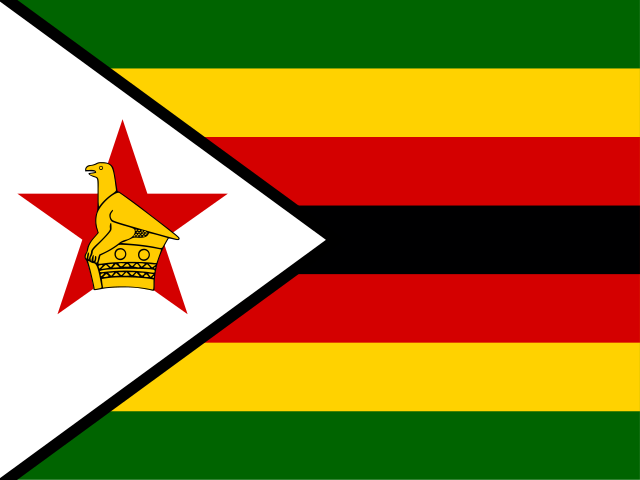
Zimbabwe
Zimbabwe is dominated by a high central plateau bordered by lower, warmer regions along the Zambezi and Limpopo valleys. Much of the country supports miombo woodland, savanna and open grassland, while the eastern border rises into the wetter Eastern Highlands, with montane forest, grasslands and dramatic escarpments. Major landscapes include Lake Kariba, the granite formations of Matobo and Victoria Falls, where the Zambezi plunges into the Batoka Gorge. The climate is generally subtropical and strongly seasonal, with summer rains and a pronounced dry winter.
Overview
Zimbabwe offers excellent southern African woodland, savanna and montane birding. The Eastern Highlands, particularly Nyanga, Bvumba and Chimanimani, are the key area for restricted-range species such as Swynnerton's Robin, Chirinda Apalis and Roberts's Warbler. Extensive miombo supports specialties including Miombo Rock Thrush, White-breasted Cuckooshrike and Southern Hyliota. Hwange National Park combines outstanding wildlife viewing with hornbills, rollers, raptors, bustards and vultures, while the Zambezi Valley and Mana Pools add rich riverine and floodplain birding. Zimbabwe has an established safari industry and experienced bird guides, making the main sites relatively straightforward to visit. A comprehensive birding trip involves substantial driving, however, and some Eastern Highland specialties require hiking and careful local site knowledge.
Top 10 target species
| Species | Annual frequency | January | February | March | April | May | June | July | August | September | October | November | December |
|---|---|---|---|---|---|---|---|---|---|---|---|---|---|
| Common Bulbul Pycnonotus barbatus | 49.8% | 51.0% | 51.4% | 43.8% | 49.9% | 51.9% | 48.3% | 45.8% | 47.3% | 50.9% | 50.7% | 52.3% | 54.6% |
| Ring-necked Dove Streptopelia capicola | 33.4% | 33.2% | 32.2% | 30.4% | 36.2% | 37.3% | 34.5% | 36.1% | 35.7% | 31.8% | 33.4% | 30.6% | 29.8% |
| Southern Cordonbleu Uraeginthus angolensis | 31.0% | 30.7% | 32.5% | 26.5% | 31.7% | 35.2% | 32.3% | 32.0% | 30.3% | 28.9% | 29.3% | 30.6% | 32.0% |
| Fork-tailed Drongo Dicrurus adsimilis | 30.8% | 25.4% | 26.2% | 26.2% | 33.2% | 36.3% | 34.5% | 36.5% | 33.5% | 31.0% | 31.7% | 28.7% | 26.7% |
| Red-eyed Dove Streptopelia semitorquata | 27.9% | 29.8% | 34.6% | 28.6% | 32.5% | 31.0% | 25.0% | 24.4% | 23.6% | 25.0% | 26.3% | 23.9% | 30.4% |
| Laughing Dove Spilopelia senegalensis | 27.6% | 27.5% | 29.6% | 28.4% | 29.0% | 30.2% | 25.8% | 27.2% | 26.9% | 27.4% | 28.7% | 26.2% | 24.7% |
| Pied Crow Corvus albus | 27.1% | 27.7% | 27.3% | 24.3% | 25.9% | 29.0% | 23.9% | 26.0% | 26.7% | 28.1% | 27.8% | 28.6% | 30.4% |
| Gray Go-away-bird Crinifer concolor | 27.0% | 23.9% | 25.5% | 22.4% | 29.5% | 32.0% | 28.7% | 31.4% | 27.2% | 26.8% | 27.0% | 25.9% | 23.4% |
| Tropical Boubou Laniarius major | 25.8% | 26.7% | 23.9% | 22.4% | 25.9% | 27.6% | 22.4% | 22.4% | 25.0% | 30.3% | 29.7% | 26.7% | 26.4% |
| Black-backed Puffback Dryoscopus cubla | 25.2% | 24.3% | 23.9% | 20.2% | 24.1% | 25.2% | 23.9% | 21.5% | 23.0% | 28.4% | 29.5% | 29.3% | 29.6% |