
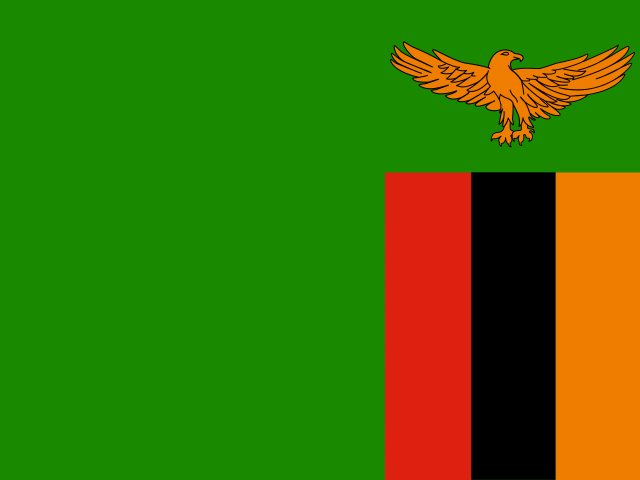
Zambia
Zambia is dominated by a broad high plateau crossed by major rivers, wetlands and escarpments. Much of the country is covered by extensive miombo woodland, interspersed with grasslands, dambos and river valleys. The Zambezi River forms some of its most dramatic landscapes, including Victoria Falls and the steep Batoka Gorge, before feeding Lake Kariba. Northern Zambia contains large wetland systems such as the Bangweulu Swamps and extensive floodplains, while the Luangwa Valley forms a lower, warmer corridor along the eastern escarpment. The climate is tropical but moderated by elevation, with distinct wet and dry seasons.
Overview
Zambia is an excellent destination for miombo woodland and wetland specialties, with strong safari infrastructure but fewer visitors than some neighbouring countries. The vast Bangweulu Wetlands are famous as one of Africa's best places to see Shoebill, alongside huge numbers of waterbirds and the endemic Black-cheeked Lovebird in southwestern Zambia. South Luangwa National Park combines outstanding mammal viewing with rich riverine, woodland and savanna birding, including bee-eaters, kingfishers, raptors and storks. Zambia is also particularly important for miombo species such as Böhm's Flycatcher, Miombo Pied Barbet and Anchieta's Sunbird. Kasanka National Park offers diverse woodland and wetland birding alongside its famous seasonal fruit-bat migration. Major parks have good lodges and guides, but specialist sites can involve long distances, rough roads and strongly seasonal access, especially during the rains.
Top 10 target species
| Species | Annual frequency | January | February | March | April | May | June | July | August | September | October | November | December |
|---|---|---|---|---|---|---|---|---|---|---|---|---|---|
| Common Bulbul Pycnonotus barbatus | 54.7% | 53.5% | 55.2% | 54.6% | 54.6% | 55.8% | 52.4% | 55.9% | 56.7% | 53.4% | 54.2% | 53.4% | 56.8% |
| Ring-necked Dove Streptopelia capicola | 42.9% | 43.4% | 45.9% | 50.1% | 46.4% | 43.8% | 41.5% | 43.5% | 45.8% | 44.2% | 38.8% | 32.7% | 38.4% |
| Emerald-spotted Wood-Dove Turtur chalcospilos | 37.9% | 42.1% | 42.8% | 42.8% | 40.1% | 37.3% | 33.9% | 37.3% | 41.5% | 37.6% | 33.9% | 28.1% | 37.4% |
| Fork-tailed Drongo Dicrurus adsimilis | 33.0% | 30.0% | 29.4% | 35.8% | 34.2% | 36.9% | 35.1% | 38.3% | 37.7% | 32.4% | 27.3% | 26.1% | 32.8% |
| Tropical Boubou Laniarius major | 32.4% | 31.5% | 28.6% | 28.3% | 34.5% | 35.2% | 29.7% | 29.6% | 34.8% | 32.9% | 35.9% | 34.9% | 32.4% |
| Red-eyed Dove Streptopelia semitorquata | 31.6% | 31.6% | 33.9% | 35.4% | 38.9% | 38.0% | 31.9% | 33.4% | 34.2% | 28.2% | 26.4% | 22.2% | 25.1% |
| Southern Cordonbleu Uraeginthus angolensis | 31.2% | 30.2% | 28.9% | 31.7% | 33.4% | 34.2% | 32.7% | 34.4% | 35.4% | 30.8% | 28.0% | 26.5% | 28.6% |
| Black-backed Puffback Dryoscopus cubla | 31.1% | 32.6% | 32.4% | 29.9% | 31.1% | 28.7% | 25.6% | 25.7% | 29.8% | 30.0% | 34.2% | 37.1% | 36.7% |
| Black-collared Barbet Lybius torquatus | 26.6% | 26.3% | 30.3% | 28.8% | 28.3% | 27.8% | 22.7% | 24.8% | 28.1% | 23.6% | 24.8% | 26.0% | 27.3% |
| White-browed Robin-Chat Cossypha heuglini | 25.4% | 25.1% | 24.6% | 25.9% | 29.8% | 29.0% | 22.8% | 24.0% | 25.4% | 20.5% | 27.8% | 25.0% | 25.0% |