
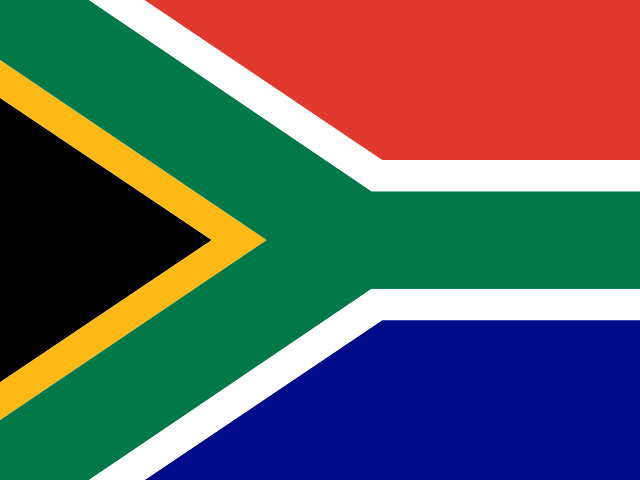
South Africa
South Africa has extraordinary geographical diversity, from the Cape's Mediterranean-climate mountains and fynbos to subtropical forests, vast grasslands, savannas and the arid Karoo and Kalahari. The Drakensberg forms the country's highest mountain system, rising above 3,000 metres, while the interior is dominated by a broad plateau. Long Atlantic and Indian Ocean coastlines create contrasting marine climates and include wetlands, dunes and rocky shores. The Cape Floristic Region is particularly remarkable for its exceptionally diverse and highly endemic plant life.
Overview
South Africa is one of Africa's leading birding destinations, combining numerous regional endemics with excellent infrastructure. The Cape region holds specialties such as Cape Rockjumper, Cape Sugarbird, Orange-breasted Sunbird and Cape Siskin, while the Drakensberg is important for Drakensberg Rockjumper, Ground Woodpecker and Bearded Vulture. The Karoo adds Karoo Lark, Namaqua Warbler and Ludwig's Bustard, while Kruger National Park offers superb savanna birding with hornbills, rollers, eagles, vultures and large mammals. Pelagic trips from Cape Town can produce albatrosses, petrels and shearwaters in exceptional numbers. South Africa has a highly developed birding industry, extensive field-guide coverage, specialist guides and an excellent road network. Most major sites are readily accessible, making it particularly suitable for independent birding and self-drive trips, although distances between regions can be substantial.
Top 10 target species
| Species | Annual frequency | January | February | March | April | May | June | July | August | September | October | November | December |
|---|---|---|---|---|---|---|---|---|---|---|---|---|---|
| Hadada Ibis Bostrychia hagedash | 36.3% | 33.2% | 32.9% | 33.3% | 34.7% | 40.7% | 38.6% | 38.8% | 38.8% | 37.2% | 36.4% | 36.4% | 34.3% |
| Egyptian Goose Alopochen aegyptiaca | 30.4% | 26.0% | 24.7% | 25.8% | 27.4% | 31.7% | 32.7% | 33.5% | 34.4% | 33.6% | 32.8% | 32.5% | 29.7% |
| Red-eyed Dove Streptopelia semitorquata | 28.8% | 27.4% | 27.9% | 30.4% | 30.9% | 33.9% | 31.0% | 30.2% | 29.4% | 27.0% | 25.9% | 25.4% | 26.0% |
| Common Bulbul Pycnonotus barbatus | 26.9% | 25.1% | 25.9% | 24.6% | 27.1% | 31.9% | 30.1% | 30.3% | 26.4% | 23.8% | 25.5% | 27.0% | 25.5% |
| Laughing Dove Spilopelia senegalensis | 26.4% | 25.0% | 26.9% | 28.3% | 26.7% | 28.6% | 27.9% | 27.0% | 26.7% | 25.2% | 24.7% | 24.8% | 24.7% |
| Ring-necked Dove Streptopelia capicola | 26.2% | 24.9% | 26.9% | 26.8% | 25.5% | 27.1% | 26.3% | 26.0% | 26.0% | 26.2% | 26.1% | 26.3% | 26.2% |
| Cape White-eye Zosterops virens | 23.5% | 22.5% | 21.3% | 23.0% | 23.2% | 25.4% | 23.7% | 22.4% | 24.6% | 25.0% | 24.9% | 22.8% | 23.4% |
| Blacksmith Lapwing Vanellus armatus | 21.5% | 19.9% | 20.2% | 21.5% | 20.9% | 22.8% | 23.2% | 22.7% | 22.0% | 21.9% | 21.0% | 21.8% | 19.9% |
| Fork-tailed Drongo Dicrurus adsimilis | 20.6% | 17.7% | 17.1% | 18.1% | 21.0% | 24.1% | 24.8% | 25.3% | 22.3% | 20.1% | 19.2% | 18.8% | 18.7% |
| Southern Fiscal Lanius collaris | 20.4% | 18.6% | 18.1% | 20.8% | 22.6% | 24.9% | 23.7% | 22.3% | 21.0% | 19.3% | 17.9% | 18.0% | 18.0% |